Wagyu vs USDA Prime: Is Wagyu Worth the Upgrade?
Comparing Wagyu (American and Japanese) to USDA Prime beef — marbling, taste, price, and when to choose each.
Understanding the Comparison
"Wagyu vs Prime" is actually two comparisons:
- American Wagyu vs Prime — similar products, different quality levels
- Japanese A5 vs Prime — completely different categories
Let's break down both.
USDA Prime: The Baseline
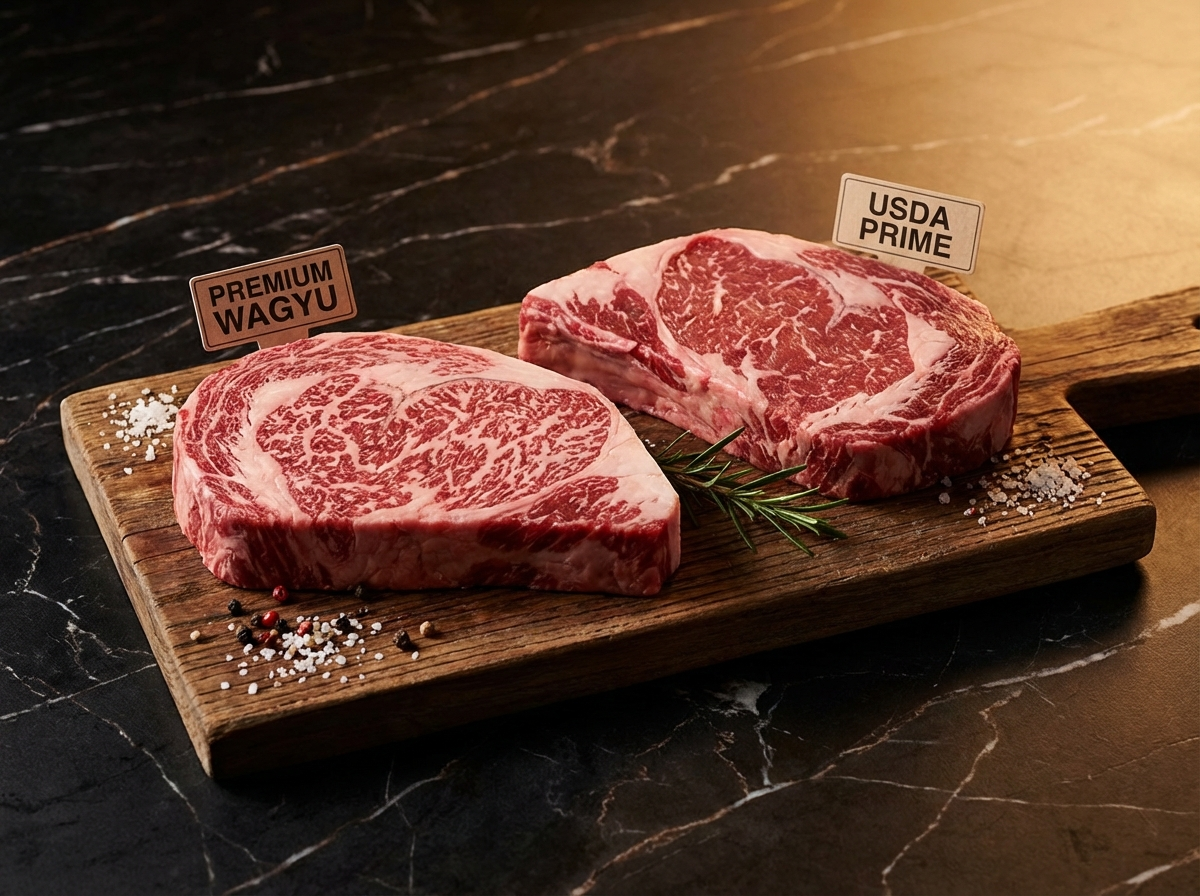
USDA Prime represents the top 2-3% of American beef based on marbling and maturity. To qualify as Prime, beef needs "slightly abundant to abundant" marbling — roughly equivalent to BMS 4-5 on the Japanese scale.
Key characteristics:
- Well-marbled but not extreme
- Classic "steak" flavor
- Works for all cooking methods
- $25-45/lb for premium cuts
- Available at quality butchers and steakhouses
American Wagyu vs Prime
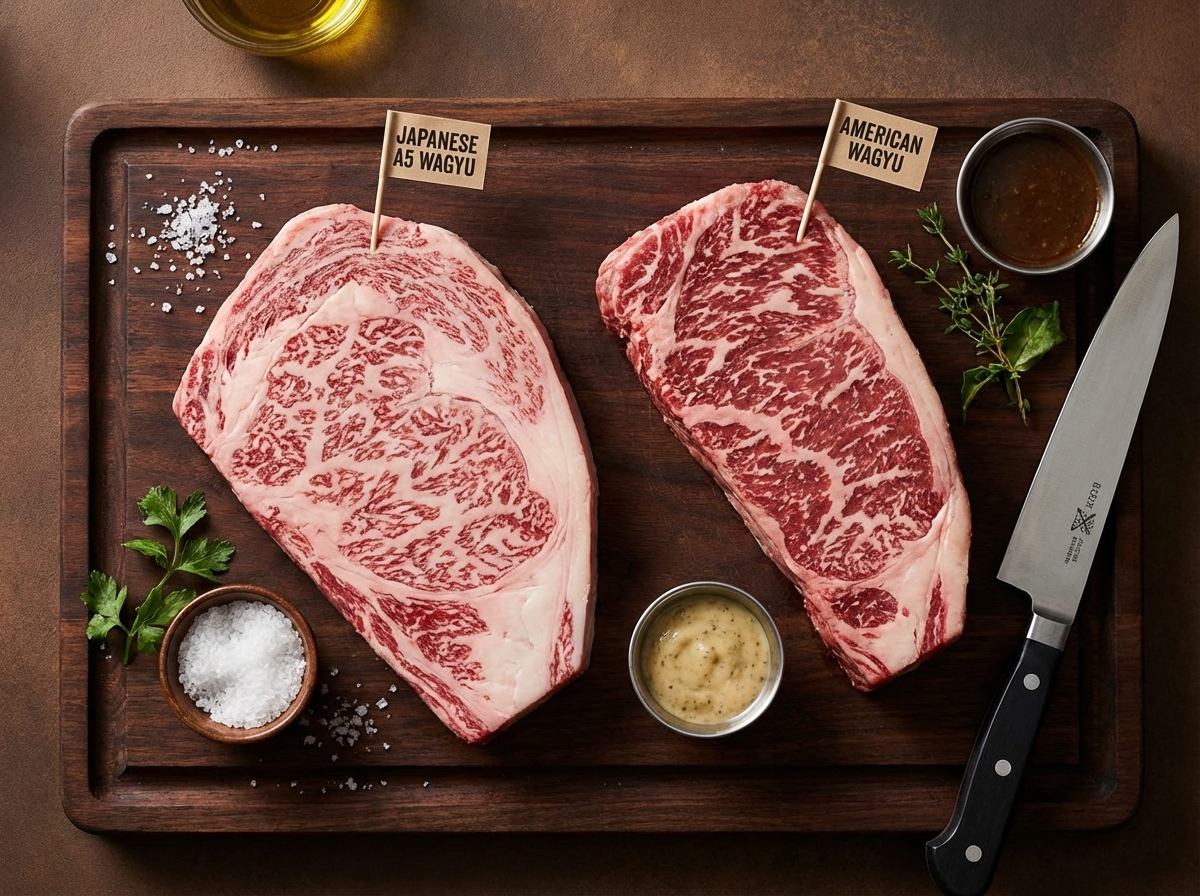
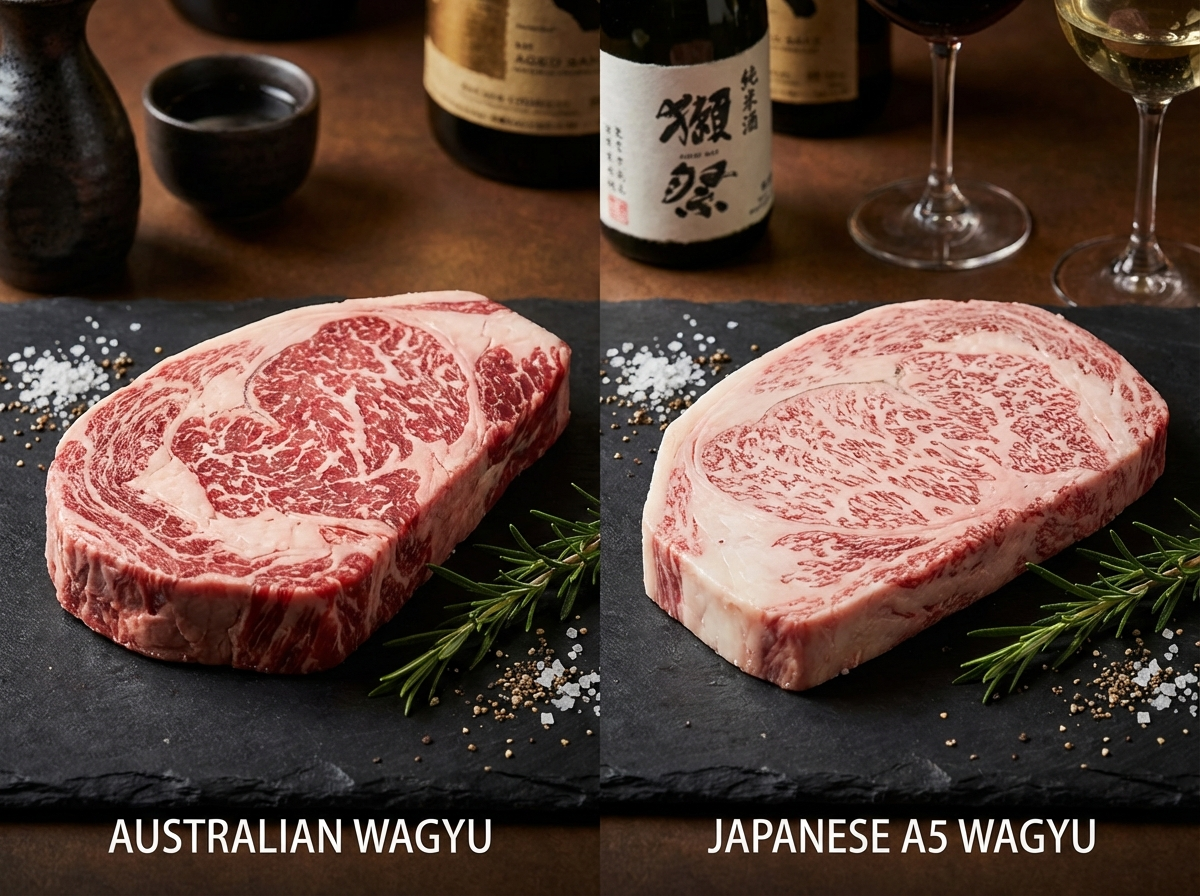
American Wagyu typically scores BMS 5-8, putting it above Prime in marbling. The Wagyu genetics (even at 50%) produce finer marbling and more intramuscular fat.
| Factor | USDA Prime | American Wagyu |
| BMS Equivalent | 4-5 | 5-8 |
| Marbling Pattern | Good | Finer, more distributed |
| Fat Quality | Standard | Higher oleic acid |
| Price/lb | $25-45 | $40-80 |
| Premium | Baseline | 1.5-2x Prime |
| Factor | USDA Prime | Japanese A5 |
| BMS Equivalent | 4-5 | 10-12 |
| Marbling | Good | Extreme |
| Portion Size | 12-16 oz | 2-4 oz |
| Flavor | Classic steak | Buttery, rich, sweet |
| Price/lb | $25-45 | $150-250 |
| Premium | Baseline | 4-6x Prime |
Is A5 worth 4-6x the price of Prime?
Not as a steak replacement — it's a different product entirely. A5 is a delicacy, meant to be savored in small portions. Prime is a steak for dinner. You can't substitute one for the other.
When to Choose Each
Choose USDA Prime when:
- You want an excellent steak at a reasonable price
- Cooking methods include high-heat grilling
- Serving traditional steak portions
- Feeding a crowd on a budget
- Everyday premium dining
Choose American Wagyu when:
- You want noticeably more marbling than Prime
- Willing to pay a moderate premium for better quality
- Want the "Wagyu" experience without extreme richness
- Serving steak as the main event
- Special but not ultra-special occasions
Choose Japanese A5 when:
- This is a special occasion / celebration
- Serving as an appetizer or small-plate course
- You want the ultimate beef experience
- Guests appreciate fine dining
- Budget is secondary to experience
- Stock Prime for weeknight steaks and casual entertaining
- Upgrade to American Wagyu for date nights and dinner parties
- Save A5 for once-or-twice-a-year special moments
The Steakhouse Perspective
Most high-end steakhouses serve Prime as their standard and offer American Wagyu as an upgrade. Very few serve Japanese A5 (and when they do, it's at astronomical prices for small portions).
This tells you something: Professional chefs know that Prime and American Wagyu work for steak dinners. A5 is a different category — special, but not a substitute.
My Recommendation
All three have their place. The key is matching the product to the occasion.
Frequently Asked Questions
Is Wagyu better than USDA Prime?
Wagyu has significantly more marbling than USDA Prime. Japanese A5 Wagyu scores BMS 8-12 compared to Prime's BMS 4-5 equivalent. American Wagyu falls between the two. However, 'better' depends on preference — Prime offers a classic beefy steak experience, while Wagyu is richer and more buttery. Many steak lovers actually prefer Prime for full-size steak dinners.
How much more expensive is Wagyu than Prime beef?
American Wagyu costs roughly 2x USDA Prime ($50-80/lb vs $25-45/lb for comparable cuts). Japanese A5 Wagyu costs 5-10x more than Prime ($150-300+/lb). The value equation changes when you consider portion sizes — A5 Wagyu is typically served in 3-4 oz portions versus 12-16 oz for Prime steaks.
Can you tell the difference between Wagyu and Prime?
Yes, the difference is immediately apparent. Wagyu has visibly more intramuscular fat (white marbling streaks throughout the meat), a softer texture, and a richer, more buttery flavor. Even American Wagyu is noticeably more marbled than the best USDA Prime. In a blind tasting, most people can distinguish them easily.
Is USDA Prime the same as Japanese A5?
No, they are very different grades from different systems. USDA Prime is the top 2-3% of American beef with 'slightly abundant' marbling. Japanese A5 requires BMS 8+ marbling — roughly 2-3x more intramuscular fat than Prime. A5 also has strict yield grade requirements. The two grading systems don't directly convert, but A5 dramatically exceeds Prime in marbling.