Australian Wagyu MSA Grading System: Complete Guide & Comparisons
Australia's MSA (Meat Standards Australia) grading system offers a unique approach to evaluating wagyu quality. This guide explains how MSA scores work, how they compare to Japanese BMS and USDA grades, and what Australian MSA levels mean for your buying decisions.
Understanding Australia's Approach to Wagyu Grading
As someone who has spent decades comparing wagyu systems across Japan, the United States, and Australia, I can tell you that Australia's MSA grading system represents one of the most sophisticated—and most misunderstood—beef quality assessment programs in the world.
Unlike Japan's purely marbling-focused BMS or America's quality-based USDA grades, Australia's MSA (Meat Standards Australia) takes a holistic approach. It's not just about what the beef looks like—it's about predicting what it will taste like when you cook it. This fundamental philosophical difference makes MSA both more complex and, in many ways, more practical for consumers.
Let's break down exactly how MSA works, what the numbers mean, and how it compares to the grading systems you may already know.
What Is MSA Grading?
MSA (Meat Standards Australia) is a comprehensive grading system developed by the Australian government and industry partners over 20+ years of research. Unlike traditional grading systems that assess beef at a single point in time, MSA predicts eating quality across different cooking methods.
The system evaluates multiple factors:
- Marbling (intramuscular fat)
- Meat color and texture
- Fat color
- Ossification (bone maturity)
- pH levels
- Ribeye muscle area
- Carcass weight
- Hump height (for Brahman genetics)
These factors are combined with production history (breed, hormone growth promotants, days on feed, processing practices) to generate eating quality predictions for specific cuts cooked in specific ways.
The MSA Score System
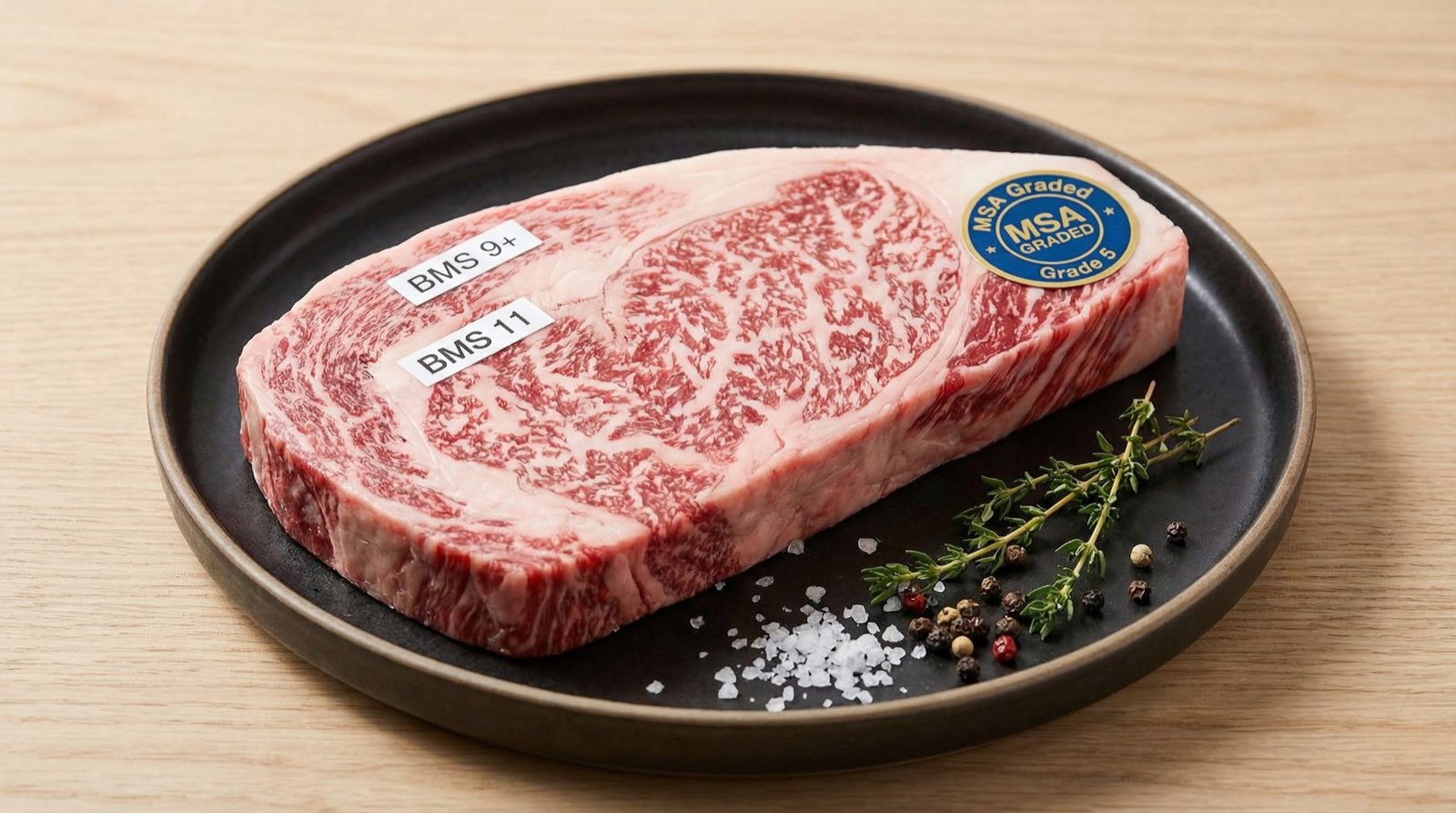
MSA uses numerical scores ranging from 0-9+ for marbling, with the system extending beyond 9 for exceptional wagyu. These marbling scores correlate roughly—but not exactly—with Japanese BMS grades. We'll explore those comparisons in detail shortly.
But marbling is just one input. The MSA system generates cooking-method-specific quality predictions:
- 3-star: Good everyday quality
- 4-star: Better than everyday
- 5-star: Premium quality
Critically, a single cut might achieve 5-star for grilling but only 3-star for stir-frying, based on predicted eating quality outcomes for each method.
MSA Marbling Scores Explained: 0-9+
MSA 0-2: Minimal Marbling
What You're Looking At: These scores indicate very limited marbling—comparable to USDA Select or lower. At MSA 0-1, the beef appears almost entirely lean with virtually no visible intramuscular fat. MSA 2 shows trace amounts—thin, isolated streaks.
Quality Implications: Beef at these levels will be lean and firm. While it may still achieve MSA grading (indicating acceptable eating quality for specific methods), it won't deliver wagyu characteristics. These scores are uncommon in wagyu cattle—you'd typically see them only in very young animals or crossbreeds with minimal wagyu genetics.
MSA 3-4: Moderate Marbling
What You're Looking At: MSA 3-4 shows modest but visible marbling—roughly comparable to USDA Choice or Japanese BMS 3-4. You'll see white fat streaks creating simple networks throughout the red muscle. Distribution is uneven but present across most of the cut.
Quality Implications: This is entry-level wagyu territory. The beef will be noticeably more tender and flavorful than conventional beef. These scores are common in crossbred Australian wagyu (F1 or F2 generations) and represent good value for those wanting wagyu character without premium pricing.
MSA 5-6: Abundant Marbling
What You're Looking At: At MSA 5-6, marbling becomes clearly abundant—roughly equivalent to high USDA Prime or Japanese BMS 5-6. The fat creates intricate networks across the entire cut. The ratio of red to white shifts toward more balanced proportions.
Quality Implications: This is where Australian wagyu truly shines. MSA 5-6 delivers the classic wagyu experience—buttery texture, rich flavor, exceptional tenderness. Many Australian wagyu programs target this range as their premium tier. These scores are achievable from quality crossbred programs (F3-F4) and full-blood wagyu programs with good genetics and feeding protocols.
MSA 7-8: Exceptional Marbling
What You're Looking At: MSA 7-8 represents exceptional marbling—comparable to Japanese BMS 7-8. The marbling network is extremely intricate, with fine fat particles distributed evenly throughout. White begins to dominate the visual appearance, though red muscle remains clearly present.
Quality Implications: At this level, you're entering premium Australian wagyu territory. The richness is pronounced, with the buttery texture becoming almost liquid. These scores are typically achieved by full-blood wagyu programs or exceptional crossbred programs (F5+) with extended grain-feeding (400+ days). Prices reflect this quality—expect to pay 3-4x what MSA 5-6 commands.
MSA 9+: Extraordinary Marbling
What You're Looking At: MSA 9+ indicates marbling beyond the standard scale—comparable to Japanese BMS 9-12. At these levels, the beef appears predominantly white with delicate red marbling. The fat networks are so fine and dense that they create an almost silky visual texture.
Quality Implications: This is rare-air territory for Australian wagyu. Only the finest full-blood programs consistently achieve MSA 9+. The eating experience rivals Japanese A5 wagyu. These are special-occasion purchases commanding premium prices. When you encounter Australian wagyu labeled "9+," you're looking at the absolute pinnacle of Australian production.
MSA vs. BMS: Direct Comparison
The most common question I receive: "How does MSA compare to BMS?" Here's the reality based on extensive side-by-side evaluations:
| MSA Score | Approximate BMS Equivalent | Visual Characteristics |
|---|---|---|
| MSA 2 | BMS 1-2 | Trace marbling, predominantly lean |
| MSA 3 | BMS 3-4 | Modest marbling, simple networks |
| MSA 4 | BMS 4-5 | Moderate marbling, developing networks |
| MSA 5 | BMS 5-6 | Abundant marbling, intricate patterns |
| MSA 6 | BMS 6-7 | Very abundant, balanced red/white ratio |
| MSA 7 | BMS 7-8 | Exceptional, fine particles throughout |
| MSA 8 | BMS 8-9 | Extraordinary, white dominates appearance |
| MSA 9+ | BMS 9-12 | Ultimate, almost entirely white appearance |
Important Caveat: These equivalencies are approximate and based on marbling alone. MSA evaluates additional factors that BMS doesn't consider, so two pieces of beef with equivalent marbling scores might achieve different overall quality ratings depending on other attributes.
Why the Scores Don't Match Exactly
MSA and BMS use different methodologies and reference standards. BMS uses a detailed photographic reference chart with specific marbling patterns. MSA uses a more quantitative approach measuring marbling percentage and distribution through imaging technology.
Additionally, Australian and Japanese wagyu often show different marbling characteristics at the same score level:
- Particle Size: Japanese wagyu tends toward finer marbling particles at equivalent grades
- Distribution Pattern: Australian wagyu often shows more linear marbling patterns, while Japanese wagyu shows more network-style patterns
- Fat Color: Australian wagyu fat may be more golden (due to grass-feeding periods), while Japanese wagyu fat is typically stark white
MSA vs. USDA: Understanding the Differences
Comparing MSA to USDA grades requires understanding that they measure different things:
USDA Grading Basics
USDA grades beef primarily on marbling and maturity:
- Prime: Abundant marbling (roughly MSA 5-7 equivalent)
- Choice: Moderate marbling (roughly MSA 3-5 equivalent)
- Select: Slight marbling (roughly MSA 1-3 equivalent)
Comparison Chart
| USDA Grade | Approximate MSA Equivalent | Approximate BMS Equivalent |
|---|---|---|
| USDA Select | MSA 2-3 | BMS 1-3 |
| USDA Choice (low) | MSA 3-4 | BMS 3-4 |
| USDA Choice (high) | MSA 4-5 | BMS 4-5 |
| USDA Prime (low) | MSA 5-6 | BMS 5-6 |
| USDA Prime (high) | MSA 6-7 | BMS 6-7 |
| Beyond Prime (unofficial) | MSA 7-9+ | BMS 7-12 |
Key Difference: USDA grading stops at Prime—there's no official category for the extreme marbling levels found in high-grade wagyu (MSA 7+, BMS 8+). Some American producers use unofficial terms like "Prime+" or "Super Prime," but these aren't official USDA grades.
The MSA Star Rating System
Beyond marbling scores, MSA assigns star ratings (3, 4, or 5 stars) based on predicted eating quality for specific cooking methods. This is where MSA truly differentiates itself.
How Star Ratings Work
The same cut of beef might receive different star ratings depending on how you plan to cook it:
- A ribeye might be 5-star for grilling but 4-star for stir-frying
- A tenderloin might be 4-star for roasting but 3-star for slow-cooking
- A chuck might be 3-star for grilling but 4-star for braising
The system recognizes that cooking method dramatically impacts eating quality, and different cuts respond differently to different cooking methods.
Star Rating Meanings
3-Star ("Good Everyday"): Meets minimum MSA standards for that cooking method. You'll get acceptable tenderness, juiciness, and flavor, but it's not exceptional. Think of this as reliable quality for family dinners.
4-Star ("Better Than Everyday"): Exceeds everyday quality expectations. Noticeably more tender, juicy, and flavorful. Suitable for informal entertaining or treating yourself to something above average.
5-Star ("Premium"): Exceptional eating quality predicted for that cooking method. This is special-occasion territory—the beef will deliver outstanding tenderness, juiciness, and flavor. Comparable to restaurant premium offerings.
Why This Matters for Wagyu
With high-marbling wagyu (MSA 7+), you'll typically see 5-star ratings across most cooking methods. The abundant marbling provides a buffer that maintains quality regardless of cooking approach. However, even premium wagyu can receive lower star ratings for inappropriate cooking methods—slow-braising a highly marbled ribeye might waste the marbling advantage, resulting in a 4-star rather than 5-star prediction.
Australian Wagyu Production and MSA Scores
Crossbred vs. Full-Blood MSA Achievement
Australian wagyu comes in two main categories, and MSA scores reflect this:
Crossbred (F1-F4): These are wagyu (usually Japanese Black/Kuroge Washu) crossed with conventional breeds (typically Angus). Crossbreds commonly achieve MSA 3-6, with exceptional programs reaching MSA 7. The degree of wagyu genetics significantly impacts achievable marbling—F1 (50% wagyu) averages MSA 3-4, while F4 (93.75% wagyu) averages MSA 5-7.
Full-Blood: 100% wagyu genetics (often imported directly from Japanese breeding programs). Full-blood programs routinely achieve MSA 7-9+. The elite full-blood programs—Blackmore, Mayura Station, Jack's Creek—consistently produce MSA 8-9+ beef that rivals Japanese A5.
Feeding Program Impact
Days on grain feed directly correlates with MSA scores:
- 100-200 days: Typically MSA 3-5
- 200-300 days: Typically MSA 5-7
- 300-450 days: Typically MSA 6-8
- 450+ days: Typically MSA 7-9+
Australian wagyu producers often specify "grain-fed XXX days" precisely because it's such a strong predictor of marbling development and MSA score.
Buying Australian Wagyu: Reading MSA Labels
What to Look For
When purchasing Australian wagyu, look for this information:
- MSA Marbling Score: Should be clearly stated (MSA 4, MSA 7, MSA 9+, etc.)
- Star Rating for Your Cooking Method: Verify the beef is rated 4 or 5-star for how you plan to cook it
- Full-Blood vs. Crossbred: Should be clearly labeled
- Days Grain-Fed: More days generally means higher marbling
- Producer/Brand: Reputable producers (Blackmore, Mayura, Jack's Creek, Rangers Valley, Westholme) consistently deliver on claimed scores
Red Flags
- Claiming MSA 9+ without full-blood designation or 400+ day grain feeding
- Using "MSA-style" or "MSA-equivalent" instead of actual MSA grading
- Providing marbling score without producer information
- Prices too low for claimed grade (MSA 8 shouldn't cost the same as MSA 5)
- No star rating information provided
Price Expectations
MSA scores should correlate with pricing:
- MSA 3-4: 1.5-2x conventional prime pricing
- MSA 5-6: 2-3x conventional prime pricing
- MSA 7-8: 3-5x conventional prime pricing
- MSA 9+: 5-8x conventional prime pricing (comparable to Japanese A5)
If pricing doesn't align with claimed grade, investigate further. Either the grade is misrepresented, or there's another issue (poor aging, inferior cut, etc.).
Australian Wagyu MSA vs. Japanese A5: The Comparison
The ultimate question many buyers ask: How does top-tier Australian MSA 9+ compare to Japanese A5?
Similarities
- Comparable marbling levels (MSA 9+ roughly equals BMS 9-11)
- Similar eating experience—buttery texture, rich flavor, exceptional tenderness
- Both represent the pinnacle of wagyu production
- Both command premium prices
Differences
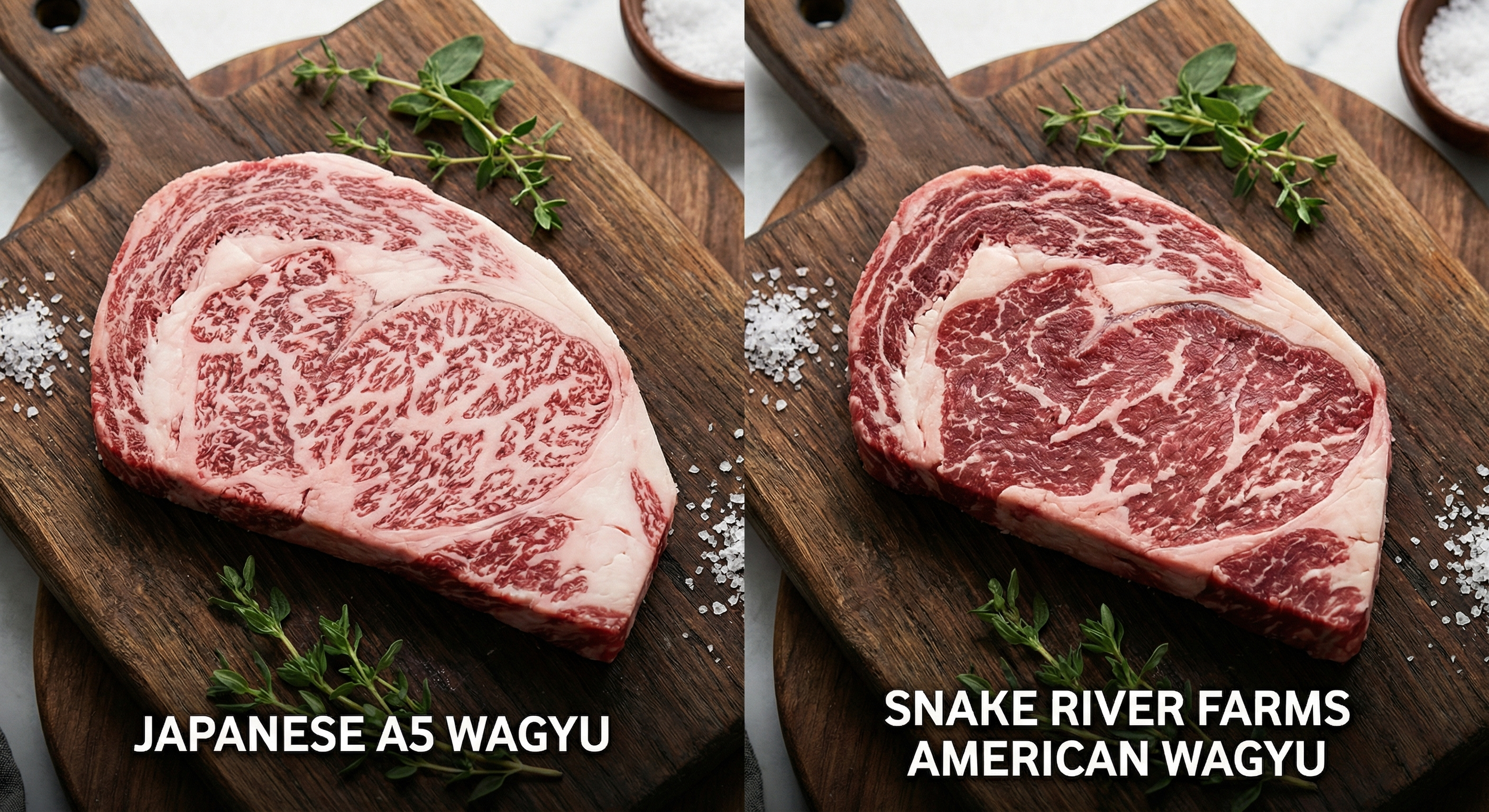
Marbling Pattern: Japanese A5 often shows finer, more intricate marbling networks. Australian MSA 9+ marbling may be slightly coarser, though still exceptional.
Fat Color: Japanese A5 typically has stark white fat. Australian wagyu fat may have a slight golden tinge due to grass-feeding periods or different feed compositions.
Muscle Color: Japanese A5 muscle is often lighter pink. Australian wagyu muscle tends toward deeper red.
Flavor Profile: Japanese A5 is prized for subtle, delicate flavor. Australian MSA 9+ often has slightly more robust beef flavor, which some prefer.
Price: Australian MSA 9+ is often 20-40% less expensive than equivalent Japanese A5, making it excellent value for comparable quality.
Which Is "Better"?
This comes down to personal preference and intended use. Japanese A5 offers unmatched fineness and delicacy—ideal for special occasions and pristine preparations. Australian MSA 9+ delivers comparable richness with slightly bolder flavor and better value—ideal for those who want exceptional wagyu without maximum cost.
For most buyers, Australian MSA 7-8 represents the sweet spot: outstanding quality at more accessible pricing than Japanese A5, with enough marbling to deliver the full wagyu experience.
FAQs: Australian Wagyu MSA Grading
Is MSA grading mandatory for Australian wagyu?
No, MSA is voluntary. However, most reputable Australian wagyu producers participate in MSA grading because it provides credibility and transparency. If Australian wagyu isn't MSA-graded, ask why—it may indicate the producer doesn't want third-party verification of quality claims.
Can I trust MSA scores from different producers equally?
Yes. MSA grading is performed by independent, government-trained assessors using standardized protocols. An MSA 7 from one producer should be comparable to MSA 7 from another. That said, overall eating quality can still vary based on factors MSA doesn't measure (dry-aging protocols, butchering skill, freshness, etc.).
Why do some Australian wagyu sellers use BMS scores instead of MSA?
Marketing. BMS is internationally recognized and associated with Japanese wagyu's premium reputation. Some Australian producers use BMS-equivalent scores to position their product alongside Japanese imports. This isn't inherently problematic, but verify whether it's actual BMS grading (rare for Australian beef) or an MSA-to-BMS conversion estimate.
What MSA score do I need to get true wagyu character?
MSA 5+ delivers recognizable wagyu characteristics—the buttery texture, rich marbling, and exceptional tenderness. Below MSA 5, you're getting wagyu genetics but not the full wagyu experience. For truly impressive wagyu, target MSA 7+.
How does aging affect MSA scores?
MSA scores are assigned to fresh beef and don't change with aging. However, aging does enhance flavor development and tenderness. Dry-aged Australian MSA 7 wagyu can rival fresh MSA 8-9 in eating quality due to concentration of flavors. Always ask about aging when buying premium grades.
Is MSA 5 Australian wagyu better than USDA Prime?
Generally yes, in terms of marbling and tenderness. MSA 5 exceeds typical USDA Prime marbling levels and includes additional quality factors USDA doesn't assess (pH, ossification, etc.). However, "better" depends on preference—some people prefer the bolder, less fatty profile of USDA Prime to the buttery richness of wagyu.
Can grass-fed wagyu achieve high MSA scores?
Rarely. Extensive marbling development requires extended grain feeding. Grass-fed wagyu typically maxes out around MSA 3-4. Some producers use grass-fed periods followed by grain-finishing (e.g., 200 days grass, 300 days grain) to balance flavor development with marbling achievement, potentially reaching MSA 6-7.
What's the most common MSA score for Australian wagyu?
For crossbred Australian wagyu in retail channels, MSA 4-6 is most common. These grades offer good wagyu character at accessible prices. For full-blood programs, MSA 7-9 is more typical. MSA 9+ remains relatively rare even among full-blood programs—perhaps 5-10% of production.
Conclusion: Making Informed Decisions with MSA
Australia's MSA system provides remarkable transparency and consistency for wagyu buyers. Unlike vague marketing terms or subjective quality claims, MSA offers objective, verified measurements that predict eating quality.
When buying Australian wagyu, use MSA scores as your primary quality indicator. Cross-reference the marbling score with producer reputation, feeding days, and full-blood vs. crossbred designation to ensure alignment. Verify star ratings match your intended cooking method.
Most importantly, understand that high MSA scores aren't always necessary. MSA 5-6 delivers excellent wagyu character for most applications. Reserve MSA 8-9+ for special occasions when you want the absolute pinnacle of Australian wagyu production.
The MSA system empowers you to make informed decisions based on objective data rather than marketing hype. Use it wisely, and you'll consistently purchase Australian wagyu that meets—or exceeds—your expectations.