Fullblood vs Purebred Wagyu: Genetics, Certification & Quality Differences
The terms "fullblood" and "purebred" wagyu are often confused, but they represent fundamentally different genetic profiles with significant implications for quality, price, and eating experience. This guide breaks down exactly what these designations mean and why they matter.
Decoding Wagyu Genetics: Why "Fullblood" and "Purebred" Aren't the Same
In my years evaluating wagyu programs across three continents, I've encountered persistent confusion about two terms that sound similar but carry vastly different implications: "fullblood" and "purebred." Buyers routinely pay premium prices assuming they're equivalent, when in reality, they represent fundamentally different genetic profiles—with corresponding differences in marbling potential, flavor, and value.
This confusion isn't accidental. The terminology seems deliberately obtuse, and some producers exploit the ambiguity for marketing advantage. Let's cut through the fog and establish exactly what these terms mean, how they differ, and why it matters for your buying decisions.
The Fundamental Definitions
Fullblood Wagyu: 100% Genetic Purity
Definition: Fullblood wagyu contains 100% wagyu genetics with no crossbreeding in its traceable ancestry. The animal's entire genetic lineage traces back to Japanese foundation cattle with no introduction of other breeds.
Technical Details: In the United States, the American Wagyu Association (AWA) designates cattle as "Fullblood" only when both parents are registered Fullblood wagyu, and the pedigree traces back exclusively to Japanese imports with no outcrossing. Australia's system is similar—the Australian Wagyu Association requires documented pure Japanese lineage.
What This Means: When you buy certified Fullblood wagyu, you're getting the same genetic foundation as wagyu raised in Japan. The cattle carry the full complement of genes responsible for extreme marbling, fine meat texture, and lower melting-point fat.
Purebred Wagyu: 93.75%+ Genetic Threshold
Definition: Purebred wagyu contains at least 93.75% wagyu genetics (15/16ths or higher), achieved through successive generations of crossbreeding between wagyu and another breed (typically Angus).
Technical Details: The AWA designates cattle as "Purebred" when they reach 93.75% wagyu genetics or higher through documented percentage breeding. This is typically achieved by F4 generation:
- F1: 50% wagyu (one wagyu parent, one Angus parent)
- F2: 75% wagyu (F1 crossed back to wagyu)
- F3: 87.5% wagyu (F2 crossed back to wagyu)
- F4: 93.75% wagyu (F3 crossed back to wagyu) — Purebred threshold
What This Means: Purebred wagyu carries the vast majority of wagyu genetics but retains a small percentage (6.25% or less) of the outcross breed. This can affect marbling potential, fat composition, and other characteristics, though the impact diminishes with each generation.
The Critical Distinction
Fullblood = 100% wagyu genetics. Purebred = 93.75%+ wagyu genetics. That 6.25% genetic difference might seem trivial, but in wagyu breeding—where extreme marbling requires the precise interaction of multiple genes—even small genetic variations can produce measurable differences in outcome.
Think of it like wine: a wine made from 100% Pinot Noir grapes is fundamentally different from one that's 94% Pinot Noir and 6% Merlot, even if both are excellent wines.
The Genetic Science: Why That 6.25% Matters
Marbling Genetics
Wagyu's extreme marbling capability is controlled by multiple genes working in concert. Key genetic factors include:
- Lipogenic enzymes: Genes controlling fat synthesis and deposition within muscle tissue
- Adipocyte development: Genes affecting the number and size of fat cells
- Fatty acid composition: Genes determining the ratio of saturated to unsaturated fats
- Fat melting point: Genes affecting the temperature at which intramuscular fat begins to liquefy
These genes don't work in isolation—they interact in complex ways. When you introduce even a small percentage of non-wagyu genetics (as in Purebred animals), you potentially disrupt these interactions. Some Purebred animals will achieve marbling levels indistinguishable from Fullblood. Others, despite being 93.75% wagyu, will plateau at lower marbling due to genetic inheritance patterns.
Phenotypic Variation
Here's the complicating factor: genetics establish potential, but individual variation means not all Fullblood animals reach maximum marbling, and not all Purebred animals fall short.
In practice:
- Fullblood wagyu: Typically grade BMS 6-12 (MSA 6-9+), with most falling in BMS 8-10 range under optimal feeding
- Purebred wagyu (F4+): Typically grade BMS 4-9 (MSA 4-8), with most falling in BMS 6-8 range under optimal feeding
The bell curves overlap significantly—a superior Purebred animal can out-marble an inferior Fullblood. However, the average and peak marbling potential is consistently higher in Fullblood genetics.
Certification and Documentation
How Fullblood Status Is Verified
Legitimate Fullblood designation requires:
- Registry Documentation: Registration with the American Wagyu Association (USA), Australian Wagyu Association (Australia), or equivalent body showing pure Japanese ancestry
- Pedigree Tracing: Complete traceable lineage to Japanese foundation cattle with no outcrossing
- DNA Verification: Some registries now require DNA testing to verify parentage and genetic purity
- Import Documentation: For cattle descended from Japanese imports, documentation showing legal import and quarantine clearance
Reputable Fullblood producers can provide registration certificates showing the animal's complete pedigree. If you're paying Fullblood prices, demand this documentation.
How Purebred Status Is Verified
Purebred designation requires:
- Percentage Documentation: Registry papers showing the animal has achieved 93.75%+ wagyu genetics through documented breeding
- Generational Records: Documentation of each cross generation (F1, F2, F3, F4) showing progressive wagyu percentage increase
- Parent Verification: Proof that each breeding step used registered wagyu bulls/cows
The documentation for Purebred is less extensive than Fullblood—you won't typically see pedigrees extending all the way to Japan, but you should see clear generational records.
Red Flags and Fraudulent Claims
Watch for these warning signs:
- "Japanese-style" or "wagyu-type": These are not designations—they're marketing terms used to avoid claiming actual wagyu genetics
- "Fullblood-quality Purebred": Contradictory and meaningless—something is either Fullblood or it isn't
- No registry information provided: Legitimate producers readily provide AWA or equivalent registry numbers
- Claiming "100% purebred": Grammatically nonsensical—Purebred by definition is not 100% wagyu
- Fullblood prices for Purebred genetics: If pricing seems too good for claimed Fullblood status, verify documentation
Taste and Eating Experience Differences
Marbling Characteristics
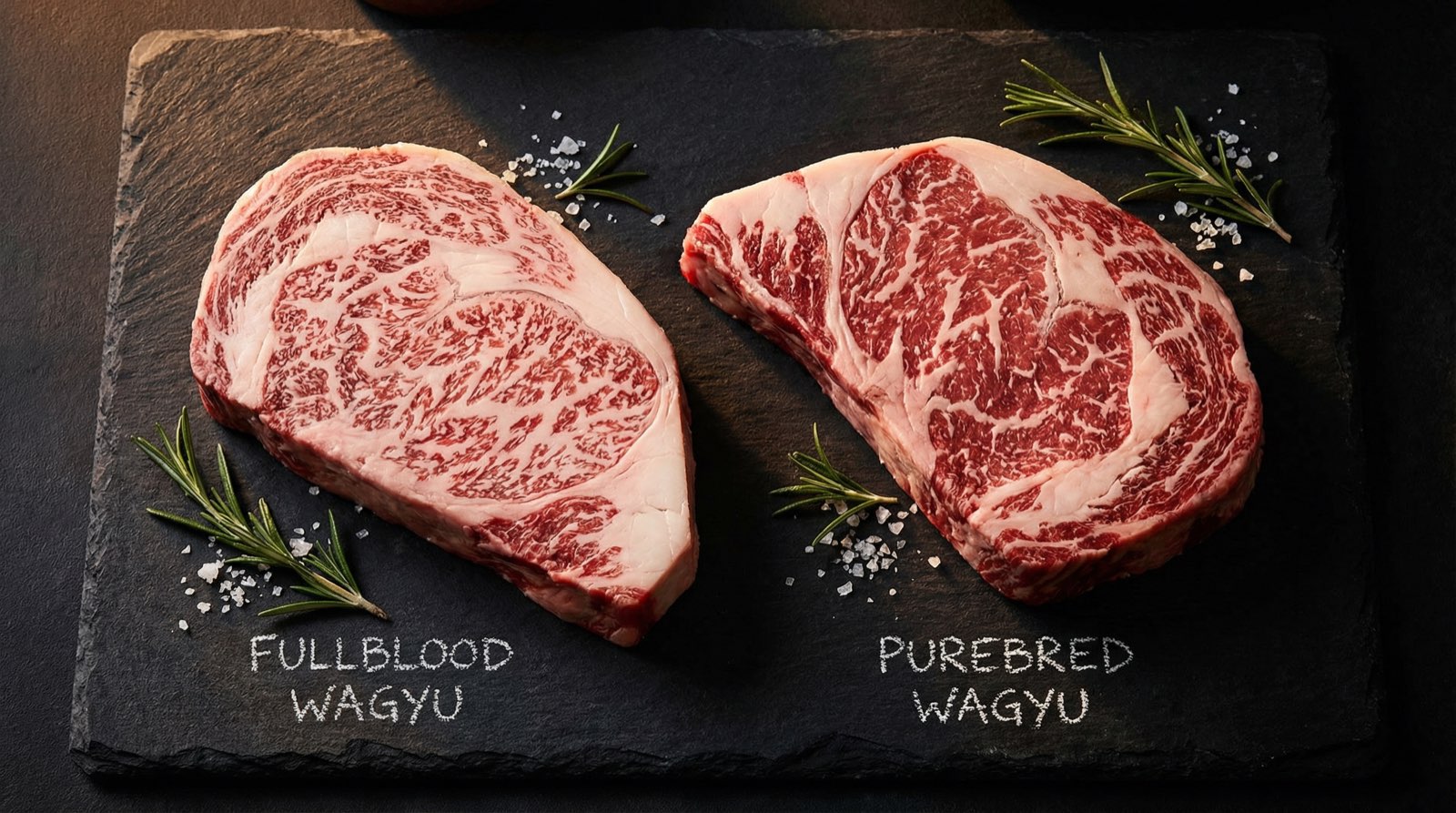
Fullblood Wagyu: Marbling tends to be finer-grained with more intricate network distribution. The fat particles are smaller and more evenly dispersed throughout the muscle. At high grades (BMS 9+), Fullblood wagyu develops the characteristic "shimmer" appearance where marbling is so fine it creates an almost iridescent effect.
Purebred Wagyu: Marbling is often slightly coarser with less intricate networks. At equivalent marbling scores (e.g., both grading BMS 7), Purebred marbling may appear as thicker fat streaks versus Fullblood's finer lattice. This doesn't necessarily impact eating quality at moderate grades (BMS 4-6), but becomes more noticeable at premium grades.
Fat Composition and Melting Point
Fullblood Wagyu: The fat has a lower melting point (around 70-75°F/21-24°C) due to higher concentrations of monounsaturated fatty acids, particularly oleic acid. This creates the signature "melts on your tongue" sensation. The fat has a cleaner, less greasy mouthfeel.
Purebred Wagyu: Fat melting point is slightly higher (around 75-80°F/24-27°C) due to small amounts of outcross genetics. You'll still experience tenderness and juiciness, but the fat may not have quite the same buttery, instantly-melting quality of Fullblood. The difference is subtle at higher percentage Purebred (F5+) but more noticeable at the F4 threshold level.
Flavor Profile
Fullblood Wagyu: The flavor is characterized by delicate, subtle sweetness with refined beef flavor. The high oleic acid content contributes to a clean, almost nutty finish. Japanese culinary tradition prizes this subtlety—the beef should taste like the essence of beef without overwhelming intensity.
Purebred Wagyu: Flavor tends to be slightly more robust and "beefy" due to the outcross genetics (typically Angus). Some people actually prefer this—it combines wagyu's tenderness and marbling with more pronounced beef flavor. The taste is less delicate but potentially more satisfying for those who like bold beef character.
Texture and Tenderness
Fullblood Wagyu: At high grades, the texture becomes almost custard-like—the meat almost dissolves with minimal chewing. The muscle fibers are extremely fine and short. Some describe it as "too tender," lacking the textural contrast that makes eating interesting.
Purebred Wagyu: The texture is very tender but retains slightly more structural integrity. You experience tenderness without the extreme softness of ultra-premium Fullblood. For many buyers, this represents an ideal balance—tender enough to be luxurious but substantial enough to feel like steak.
Price Differences and Value Considerations
Typical Price Premiums
Fullblood wagyu typically commands 30-60% higher prices than Purebred wagyu at equivalent marbling grades:
| Grade/Score | Purebred Price (per lb) | Fullblood Price (per lb) | Premium % |
|---|---|---|---|
| BMS 5 / MSA 5 | $35-50 | $45-70 | 30-40% |
| BMS 7 / MSA 7 | $60-80 | $85-120 | 40-50% |
| BMS 9 / MSA 9 | $90-120 | $130-180 | 45-50% |
| BMS 10+ / MSA 9+ | Rare | $150-250+ | N/A |
Note: Prices vary significantly by region, supplier, cut, and market conditions. These are representative ranges for ribeye.
Is the Fullblood Premium Worth It?
The value equation depends on several factors:
When Fullblood Premium Is Justified:
- You're buying ultra-premium grades (BMS 9+) where genetic purity becomes most relevant
- You're seeking the absolute finest marbling and texture
- You appreciate the subtle flavor nuances of pure Japanese genetics
- You're making a special occasion purchase where "best available" is the priority
- The price difference is modest (20-30%) rather than extreme
When Purebred Offers Better Value:
- You're buying moderate grades (BMS 4-7) where Purebred and Fullblood are nearly indistinguishable
- You prefer more robust beef flavor over delicate subtlety
- You're purchasing for everyday or frequent consumption rather than rare occasions
- The Fullblood premium exceeds 50%—you can get higher-grade Purebred for less than lower-grade Fullblood
- You're using preparations (marinades, sauces) that would obscure subtle genetic differences
The Forgotten Option: F2-F3 Crossbreds
Don't overlook crossbred wagyu below the Purebred threshold (F2 at 75% wagyu, F3 at 87.5% wagyu). These animals deliver recognizable wagyu characteristics at significantly lower prices—often 40-60% less than Purebred and 60-70% less than Fullblood.
For buyers seeking wagyu character without premium pricing, F2-F3 crossbreds grading BMS 4-6 represent excellent value. The eating experience will be noticeably superior to conventional beef while remaining accessible for regular consumption.
Regional Variations
American Fullblood vs. Purebred
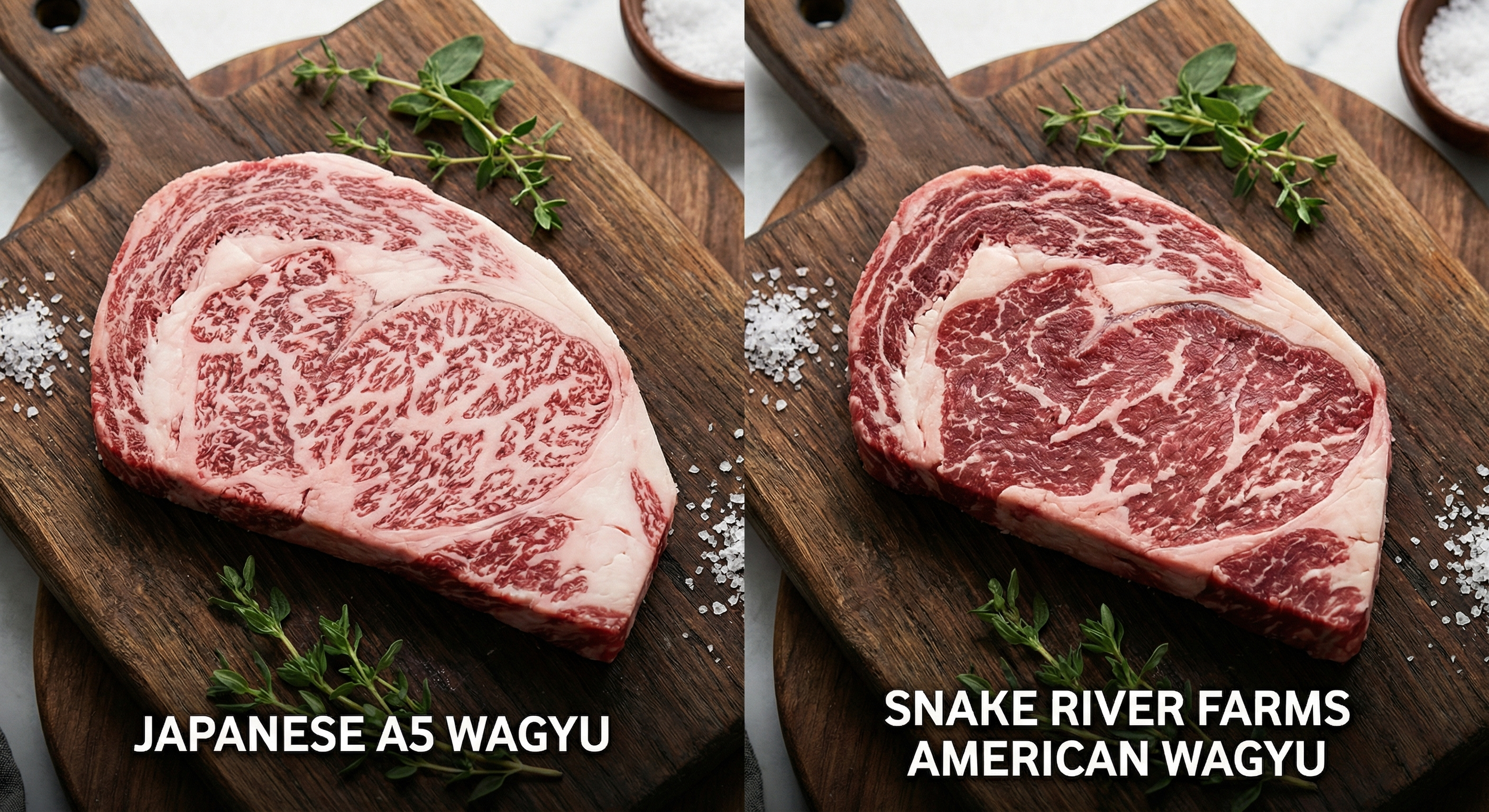
The United States has the largest wagyu herd outside Japan, with roughly equal distribution between Fullblood and Purebred/crossbred programs. American producers tend to emphasize genetic percentage clearly—you'll commonly see "F4" or "Purebred" specified.
American Fullblood programs focus on genetic preservation, often using imported Japanese semen from elite sire lines. American Purebred programs emphasize Angus crossbreeding for hybrid vigor—combining wagyu marbling with Angus size, efficiency, and beef flavor.
Australian Fullblood vs. Purebred
Australia's premium wagyu programs are predominantly Fullblood, with elite producers like Blackmore, Mayura Station, and Westholme maintaining pure Japanese genetics. Australian Purebred/crossbred programs are common at lower tiers, often marketed to domestic consumers while Fullblood production targets export markets (especially Japan, where only Fullblood genetics command premium prices).
Australian labeling often uses marbling scores (MSA system) rather than genetic designation, so you may need to specifically inquire whether the product is Fullblood or Purebred.
Japanese Standards
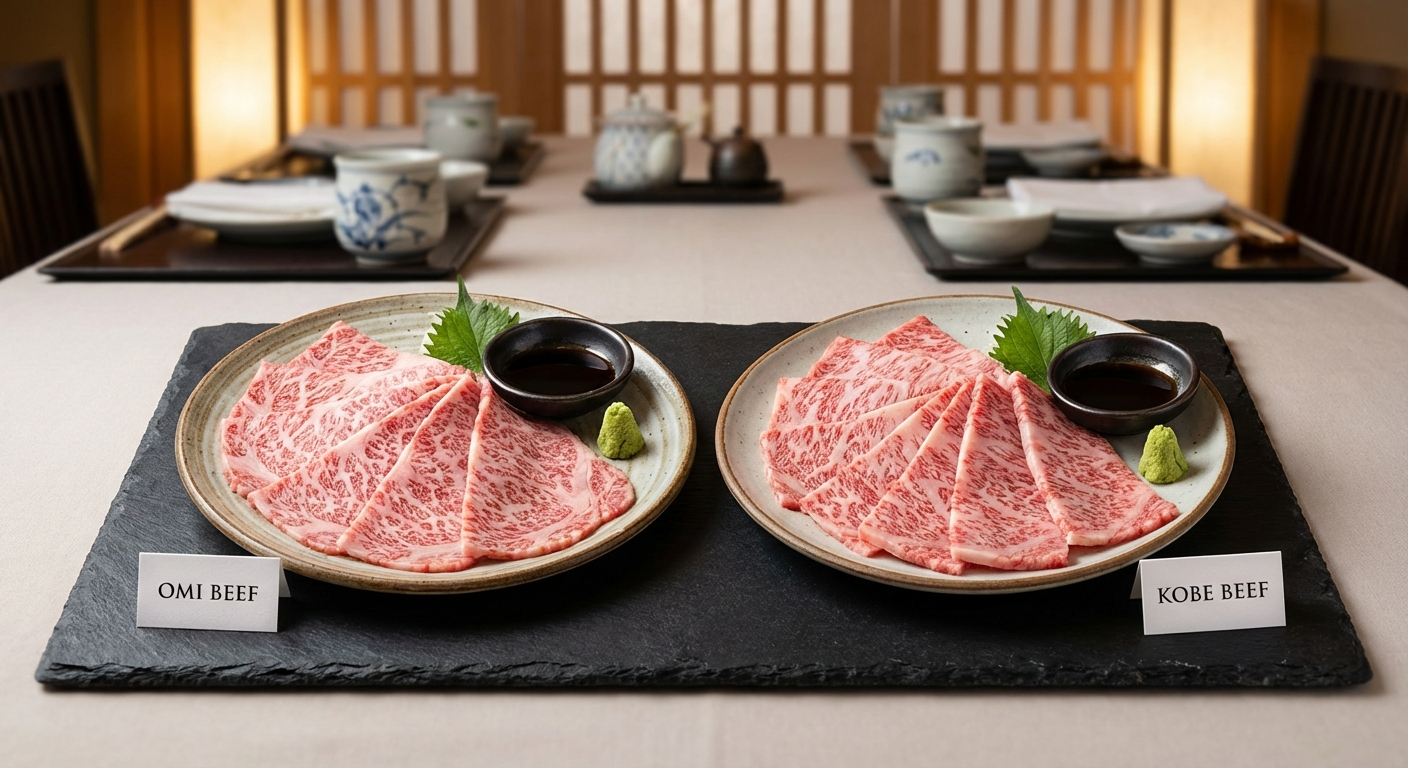
In Japan, the concepts of "Fullblood" and "Purebred" don't exist as formal categories—all Japanese domestic wagyu is 100% wagyu by definition, as crossbreeding is prohibited for beef labeled as Japanese wagyu. The Japanese system focuses on regional branding (Kobe, Matsusaka, Omi) and quality grades (A1-A5, BMS 1-12).
When Japanese buyers evaluate exported wagyu, they strongly prefer Fullblood genetics—Purebred/crossbred wagyu rarely achieves premium pricing in Japanese markets regardless of marbling score.
Certification Bodies and Standards
American Wagyu Association (AWA)
The AWA maintains the most comprehensive registry outside Japan, with strict standards for Fullblood and Purebred designation:
- Fullblood: Both parents must be registered Fullblood wagyu; no outcross genetics in documented pedigree
- Purebred: Minimum 93.75% wagyu genetics (15/16ths or greater) through documented percentage breeding
- Percentage Wagyu: Below 93.75% (F1, F2, F3) documented by percentage
The AWA issues registration certificates with unique animal identification numbers. Legitimate producers can provide these certificates on request.
Australian Wagyu Association (AWA - different from American AWA)
Australia's system is similar but with some variations:
- Fullblood: Traceable to Japanese imports with no outcrossing; DNA verification increasingly standard
- Purebred: 93.75%+ wagyu genetics through documented crossbreeding
Australian producers often supplement registry documentation with MSA grading, providing both genetic designation and objective marbling scores.
Genetic Testing and DNA Verification
Modern wagyu certification increasingly uses DNA testing to verify:
- Parentage accuracy (confirming claimed sire and dam)
- Genetic percentage (precise wagyu content)
- Breed purity (detecting undisclosed outcross genetics)
DNA verification eliminates fraud and documentation errors. When buying ultra-premium Fullblood wagyu (especially at BMS 9+ prices), DNA-verified stock provides additional assurance.
Making Your Buying Decision
Questions to Ask Your Supplier
- "Is this Fullblood or Purebred wagyu?" If they can't answer clearly, that's a red flag.
- "Can you provide registry documentation?" Legitimate producers have this readily available.
- "What's the marbling score (BMS or MSA)?" Genetic designation alone isn't enough—grade matters too.
- "What's the feeding program?" Days on grain feed significantly impacts marbling regardless of genetics.
- "What generation is this (if Purebred)?" F4 (93.75%) is very different from F2 (75%) despite both being sold as "wagyu."
Decision Framework
Use this framework to guide your choice:
Choose Fullblood when:
- You want maximum marbling potential (targeting BMS 9+)
- You value genetic purity and authentication
- You appreciate subtle, delicate flavor profiles
- It's a special occasion justifying premium investment
- The price premium over comparable-grade Purebred is reasonable (<40%)
Choose Purebred when:
- You're targeting BMS 4-7 grades where quality differences are minimal
- You prefer more robust beef flavor
- You want excellent value—high wagyu percentage at lower cost
- It's for regular consumption rather than rare occasions
- Fullblood options are unavailable or prohibitively expensive
Consider F2-F3 Crossbred when:
- You want wagyu character without premium pricing
- You're new to wagyu and exploring different options
- You're purchasing larger quantities for entertaining
- You value tenderness and marbling improvement over conventional beef but don't need maximum intensity
FAQs: Fullblood vs Purebred Wagyu
Can Purebred wagyu ever match Fullblood quality?
Individual Purebred animals can absolutely match or even exceed individual Fullblood animals in marbling and quality. However, the average and ceiling for Fullblood are higher. A top-tier Purebred F5 (96.875% wagyu) can rival many Fullblood animals, but achieving BMS 11-12 is virtually impossible with Purebred genetics.
Is F5 or F6 generation better than F4 Purebred?
Potentially, yes. F5 (96.875% wagyu) and F6 (98.4375% wagyu) are genetically closer to Fullblood and may achieve higher marbling. However, the quality difference between F4 and F5 is typically smaller than between F3 and F4. Some registries classify F5+ as "ultra-Purebred." The practical eating quality difference is often negligible—marbling score matters more than the difference between 93.75% and 98.4% genetics.
Why do some producers crossbreed instead of raising Fullblood?
Economic and practical reasons: (1) Crossbred animals grow faster and larger due to hybrid vigor, (2) Angus genetics add cold-hardiness and ease of calving, (3) Initial investment is lower—Fullblood breeding stock is expensive, (4) Crossbreds can be highly profitable at lower grades (BMS 4-7) with less intensive feeding. Many producers find F3-F4 crossbreds offer the best balance of marbling, growth efficiency, and market acceptance.
Does Fullblood wagyu always cost more than Purebred?
Almost always, yes—at equivalent grades. However, you may find higher-grade Purebred (BMS 8) priced similarly to lower-grade Fullblood (BMS 6). In these cases, the higher-grade Purebred typically offers better value unless you specifically want genetic purity over marbling score.
Can restaurants accurately represent Fullblood vs. Purebred?
Many don't. Restaurant menus often use vague terms like "wagyu beef" without specifying genetics or grade. Unless the restaurant provides specific sourcing information (producer name, genetic designation, marbling score), assume you're getting crossbred wagyu at moderate grades. High-end establishments serving genuine Fullblood A5 typically emphasize this prominently and charge accordingly.
Is Australian Fullblood the same as Japanese Fullblood?
Genetically, yes—Australian Fullblood descends from Japanese imports and maintains 100% Japanese wagyu genetics. However, environmental factors (climate, feed, water, stress levels) and breeding selection priorities can create differences. Australian Fullblood tends toward slightly larger carcass size and may develop marbling at slightly younger ages. The genetics are equivalent, but expression can vary.
How can I verify Fullblood claims?
Request registration documentation from the American Wagyu Association, Australian Wagyu Association, or equivalent certifying body. The registration certificate will show the animal's registration number, both parents' registration numbers, and genetic designation (Fullblood vs. Purebred). For ultra-premium purchases, ask whether the producer offers DNA verification. Reputable sellers provide this documentation readily; evasiveness is a red flag.
What percentage wagyu is required to legally call beef "wagyu" in the US?
Surprisingly, there's no federal legal requirement—the term "wagyu" is not regulated like "USDA Prime" or "organic." Some producers use "wagyu" for cattle with as little as 25% wagyu genetics (F1). This is why specific designation (Fullblood, Purebred, or F1/F2/F3) is essential. Don't accept vague "wagyu" labels without clarification of genetic percentage and generation.
Conclusion: Choosing Based on Your Priorities
The Fullblood versus Purebred decision ultimately comes down to your priorities: Are you pursuing the absolute pinnacle of marbling and genetic purity, or seeking the best eating experience relative to cost?
Fullblood wagyu represents genetic preservation and maximum marbling potential—the closest you can get to Japanese wagyu genetics outside Japan. It commands premium prices for valid reasons: consistent high grading, superior marbling fineness, and authentication value.
Purebred wagyu represents practical excellence—combining the vast majority of wagyu genetics with hybrid vigor and more robust flavor. At BMS 5-7 grades, Purebred delivers outstanding wagyu character at more accessible prices.
Neither is inherently "better"—they serve different purposes and budgets. The key is understanding what you're buying, verifying claims with documentation, and ensuring the price aligns with the genetic designation and marbling grade.
Armed with the knowledge from this guide, you can now make informed decisions, ask the right questions, and avoid paying Fullblood prices for Purebred genetics—or vice versa, overpaying for low-grade Fullblood when high-grade Purebred would deliver superior eating quality at lower cost.
Focus on the combination of genetic designation, marbling score, and price. When all three align appropriately, you'll get exactly the wagyu experience you're seeking at fair value.