Japanese Wagyu vs American Wagyu: Genetics, Grading, Taste, and Value Compared
Japanese and American Wagyu share genetic roots but deliver completely different eating experiences. We compare genetics, grading, marbling, flavor, and price so you can choose with confidence.
If you've ever stood at a premium butcher counter wondering whether to spend on an A5 strip from Miyazaki or an American Wagyu ribeye from Snake River Farms, you're not alone. The Japanese wagyu vs American wagyu debate is one of the most common questions in the specialty beef world — and the answer is more nuanced than most people think. These two products share genetic roots but diverge dramatically in breeding philosophy, grading standards, flavor profile, and price. In this guide, we break down every meaningful difference so you can make an informed decision for your next meal.
Wagyu Genetics: Fullblood Japanese vs Crossbred American
The word "wagyu" translates literally to "Japanese cow," and it refers to four native breeds: Japanese Black (Kuroge), Japanese Brown (Akage), Japanese Shorthorn, and Japanese Polled. Of these, Japanese Black accounts for roughly 90% of all wagyu production in Japan and is the breed responsible for the intensely marbled beef the country is famous for.
Japan declared wagyu genetics a national treasure and banned the export of live animals in 1997. Before that ban, however, a small number of fullblood wagyu cattle — primarily Japanese Black — were exported to the United States and Australia during the 1970s and 1990s. These genetics form the foundation of every American Wagyu program today.
Here's where the critical distinction emerges:
- Japanese Wagyu is 100% fullblood, purebred within those four recognized breeds. Lineage is meticulously tracked through a national identification system that traces every animal back 3+ generations.
- American Wagyu is almost always a crossbreed — typically 50% Japanese Black genetics crossed with Angus. The American Wagyu Association does register fullblood animals (F1 through purebred), but the vast majority of American Wagyu beef sold at retail is crossbred, often labeled "F1" (50% wagyu) or marketed simply as "American Wagyu."
This genetic difference is the single biggest driver of every other distinction on this list. Fullblood Japanese cattle have been selectively bred for intramuscular fat deposition for centuries. Crossbred American Wagyu inherits some of that marbling tendency but balances it with the Angus influence — larger frame, faster growth, and a more familiar beefy flavor.
For a deeper dive into wagyu breed history and bloodlines, WagyuHandbook.com maintains an excellent reference library.
Grading Systems: JMGA vs USDA Standards
One of the most confusing aspects of comparing these two products is that they're graded on entirely different scales.
Japan's JMGA System
The Japanese Meat Grading Association (JMGA) evaluates carcasses on two axes:
- Yield grade (A, B, or C) — how much usable meat the carcass produces relative to its weight. A is the highest.
- Quality grade (1–5) — based on four factors: marbling (BMS), meat color and brightness, fat color and luster, and firmness/texture.
The famous "A5" designation means the animal scored an A for yield and a 5 for quality. Within the quality grade, Beef Marbling Standard (BMS) ranges from 1 to 12. To qualify as grade 5, a carcass must score BMS 8–12. The most elite cuts — the ones that look almost white with fat — score BMS 10, 11, or 12.
USDA Grading
The USDA system is far simpler. It grades beef as Select, Choice, or Prime (among others), based primarily on marbling in the ribeye muscle at the 12th rib. USDA Prime — the highest grade — requires only modest marbling that roughly corresponds to BMS 4–5 on the Japanese scale.
This means a steak graded USDA Prime would barely register as a quality grade 2 or 3 in Japan. The scales simply don't overlap at the top end.
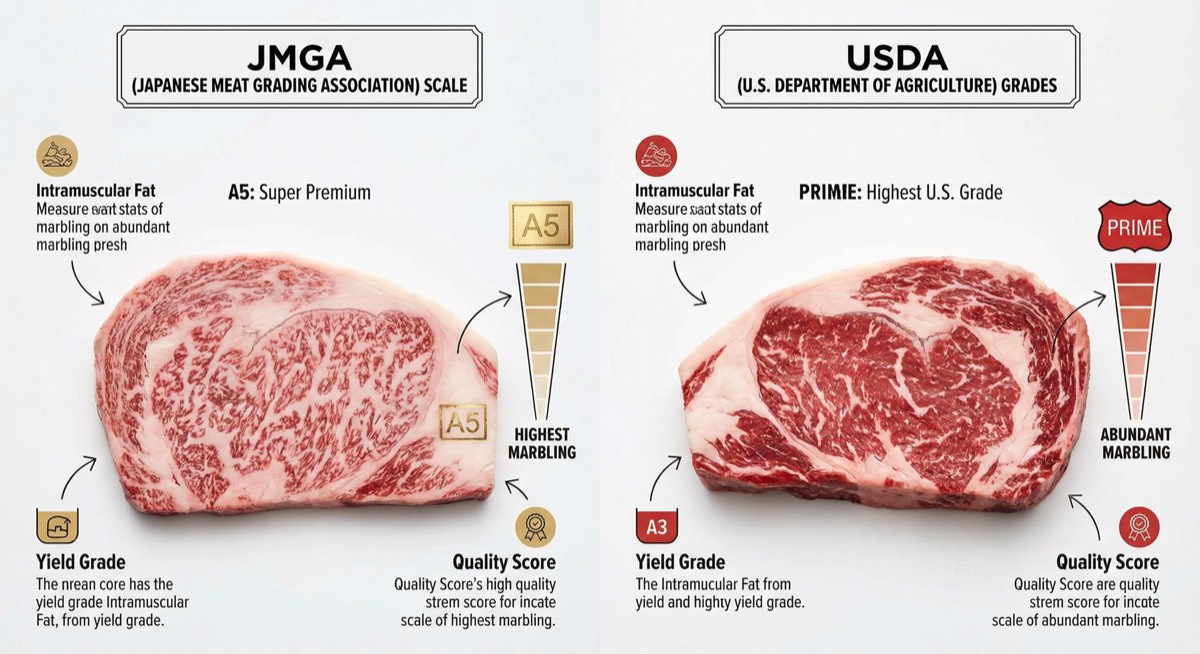
| Grade | BMS Equivalent | Marbling Level |
|---|
| USDA Select | BMS 1–2 | Slight |
| USDA Choice | BMS 2–4 | Small to Moderate |
| USDA Prime | BMS 4–5 | Slightly Abundant |
| JMGA A4 | BMS 6–7 | Abundant |
| JMGA A5 | BMS 8–12 | Very Abundant to Extraordinary |
Most American Wagyu beef grades USDA Prime or above-Prime (sometimes informally called "Prime+"), landing in the BMS 5–7 range. That's excellent marbling by American standards but still a tier below true A5 Japanese Wagyu.
Marbling Differences: What BMS Really Means for Your Steak
Marbling is the visible network of intramuscular fat within the lean meat. It's the primary driver of tenderness, juiciness, and flavor in high-quality beef — and it's where Japanese and American Wagyu differ most visibly.
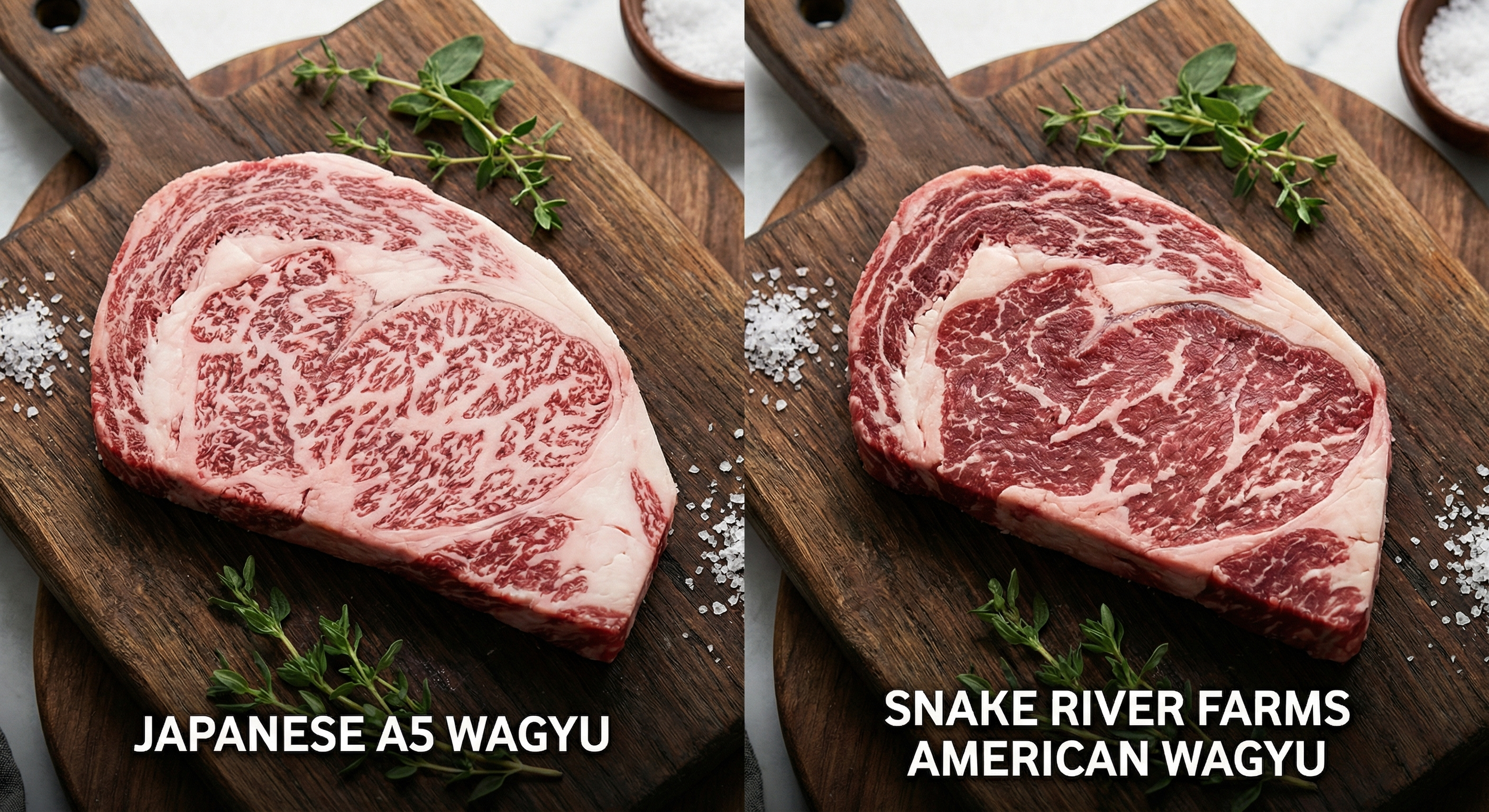
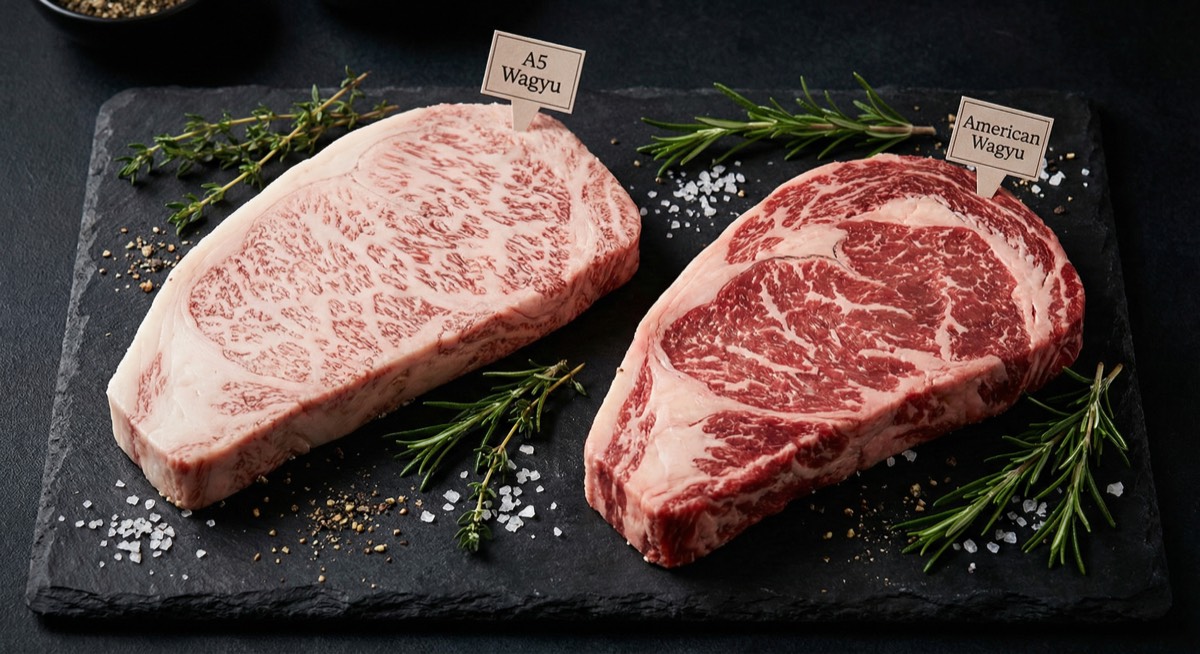
Japanese A5 Wagyu (BMS 8–12): The marbling is so dense that the meat appears pink-white rather than red. Fat is distributed in extremely fine, web-like patterns throughout the muscle. At BMS 10+, the ratio of fat to lean can exceed 50%. This isn't a defect — it's the result of centuries of selective breeding combined with extended feeding periods (often 28–32 months on carefully managed grain diets).
American Wagyu (BMS 5–7 typical): Marbling is generous compared to conventional beef — often double or triple what you'd see in standard USDA Prime — but it's distributed in slightly coarser streaks rather than the ultra-fine webbing of Japanese beef. The lean-to-fat ratio remains firmly in favor of lean meat.
The practical difference on your plate: Japanese A5 has a butter-like, almost custard-soft texture. American Wagyu has a rich, juicy steak texture with enhanced tenderness. Both are exceptional. They're simply different experiences.
Flavor Profiles: Rich and Buttery vs Bold and Beefy
This is where personal preference matters most, and where the "which is better" question breaks down entirely.
Japanese A5 Wagyu
The flavor profile of Japanese A5 is dominated by its fat. Wagyu fat has a uniquely low melting point (around 77°F / 25°C for highly marbled cuts), meaning it literally begins to dissolve on your tongue. Tasting notes commonly include:
- Buttery, almost sweet richness
- Umami depth with subtle nutty undertones
- Delicate beef flavor that takes a back seat to the fat's richness
- A clean, non-greasy finish despite the high fat content
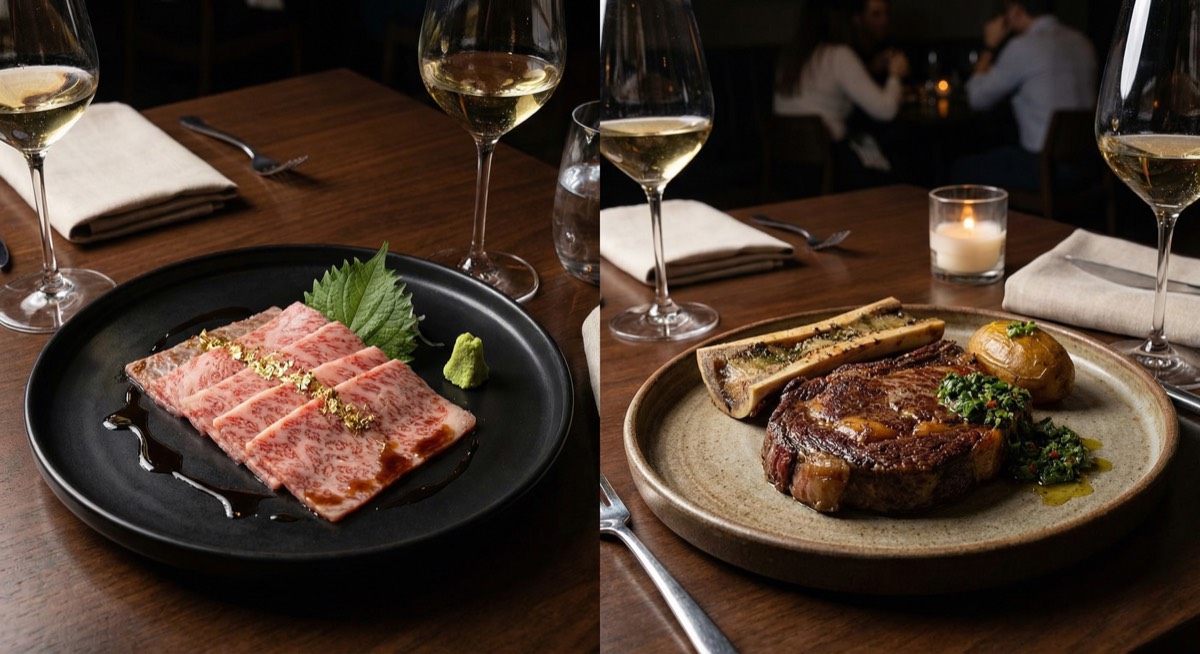
Because of the intensity, Japanese A5 is traditionally served in small portions — 3 to 4 ounces is a standard serving in Japan. Eating an entire 12-ounce A5 ribeye would overwhelm most palates (and stomachs).
American Wagyu
American Wagyu delivers a more familiar steak experience, amplified:
- Pronounced beefy flavor from the Angus genetics
- Rich marbling adds juiciness and tenderness without overwhelming the palate
- More balanced fat-to-lean ratio allows for larger portion sizes
- Pairs well with traditional steakhouse sides and bold seasonings
Many steak enthusiasts actually prefer American Wagyu for everyday luxury dining because it delivers the "best steak I've ever had" experience in a format they're used to — a full-sized, deeply flavorful steak you can eat as a complete main course.
Price Comparison: What You'll Actually Pay
Price is often the deciding factor, and the gap between Japanese and American Wagyu is substantial.
Japanese A5 Wagyu Pricing (2026 retail)
- A5 Ribeye: $120–$180 per pound
- A5 Striploin: $100–$150 per pound
- A5 Filet: $150–$250 per pound
- A5 Flat Iron / lesser cuts: $60–$90 per pound
Browse current offerings at TheMeatery.com's Japanese A5 Wagyu collection for real-world pricing.
American Wagyu Pricing (2026 retail)
- Ribeye: $40–$70 per pound
- Striploin: $35–$60 per pound
- Filet: $50–$80 per pound
- Ground / lesser cuts: $15–$25 per pound
Check TheMeatery.com's American Wagyu collection for current availability.
Cost Per Serving
Here's where the math gets interesting. Since Japanese A5 is served in 3–4 oz portions while American Wagyu is served in 8–12 oz portions, the cost per serving narrows:
- Japanese A5 serving (4 oz ribeye): ~$30–$45
- American Wagyu serving (10 oz ribeye): ~$25–$44
Per serving, the two products are surprisingly comparable. The difference is the type of dining experience — a precious, focused tasting moment vs. a hearty, indulgent steak dinner.
Raising and Feeding Practices
Japanese Wagyu cattle are raised under strict protocols that vary by prefecture but generally include:
- Individual animal identification and tracking from birth
- Extended feeding periods of 28–32 months (vs. 18–22 for conventional U.S. cattle)
- Carefully formulated grain-based diets, often including rice straw, barley, wheat bran, and corn
- Small herd sizes — many Japanese wagyu farms raise fewer than 20 head at a time
- Stress-minimization practices (comfortable housing, consistent handling)
The mythology around beer-fed, massaged wagyu is largely exaggerated, though some farms do use brushing or sake mash in feed. The real differentiator is time, genetics, and meticulous individual attention.
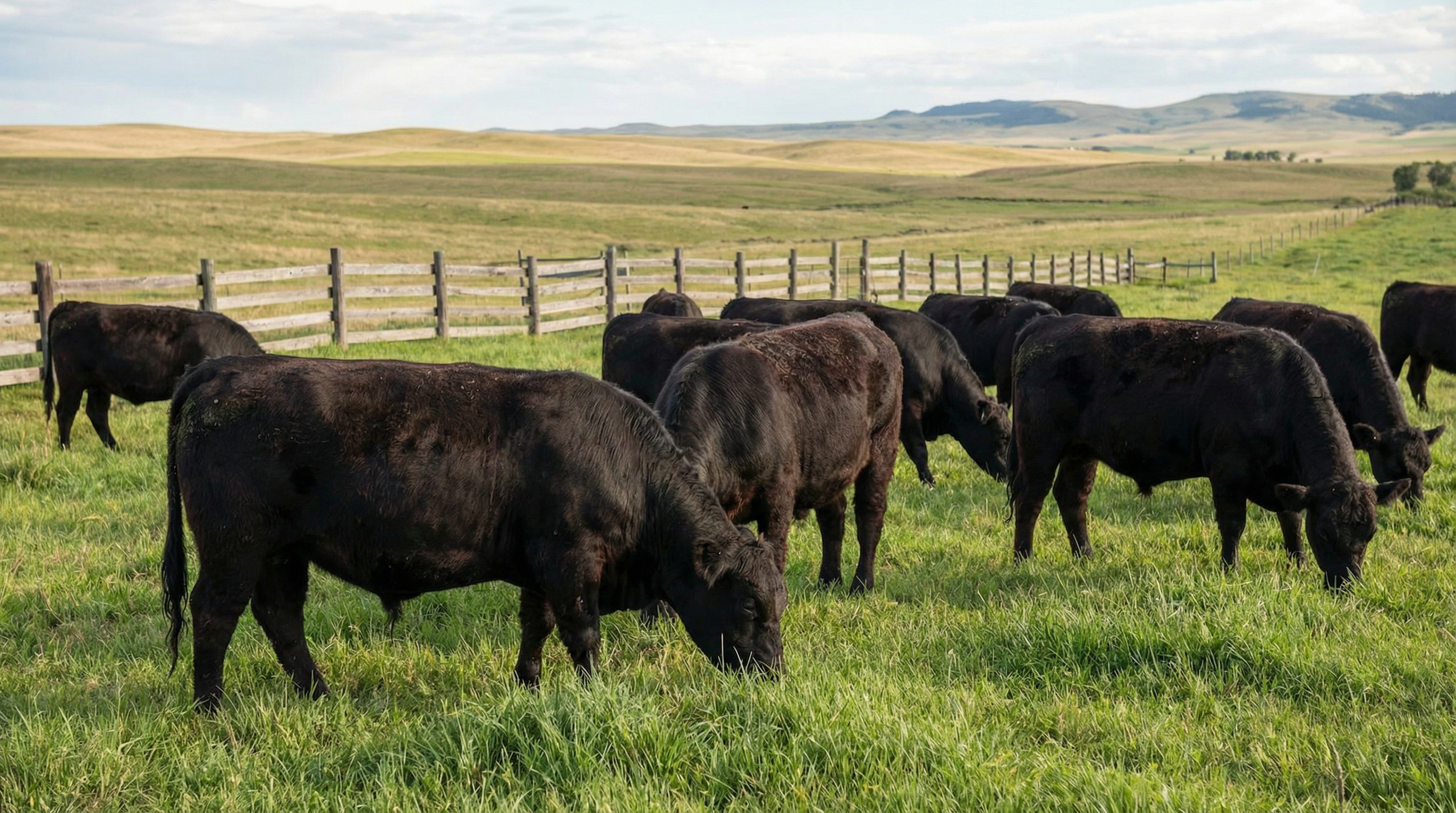
American Wagyu cattle are raised under more conventional U.S. beef production systems, though premium programs emphasize:
- Longer feeding periods than standard beef (often 400+ days on grain)
- No added hormones or antibiotics (in premium programs)
- Larger operations with greater scale efficiency
- Corn-heavy finishing diets typical of U.S. feedlots
The scale and efficiency of American production is a key reason American Wagyu costs less — it's simply more economical to produce in the U.S. system.
Which Should You Choose? A Guide by Occasion
Rather than declaring a winner, here's a practical framework for choosing between Japanese and American Wagyu based on the occasion.
Choose Japanese A5 Wagyu When:
- Special celebrations — anniversaries, milestone birthdays, promotions
- Tasting experiences — you want to explore an entirely different category of beef
- Entertaining food enthusiasts — guests who appreciate culinary novelty
- Small, focused courses — as part of a multi-course dinner or tasting menu
- Cooking Japanese-style — yakiniku, shabu-shabu, sukiyaki, or seared with minimal seasoning
Choose American Wagyu When:
- Steakhouse-style dinners — you want a full-sized, indulgent steak
- Grilling and entertaining — backyard cookouts where you want to impress
- Everyday luxury — a Tuesday night upgrade that won't break the bank
- Bold preparations — steaks with rubs, compound butters, or robust sauces
- Burgers and ground beef dishes — American Wagyu ground beef makes extraordinary burgers at a reasonable price point
The Best of Both Worlds
Many wagyu enthusiasts keep both in rotation. A freezer stocked with American Wagyu steaks for weeknight indulgence and a few portions of Japanese A5 reserved for special moments is arguably the ideal approach.
For further reading on wagyu cuts, cooking techniques, and sourcing, visit WagyuHandbook.com — a comprehensive resource covering everything from breed history to preparation guides.
The Bottom Line
The Japanese wagyu vs American wagyu comparison isn't about which is "better" — it's about understanding two distinct products that happen to share genetic ancestry. Japanese A5 Wagyu is an ultra-premium delicacy defined by extraordinary marbling, buttery texture, and a tasting-portion format. American Wagyu is a luxurious upgrade to the traditional steak experience, offering exceptional marbling and flavor in familiar serving sizes at more accessible prices.
Both deserve a place in any serious beef lover's repertoire. The key is matching the product to the occasion, your cooking style, and your budget. Now that you understand the genetics, grading, flavor, and value behind each, you're equipped to make that choice with confidence.