Japanese Wagyu vs Australian Wagyu: The Complete Comparison
Japanese and Australian wagyu both deliver extraordinary marbling, but they represent different philosophies, grading systems, and eating experiences. Here is the complete comparison.
After two decades sourcing wagyu from both Japan and Australia, I'm asked constantly: which is better? The honest answer is that they're different products serving different purposes. Japanese wagyu represents tradition, precision, and the absolute peak of marbling. Australian wagyu represents innovation, value, and the skillful adaptation of Japanese genetics to a different climate and production system.
Let me break down exactly how they compare.
The Grading Systems: BMS vs MBS
Understanding the grading difference is essential for comparing the two.
Japanese BMS (Beef Marbling Standard)
Japan uses a 1-12 scale, with A5 grade requiring BMS 8-12. The grading is performed by certified graders from the Japanese Meat Grading Association (JMGA) at the ribeye cross-section between ribs 6 and 7.
| BMS Score | Quality Grade | Description |
|---|
| 8-9 | A5 | Entry-level A5, exceptional by any standard |
| 10-11 | A5 | Premium A5, dense marbling |
| 12 | A5 | Peak marbling, extremely rare |
Australian MBS (Marble Score)
Australia uses the AUS-MEAT marbling system, scoring from 0 to 9+ (sometimes extended to 11-12 for exceptional cattle). The MSA (Meat Standards Australia) system provides even more granularity with scores up to 1200+.
| MSA Marble Score | Approximate BMS Equivalent | Description |
|---|
| 300-500 | 3-5 | Choice to Prime equivalent |
| 600-700 | 6-7 | Above Prime, excellent marbling |
| 800-900 | 8-9 | A5 equivalent, exceptional |
| 1000-1100+ | 10-11+ | Peak marbling, competing with top Japanese |
Key insight: When comparing, always ask for the specific MSA score for Australian wagyu and BMS score for Japanese. "A5" and "9+" are broad categories with significant internal variation.
Genetics: Fullblood vs Crossbred
Japanese Wagyu
100% purebred Japanese Black (Kuroge Washu) cattle, with documented lineage going back generations. The four major Japanese breeds are Japanese Black (Kuroge), Japanese Brown (Akage), Japanese Polled (Mukaku), and Japanese Shorthorn (Nihon Tankaku), but Japanese Black dominates premium production (90%+).
Genetic selection in Japan focuses on marbling potential, feed efficiency, and carcass quality. Bloodlines like Tajima-gyu (the foundation of Kobe beef) are prized for fine-grained marbling and superior fat quality.
Australian Wagyu
Australia produces both Fullblood (100% Japanese genetics) and crossbred wagyu. The majority of Australian "wagyu" is F1 (50% wagyu × 50% Angus or other breeds) or F2 (75% wagyu genetics).
Fullblood Australian Wagyu: 100% Japanese genetics, raised in Australia. These cattle can produce marbling scores (MSA 9+) that compete directly with Japanese A5. Producers like Blackmore, Mayura Station, and Jack's Creek produce Fullblood programs that reach BMS 10-11 equivalent.
Crossbred Australian Wagyu: F1 and F2 crosses typically produce MSA 4-7 marbling — excellent beef that's significantly better than conventional, but not in the same category as Fullblood or Japanese A5.
Critical distinction: When buying Australian wagyu, always clarify whether it's Fullblood or crossbred. The price difference is 2-3x and the eating experience is dramatically different.
Production Methods
Japanese Wagyu Production
Duration: 28-32 months total (10-12 months backgrounding + 18-20 months intensive grain feeding).
Diet: Proprietary grain mixes (often including rice straw, barley, corn, wheat bran, soybean meal) designed to maximize marbling while maintaining animal health. Each prefecture and producer has closely guarded feeding formulas.
Philosophy: Low-stress environment, individual attention, meticulous record-keeping. Cattle are often housed in small groups or individually, with climate-controlled barns in some operations.
Scale: Japanese operations are smaller — a "large" farm might have 200-500 head. The focus is on quality and traceability over volume.
Australian Wagyu Production
Duration: Varies by program. Fullblood programs: 24-30 months (similar to Japan). Crossbred programs: 18-24 months.
Diet: Grain-based finishing (barley, wheat, sorghum) with some programs incorporating specialty feeds. Premium Australian producers have developed their own feeding protocols — Mayura Station, for example, uses a beer and chocolate-supplemented diet for their "Mayura Station" line.
Philosophy: Australian wagyu production combines Japanese principles with Australian pastoral traditions. Cattle often have pasture access early in life, then move to grain-intensive finishing in feedlots. The approach is more scalable than Japanese production but maintains quality focus in premium programs.
Scale: Australian operations are larger. A premium wagyu producer might have 2,000-10,000 head. This scale allows for more competitive pricing while maintaining quality in Fullblood programs.
Flavor and Eating Experience
Japanese A5 Wagyu
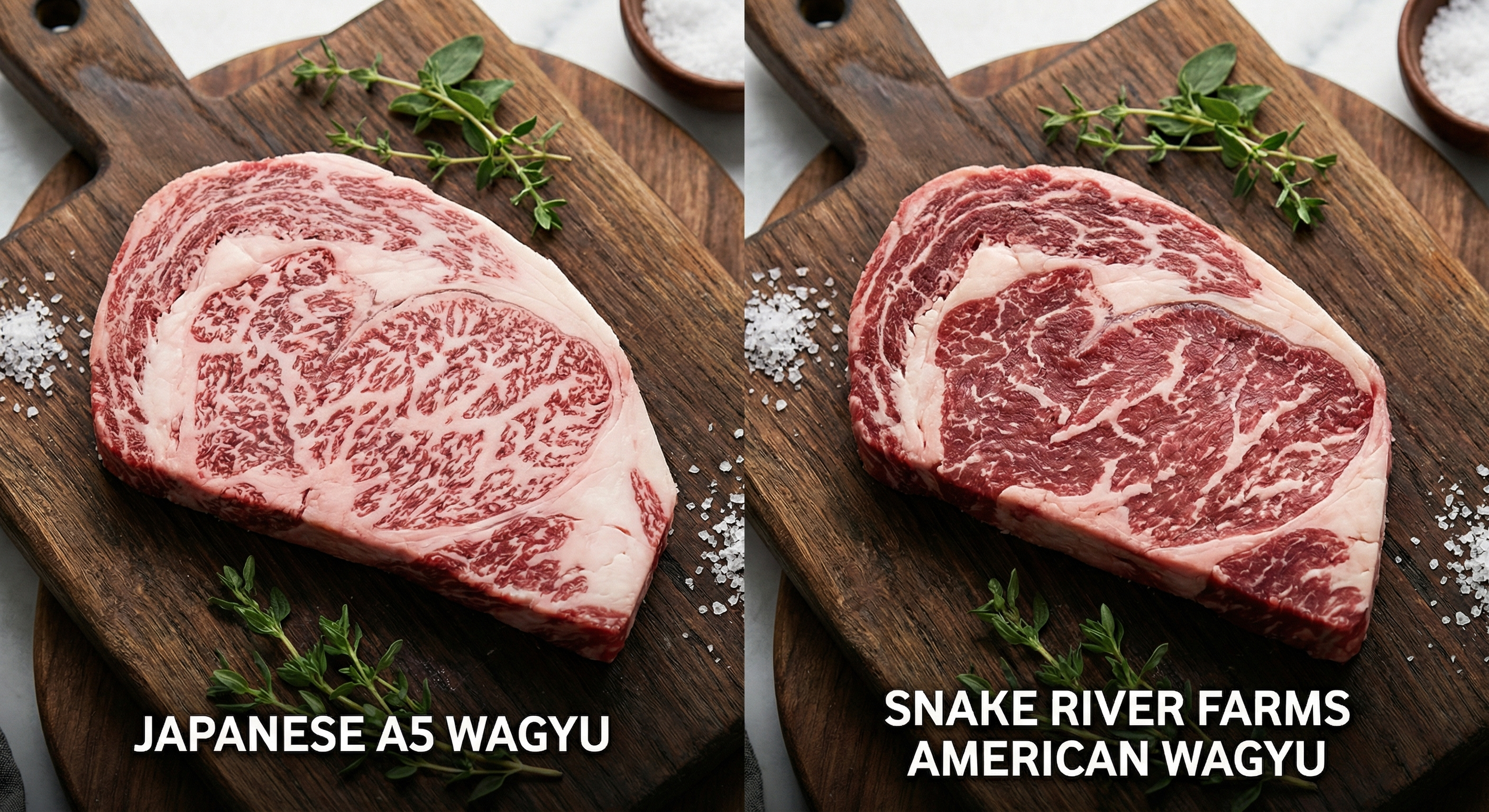
Fat quality: Sweet, clean, almost floral. The fat melts at an extremely low temperature (~77°F / 25°C), creating a silky mouthfeel that's closer to foie gras than conventional beef.
Flavor profile: Delicate, sweet, with subtle umami depth. The beef flavor is present but refined — never aggressive. The finish is clean, with no greasy aftertaste despite the extreme fat content.
Texture: At BMS 10+, the texture is remarkably soft — the beef literally dissolves on the tongue. There's minimal chew required. This can be polarizing — some find it transcendent, others find it too rich or lacking the "steak" experience.
Portion size: 3-4 oz per person is standard. The richness is intense enough that larger portions become overwhelming for most diners.
Australian Fullblood Wagyu (MSA 9+)
Fat quality: Rich, buttery, with a slightly more robust character than Japanese wagyu. The fat is still exceptionally soft but has a touch more "beef" character.
Flavor profile: More assertive beef flavor than Japanese wagyu while maintaining the signature buttery richness. You get the wagyu marbling with a flavor that's closer to what most people expect from premium steak. This makes Australian Fullblood more approachable for wagyu first-timers.
Texture: At equivalent marbling scores (MSA 9+ / BMS 9-10 equivalent), the texture is tender and rich but retains slightly more structure than Japanese wagyu. There's a bit more chew — which some diners prefer.
Portion size: 4-6 oz per person is comfortable. Still rich, but most diners can handle a larger portion than they would with Japanese A5.
Australian Crossbred Wagyu (MSA 5-7)
Fat quality: Good marbling for the price, but distinctly different from Fullblood. The fat is firmer, the melting point is higher, and the flavor is more conventionally "beefy."
Flavor profile: Balanced between wagyu characteristics and Angus beefiness. You get enhanced marbling and some of the buttery quality, but it's recognizably a "steak" rather than the unique wagyu experience.
Texture: Tender but not melt-in-your-mouth. Comparable to a very well-marbled USDA Prime steak with slightly better fat distribution.
Portion size: 8-12 oz per person — this is a conventional steak portion. The richness doesn't limit portion size the way Fullblood or Japanese wagyu does.
Price Comparison
| Type | Ribeye Price (per lb) | Notes |
|---|
| Japanese A5 (BMS 10-12) | $150-$220 | Peak marbling, extreme richness |
| Japanese A5 (BMS 8-9) | $100-$160 | Entry A5, still exceptional |
| Australian Fullblood (MSA 9+) | $80-$150 | Competing with mid-tier A5 |
| Australian Fullblood (MSA 7-8) | $50-$90 | Excellent marbling, great value |
| Australian Crossbred (MSA 5-7) | $30-$60 | Better than Prime, accessible |
Value analysis: Australian Fullblood at MSA 9+ (roughly BMS 9-10 equivalent) costs 30-50% less than Japanese A5 at the same marbling level. For many buyers, Australian Fullblood represents the best value in ultra-premium beef.
Halal Certification
This is a significant practical difference for some markets:
Australian Wagyu: Many Australian producers offer Halal-certified programs. The Australian meat industry has extensive experience with Halal processing for export to Muslim-majority countries. This makes Australian wagyu accessible to consumers who require Halal certification.
Japanese Wagyu: Halal-certified Japanese wagyu is available but less common. Some prefectures and producers have developed Halal processing capabilities, but it's not standard. Sourcing Halal-certified Japanese A5 requires working with specialized importers.
Availability and Supply Chain
Japanese Wagyu: Limited production, strict export requirements, complex supply chains. Availability can be inconsistent. Premium cuts sell out quickly. Shipping is expensive (frozen air freight from Japan), which adds to the final price.
Australian Wagyu: Larger production volume, more reliable supply chains, established export infrastructure. Australian producers have optimized for international markets. Shipping is more economical (sea freight or shorter air routes), which helps keep prices competitive.
Which Should You Choose?
Choose Japanese A5 When:
- It's a special occasion — celebrating a milestone, once-in-a-lifetime experience
- You want the absolute peak — the most extreme marbling, the most refined eating experience
- Authenticity matters — the cultural heritage and traditional production methods are part of the appeal
- You're serving small portions — tasting menu, omakase, shabu-shabu where 3-4 oz per person is appropriate
- You appreciate delicate, sweet flavors — the refined fat quality is a priority
Choose Australian Fullblood Wagyu When:
- You want exceptional quality at better value — MSA 9+ Fullblood competes with mid-tier A5 at 30-50% lower cost
- You prefer more assertive beef flavor — the balance between wagyu richness and conventional "steak" character appeals to you
- You're serving full steak portions — 6-8 oz per person where Japanese A5 would be too rich
- Consistent availability matters — you want to be able to reorder the same quality reliably
- Halal certification is required — Australian producers make this easier
Choose Australian Crossbred Wagyu When:
- You want an upgrade from Prime — better marbling than conventional beef without the extreme price
- You're feeding a crowd — larger portions at a more accessible price point
- You're introducing someone to wagyu — the eating experience is less intense, more familiar
- Budget is a primary concern — you want "wagyu" quality without the peak-tier price
The Honest Bottom Line
Japanese A5 represents the pinnacle of beef production — the absolute extremes of what's possible with marbling, fat quality, and refinement. If you want the best regardless of cost, Japanese A5 (especially BMS 10-12 from premier prefectures) is unmatched.
Australian Fullblood wagyu at MSA 9+ is the best value proposition in ultra-premium beef. You get 85-90% of the Japanese A5 experience at 50-70% of the cost, with more assertive flavor that many people actually prefer for full steak portions.
Australian crossbred wagyu is a different category entirely — a meaningful upgrade from conventional beef that makes "wagyu" accessible to a much wider audience.
None is objectively "better." They serve different purposes, different occasions, and different preferences. The key is understanding what you're buying and setting appropriate expectations.
For authentic Japanese A5 and premium Australian Fullblood wagyu with full traceability, check out The Meatery's Japanese wagyu collection and Australian wagyu selection.