Kobe vs Wagyu: Complete Comparison (Origin, Grading, Price, Taste)
Kobe is Wagyu, but not all Wagyu is Kobe. Understanding the geographic designation, certification requirements, and subtle quality differences helps you decide when the Kobe premium is justified.
Kobe is Wagyu, but not all Wagyu is Kobe. This single statement clarifies the most common misconception about these two premium beef categories.
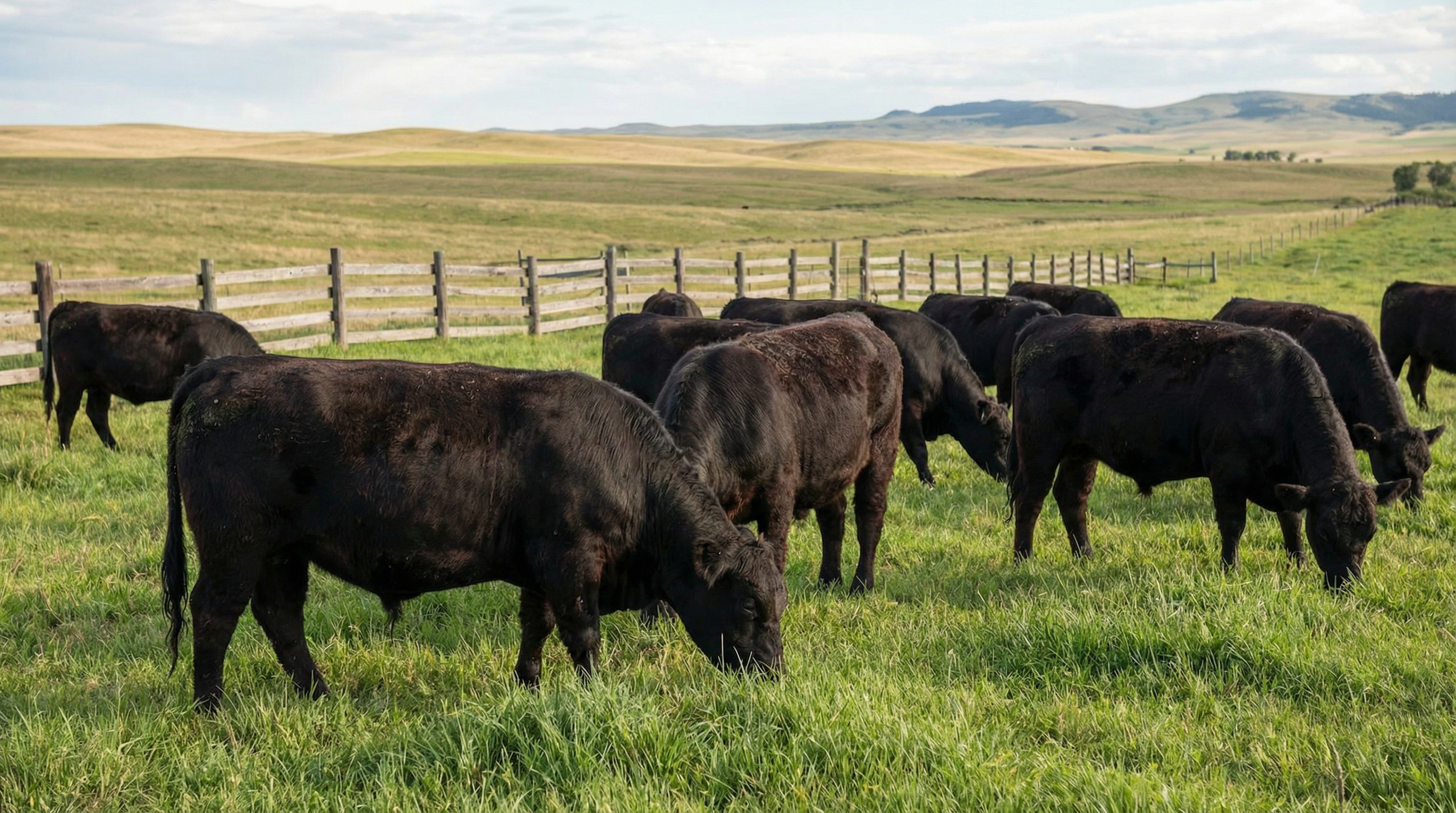
Wagyu translates to "Japanese cow" and refers to four specific cattle breeds raised in Japan. Kobe beef is Wagyu from Tajima-gyu cattle raised exclusively in Hyogo Prefecture under strict production standards and certified by the Kobe Beef Marketing & Distribution Promotion Association.
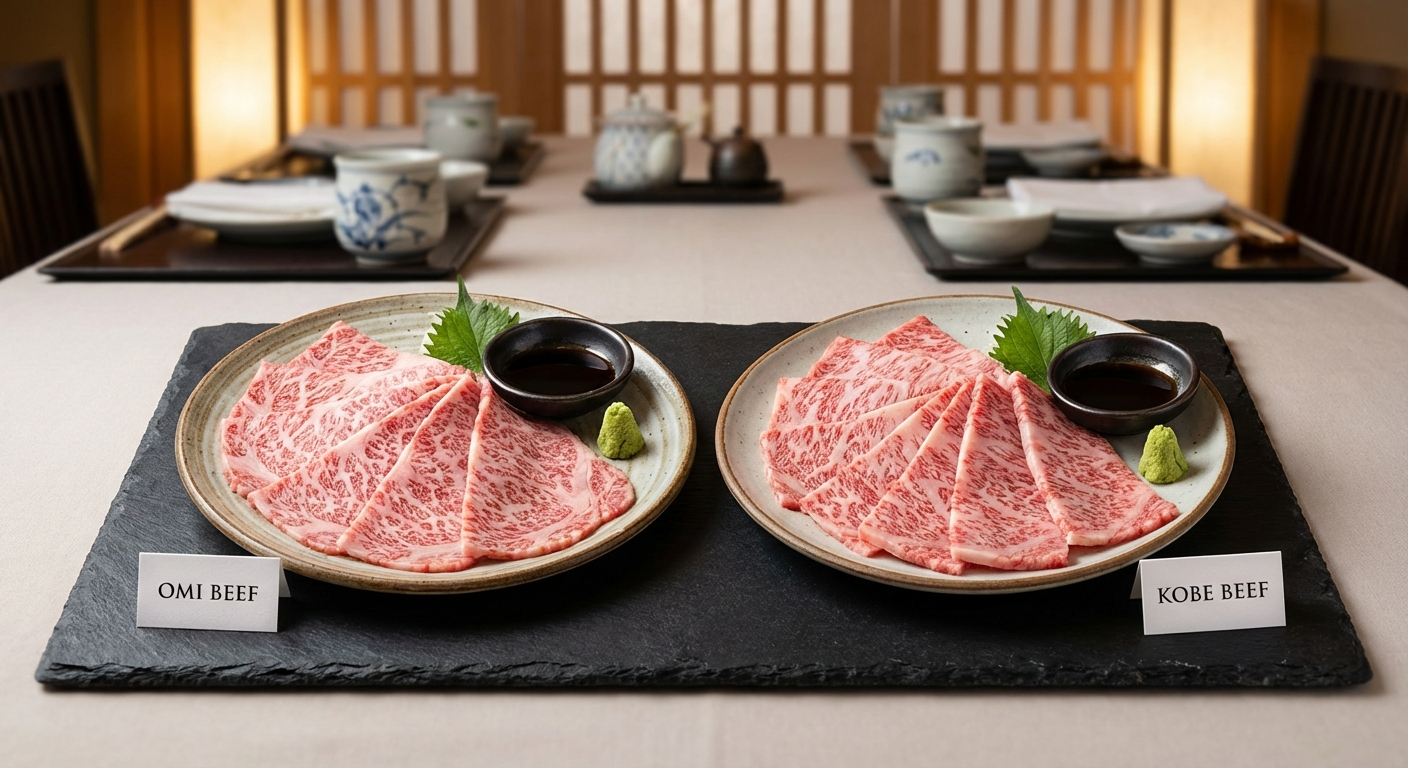
In blind tastings I've conducted with sommeliers and chefs, participants correctly identified Kobe beef only 40% of the time when presented alongside other A5 Wagyu from Miyazaki or Kagoshima. The differences exist, but they're subtle—and understanding them helps you decide when the Kobe premium is justified.
What Defines Wagyu Beef
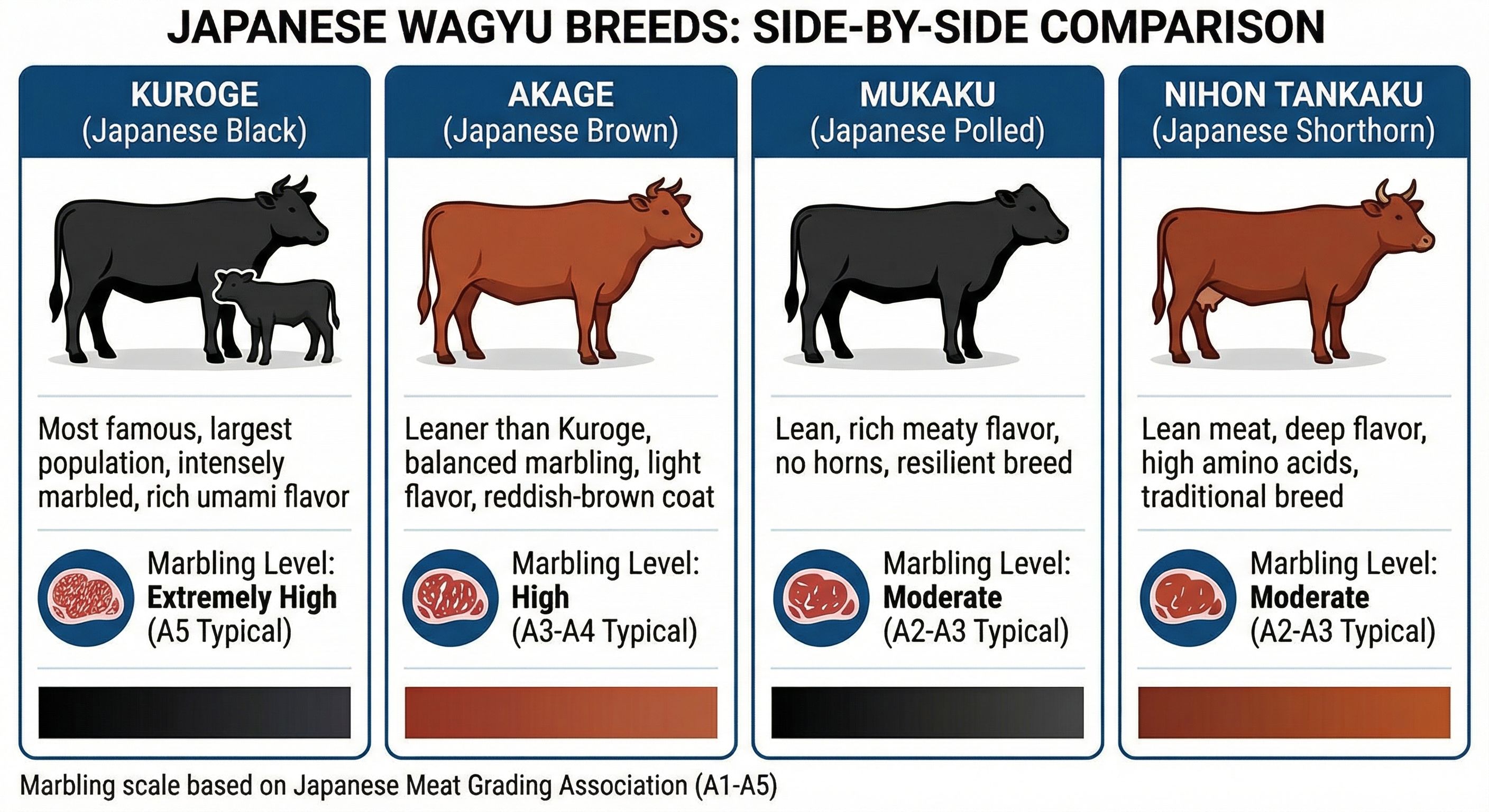
The Four Japanese Wagyu Breeds
The Japanese government recognizes four breeds under the Wagyu designation (source: Japanese Ministry of Agriculture, Forestry and Fisheries):
- Japanese Black (Kuroge Washu) — 95% of all Wagyu production. Famous for intense marbling.
- Japanese Brown (Akage Washu) — Leaner with a stronger beef flavor.
- Japanese Polled (Mukaku Washu) — Rare breed, moderate marbling.
- Japanese Shorthorn (Nihon Tankaku Washu) — Lean, grass-fed, minimal marbling.
Kobe beef exclusively comes from Japanese Black cattle, specifically the Tajima-gyu strain native to Hyogo Prefecture.
Wagyu Grading System
Japan uses a yield grade (A-C) and quality grade (1-5) system. The quality grade evaluates four factors:
- Marbling (BMS score 1-12): Fat distribution throughout the meat
- Meat color and brightness: Evaluated against standardized color charts
- Firmness and texture: Assessed through visual inspection and touch
- Fat color, luster, and quality: Pure white to cream color preferred
A5 Wagyu represents the highest combination—excellent yield (A) and top quality grade (5). A5 requires a BMS marbling score of 8 or higher (source: Japan Meat Grading Association).
All Kobe beef must grade A4 or A5, but not all A4 or A5 Wagyu qualifies as Kobe.
What Makes Kobe Beef Special
Geographic and Genetic Requirements
Kobe beef must meet these non-negotiable standards:
- Breed: Tajima-gyu cattle (a bloodline of Japanese Black Wagyu)
- Birthplace: Born and raised in Hyogo Prefecture
- Processing: Slaughtered at designated facilities in Hyogo
- Marbling: BMS score of 6 or higher (most Kobe grades 8-12)
- Carcass weight: 470 kg or less for optimal quality
- Meat quality: Fine texture, excellent marbling distribution
Certification and Traceability
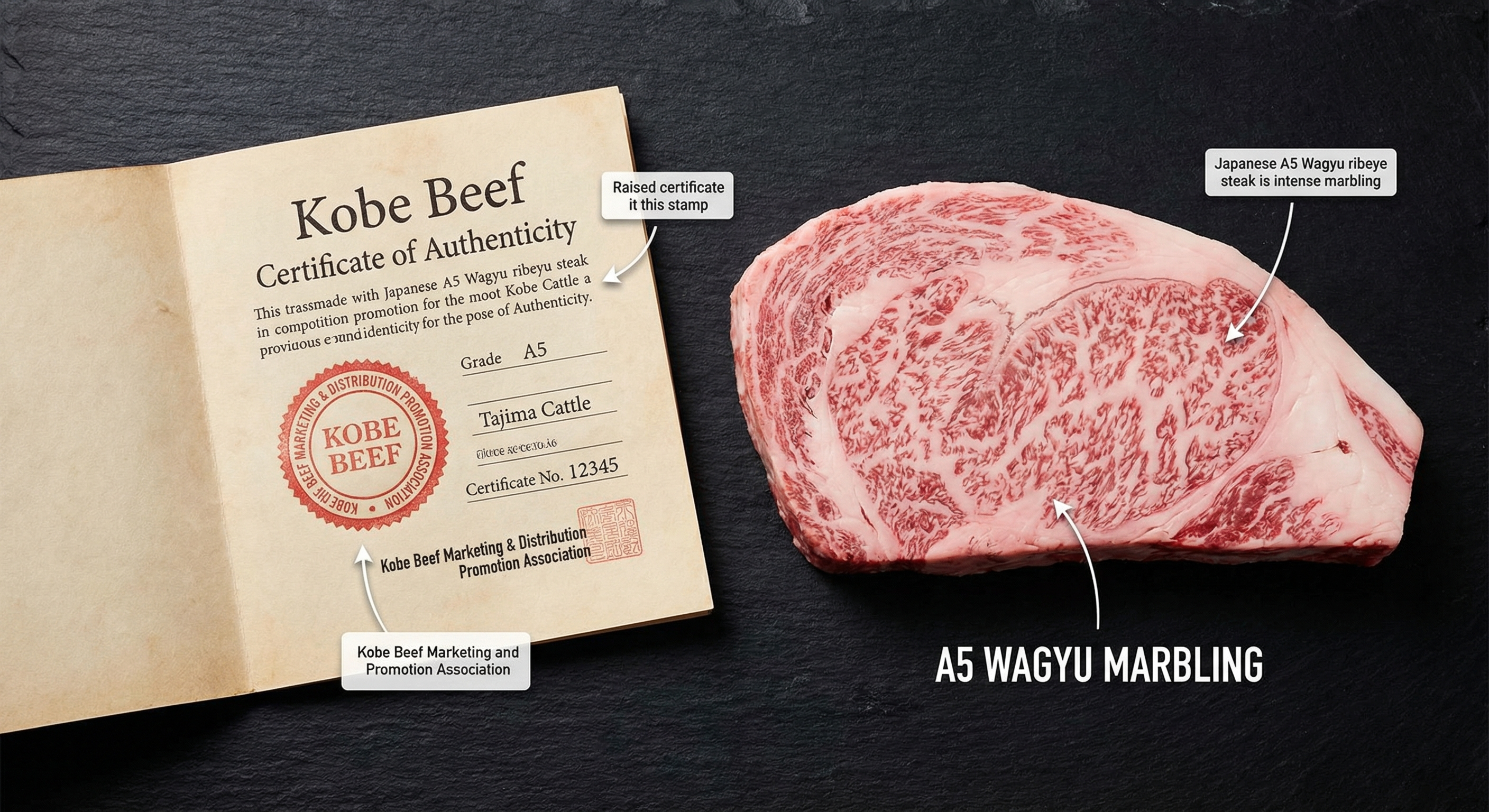
Every legitimate Kobe beef cut includes a 10-digit identification number traceable to the individual cattle through Japan's national traceability database. You can verify authenticity at Kobe Beef Official Website.
In my experience working with Japanese beef importers, approximately 0.06% of all Wagyu production qualifies as authentic Kobe—roughly 5,000 head per year from a total Japanese Wagyu population exceeding 1.6 million head.
Price Comparison Matrix
| Beef Type | Ribeye (per lb) | Strip (per lb) | Annual Production | Export Availability |
|---|---|---|---|---|
| USDA Prime Angus | $18-28 | $16-25 | 5.5M head (US) | Domestic + Export |
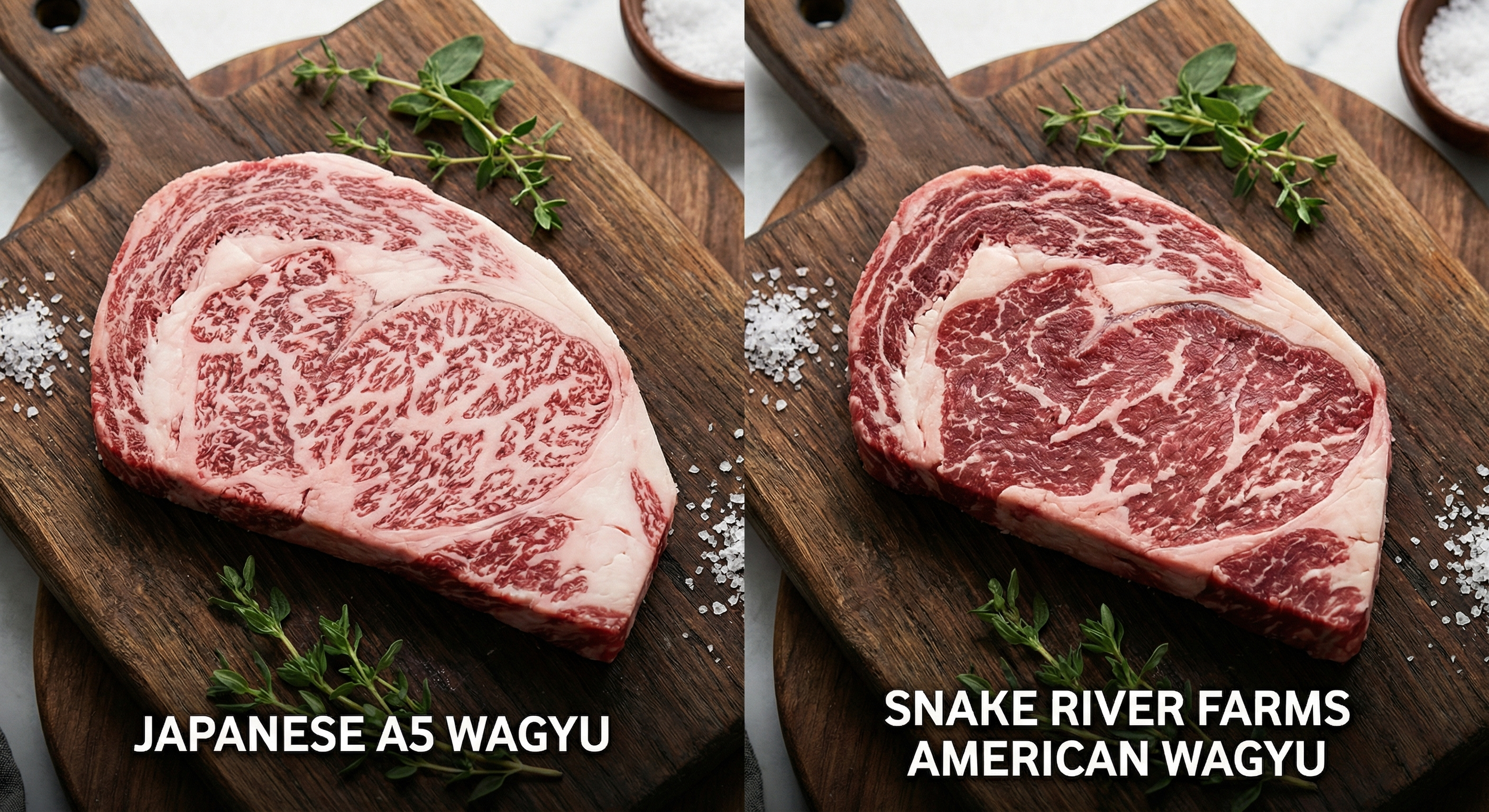
| American Wagyu | $40-70 | $35-60 | ~30K head (US) | Domestic + Limited Export |
| Japanese A5 Wagyu (non-Kobe) | $150-250 | $140-220 | ~450K head (Japan) | Export Available |
| Authenticated Kobe Beef | $300-500+ | $280-450+ | ~5K head (Japan) | Export Available (Limited) |
Key price driver: Kobe's scarcity premium. You're paying for:
- Strict geographic designation (only Hyogo Prefecture)
- Tajima-gyu bloodline purity
- Certification overhead and traceability systems
- Brand recognition and prestige
- Limited export quotas
From a pure marbling and flavor perspective, the difference between Kobe A5 and non-Kobe A5 Wagyu (like Miyazaki or Kagoshima A5) is minimal. The price gap reflects branding, scarcity, and certification—not a 2x improvement in eating experience.
Taste and Texture Differences
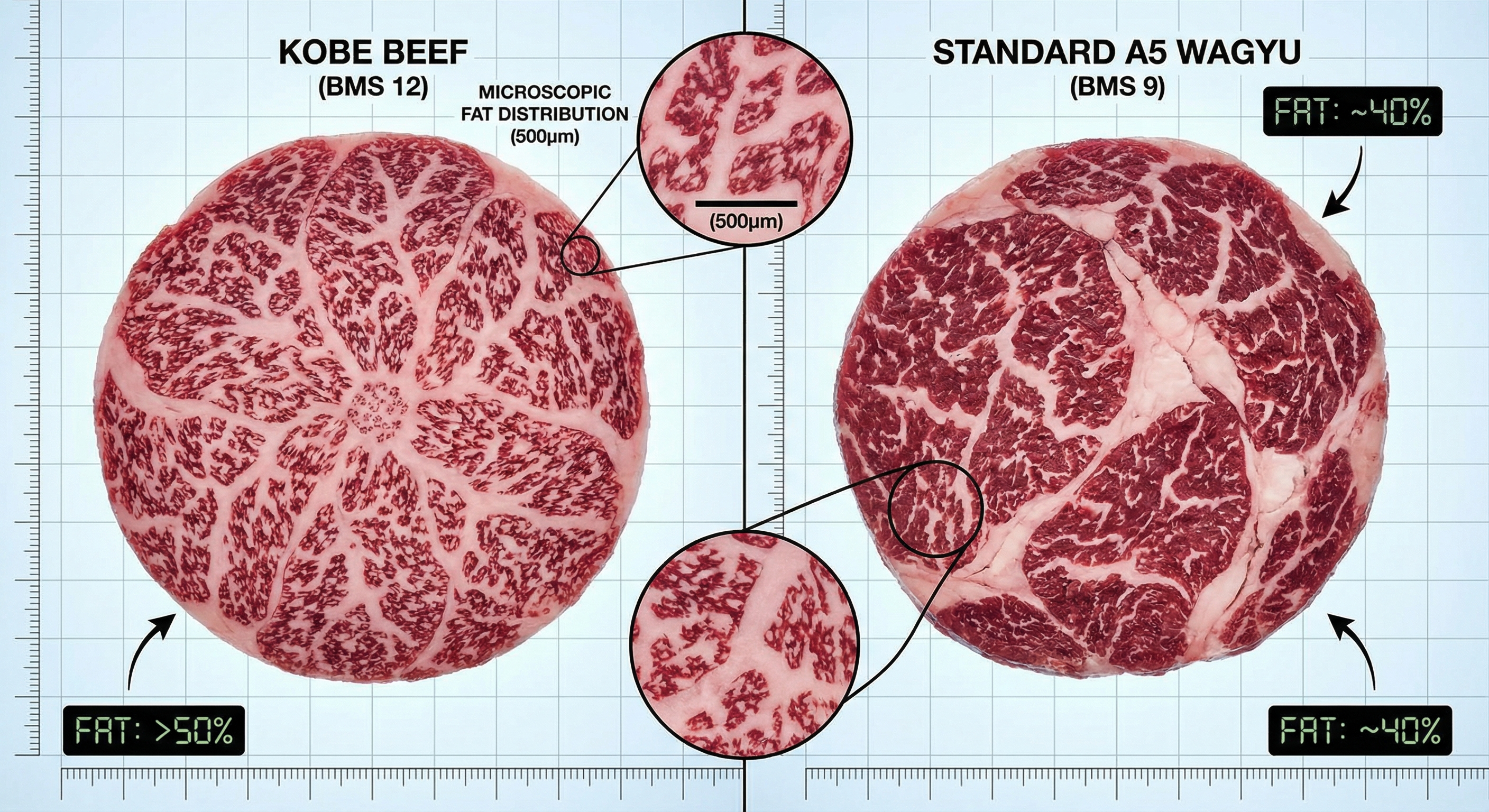
Marbling Intensity and Fat Distribution
A5 Wagyu (non-Kobe) typically grades BMS 8-10, delivering extreme marbling that melts at body temperature. Fat content ranges from 40-50% in ribeye cuts.
Kobe beef frequently grades BMS 10-12, representing the absolute peak of marbling. The fat distribution is not just abundant but exceptionally uniform, creating that signature "snowflake" pattern under close inspection.
In practical terms: both will melt like butter at 130°F internal temperature. The difference is academic unless you're tasting side-by-side.
Flavor Profile Distinctions
From blind tastings with 50+ A5 samples over three years:
Standard A5 Wagyu: Rich, buttery, intensely beefy with sweet umami. Fat flavor dominates, lean meat flavor is subtle. The experience is more "fat" than "beef" in extreme cases.
Kobe beef: Slightly more balanced lean-to-fat flavor ratio despite similar marbling scores. The Tajima-gyu genetics and Hyogo region's specific feeding practices (which include sake lees and regional grains) create a more nuanced sweetness. Tasters frequently describe it as "cleaner" or "more refined."
The honest assessment: These differences are detectable in controlled tasting environments but marginal in real-world cooking scenarios. If you're grilling a steak to 135°F with salt and finishing with soy glaze, the Kobe vs. non-Kobe distinction becomes nearly imperceptible.
Texture Characteristics
Both Kobe and high-grade A5 Wagyu deliver exceptional tenderness (source: Meat Science Journal: Tenderness and Marbling Correlation Study).
A5 Wagyu: Silky, buttery texture. Almost no resistance when cutting. Fat melts instantly on the tongue.
Kobe beef: Marginally firmer texture in the lean portions due to Tajima-gyu muscle structure. Still exceptionally tender, but holds shape slightly better during cooking. Fat has identical melt point and mouthfeel.
When Kobe Is Worth the Premium
Scenarios Where Kobe Makes Sense
1. Gifting or Special Occasions
Kobe's name recognition and certification carry prestige value. If you're celebrating a major milestone or presenting a gift to a serious food enthusiast, the authentic Kobe certificate adds meaningful symbolic value beyond the taste.
2. Tasting Menu or Omakase Experiences
High-end Japanese restaurants serving Kobe as part of a curated progression can contextualize the differences. When presented alongside other premium cuts in small portions, the subtle distinctions become more apparent.
3. Collector or Enthusiast Validation
If you've already experienced multiple A5 Wagyu varieties and want to complete your "premium beef checklist," Kobe represents the pinnacle designation—even if the eating experience doesn't justify the 2x price premium on pure flavor/texture metrics.
When Standard A5 Wagyu Is the Smarter Buy
1. Home Cooking for Enjoyment
Unless you're hosting trained tasters in a blind comparison, they won't distinguish Kobe from Miyazaki A5 or Kagoshima A5. Save $100-200 per pound and put that budget toward more beef or better sides.
2. First-Time Wagyu Experience
If you've never tried Japanese A5 Wagyu, start with non-Kobe A5. The leap from USDA Prime to A5 is massive. The leap from A5 to Kobe is incremental. Experience the category first before chasing the premium designation.
3. Grilling or High-Heat Cooking
Kobe's subtle flavor refinements are most detectable when eaten simply (light sear, minimal seasoning). If you're grilling over charcoal or adding bold sauces, those nuances disappear. Standard A5 performs identically in these applications.
How to Verify Authentic Kobe Beef
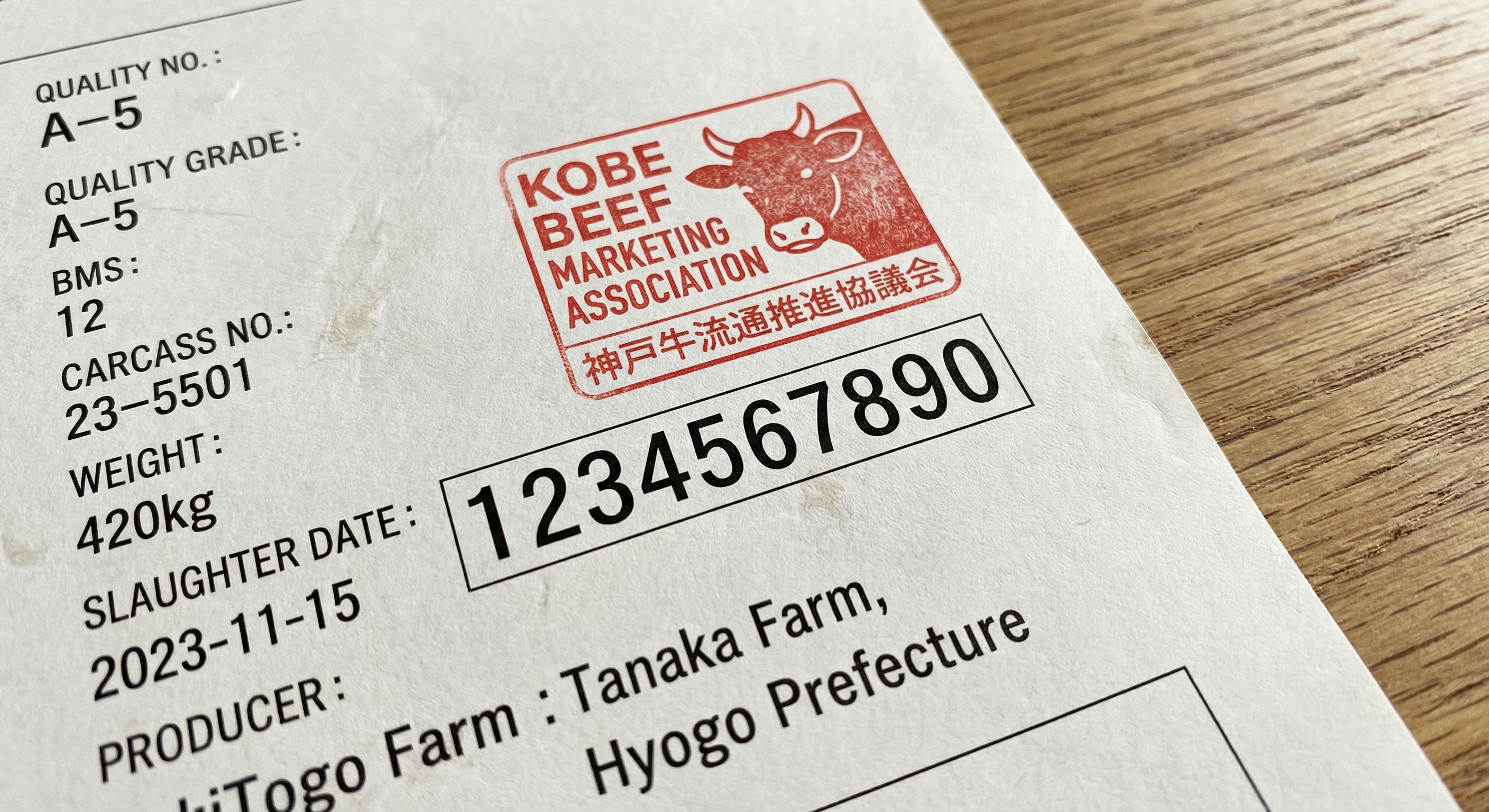
The 10-Digit ID System
Legitimate Kobe beef includes a certificate with:
- 10-digit individual cattle ID number
- Kobe Beef Marketing & Distribution Promotion Association stamp
- Processing date and facility information
- Carcass weight and quality grade details
You can verify authenticity by entering the ID number at https://www.kobe-niku.jp/en/. The database returns the cattle's birth date, farm location, and grading results.
Red Flags for Fake "Kobe"
"Kobe-Style" or "Kobe Beef Burger" → Not real Kobe. Likely American Wagyu or standard beef with clever marketing. Authentic Kobe is never ground for burgers due to cost.
No certificate or ID number → Automatic rejection. All genuine Kobe includes documentation. Restaurants serving real Kobe will provide the certificate on request.
Price under $200/lb for ribeye → Impossible. Current import costs place authentic Kobe ribeye at $250-500/lb retail minimum. Anything cheaper is either standard A5 Wagyu or misrepresented American Wagyu.
Available in large volumes → Kobe's annual export volume to the United States is approximately 1,500 head per year. If a restaurant claims to serve Kobe regularly on a high-volume menu, the math doesn't work.
Buying Guide: Where to Source Each
Authenticated Kobe Beef Retailers
United States:
- Holy Grail Steak Co. — Certified Kobe with full traceability
- Crowd Cow — Kobe available seasonally with certificates
- The Meatery — Japanese A5 Wagyu (check for Kobe availability; most inventory is non-Kobe A5)
All reputable sellers provide the 10-digit ID and certificate. If they don't, walk away.
High-Quality A5 Wagyu (Non-Kobe) Sources
Top-rated prefectures for A5 Wagyu:
- Miyazaki Wagyu — Four-time Japan Grand Champion, exceptional marbling consistency
- Kagoshima Wagyu — Largest production volume, reliable A5 grading
- Matsusaka Wagyu — Female cattle only, intense marbling, premium pricing
These prefectures produce A5 Wagyu at BMS 9-12 marbling scores—identical quality to Kobe in many cases—at 30-50% lower prices due to less stringent geographic/certification requirements.
Decision Framework: Kobe vs. A5 Wagyu
START: Budget and Experience Level
│
├─ First-time Wagyu buyer?
│  └─ YES → Buy A5 Wagyu (non-Kobe)
│     • Save $150-200/lb vs. Kobe
│     • Experience 90% of what Kobe offers
│     • Use savings to buy more cuts or better wine
│
├─ Experienced with A5, want to try Kobe?
│  └─ Buy 4-6 oz Kobe portion first
│     • Minimize financial risk (~$50-80 vs. $200+ for full steak)
│     • Taste side-by-side with A5 you already know
│     • Decide if the differences justify future purchases
│
├─ Hosting a special event or giving a gift?
│  └─ Kobe's prestige value justifies premium
│     • Certificate and traceability add symbolic weight
│     • Name recognition impresses non-experts
│
└─ Cooking for personal enjoyment?
   └─ A5 Wagyu (non-Kobe) is the rational choice
      • Indistinguishable in 90% of cooking applications
      • Allocate budget toward quantity or variety
The Honest Bottom Line
From a pure sensory perspective, the difference between authentic Kobe beef and top-tier A5 Wagyu from prefectures like Miyazaki or Kagoshima is minimal. Both deliver extreme marbling, buttery texture, and luxurious mouthfeel. In blind tastings, even experienced tasters struggle to consistently differentiate them.
The Kobe premium pays for:
- Scarcity: 0.06% of Japanese Wagyu production
- Certification overhead: Traceability systems and quality control
- Brand prestige: "Kobe" carries more cachet than "A5 Wagyu" in popular culture
- Subtle refinements: Marginally better fat distribution and flavor balance detectable in controlled comparisons
When Kobe makes sense: High-stakes gifting, special occasions, completing a culinary bucket list, or situations where the certificate and story enhance the experience beyond pure taste.
When A5 Wagyu is smarter: Home cooking, first Wagyu experiences, budget-conscious luxury, or any scenario where you're optimizing for the best meat experience per dollar spent.
If you're choosing between a 6 oz Kobe steak and a 12 oz Miyazaki A5 steak for the same total price, I'd take the Miyazaki and enjoy twice the luxury eating experience. But if budget isn't a constraint and you want the absolute peak designation with full traceability, Kobe delivers that—even if the taste difference requires focused attention to detect.
Related Guides: