Miyazaki Wagyu vs Kobe Beef: Which Japanese Premium Is Worth Your Money?
Miyazaki has won the Wagyu Olympics three times running. Kobe has the global name recognition. Both are A5 Japanese Black cattle — so what actually separates them, and which deserves your money?
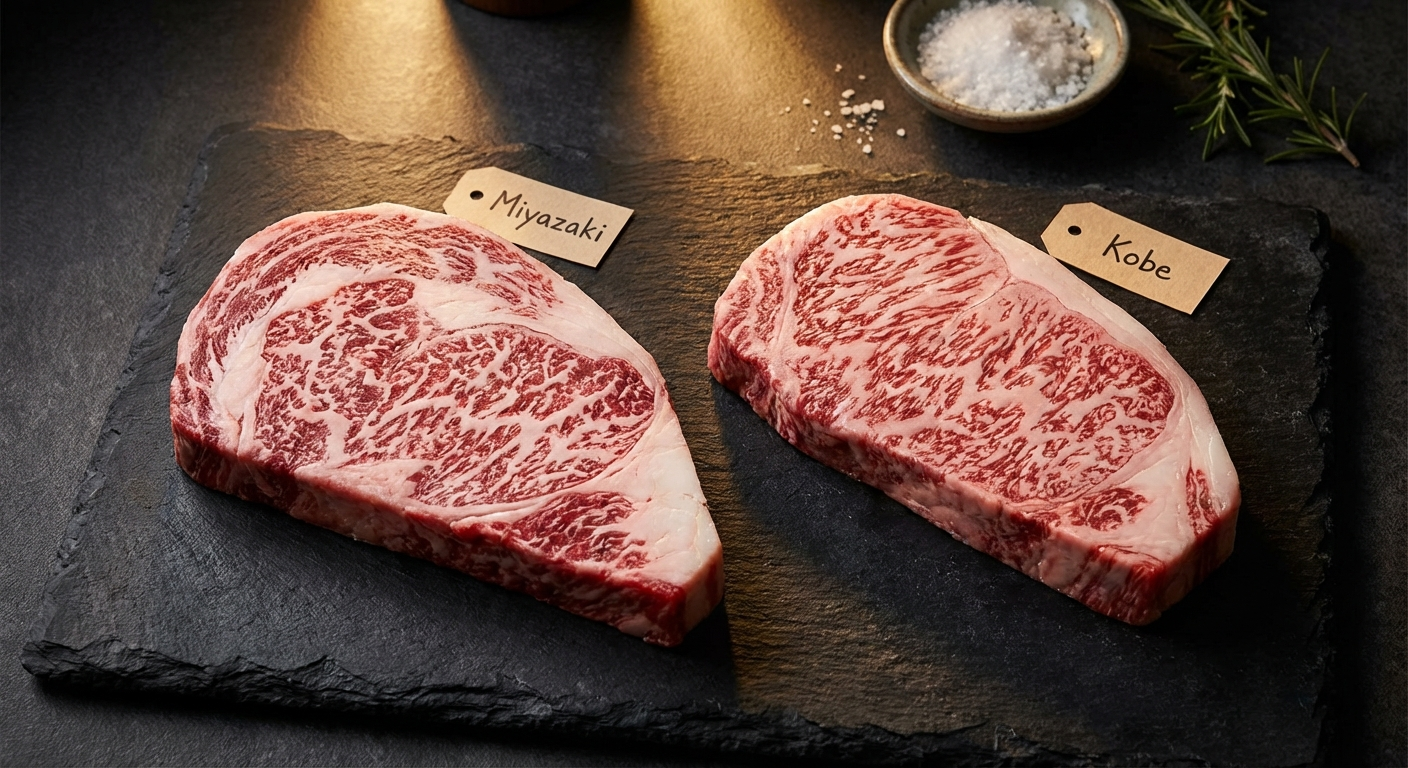
In the world of Japanese wagyu, two names dominate the conversation: Kobe and Miyazaki. Kobe has the global brand recognition — it is the wagyu most non-Japanese people have heard of, the name that appears (often fraudulently) on restaurant menus worldwide. Miyazaki has the competition results — three consecutive Prime Minister’s Awards at the Wagyu Olympics, the most prestigious cattle competition in Japan.
Both are A5-grade Japanese Black (Kuroge Washu) cattle. Both produce beef with extraordinary marbling. Both command premium prices. But they come from different prefectures with different climates, different breeding philosophies, and subtly different flavor profiles. This guide breaks down every meaningful difference so you can make an informed choice.
Origins and Geography
Kobe Beef: Hyogo Prefecture
Kobe beef comes exclusively from Tajima-gyu cattle — a specific strain of Japanese Black — raised in Hyogo Prefecture on the western end of Honshu. The city of Kobe is the prefectural capital, and its name has become synonymous with premium Japanese beef worldwide.
Hyogo Prefecture has a temperate maritime climate moderated by the Seto Inland Sea to the south and the Sea of Japan to the north. The mountainous terrain means most cattle are raised in small valley operations. Tajima-gyu cattle have been bred in this region for over a century, and the closed genetic pool is one of the most tightly controlled in Japan.
- Annual production: Approximately 3,000–5,000 head certified as Kobe beef
- Cattle strain: Tajima-gyu (a sub-strain of Japanese Black)
- Prefecture: Hyogo, western Honshu
- Certification body: Kobe Beef Marketing & Distribution Promotion Association
- Global recognition: The most internationally famous wagyu brand
Miyazaki Wagyu: Miyazaki Prefecture
Miyazaki wagyu comes from Japanese Black cattle raised in Miyazaki Prefecture on the southeastern coast of Kyushu, Japan’s southernmost main island. The warm, humid subtropical climate and lush pastureland create excellent conditions for cattle raising.
While Miyazaki lacks Kobe’s global name recognition, it has earned something arguably more meaningful in the wagyu world: dominance at the Zenkoku Wagyu Noryoku Kyoshinkai (National Wagyu Ability Exposition), commonly known as the “Wagyu Olympics.” This competition, held every five years, is the most rigorous and objective quality assessment of wagyu in Japan.
- Annual production: Approximately 250,000 head
- Cattle strain: Japanese Black (multiple bloodlines)
- Prefecture: Miyazaki, southeastern Kyushu
- Key achievement: Three consecutive Prime Minister’s Awards (2007, 2012, 2017)
- Growing international reputation: Increasingly recognized as Japan’s top-quality producer
Certification and Authenticity Requirements
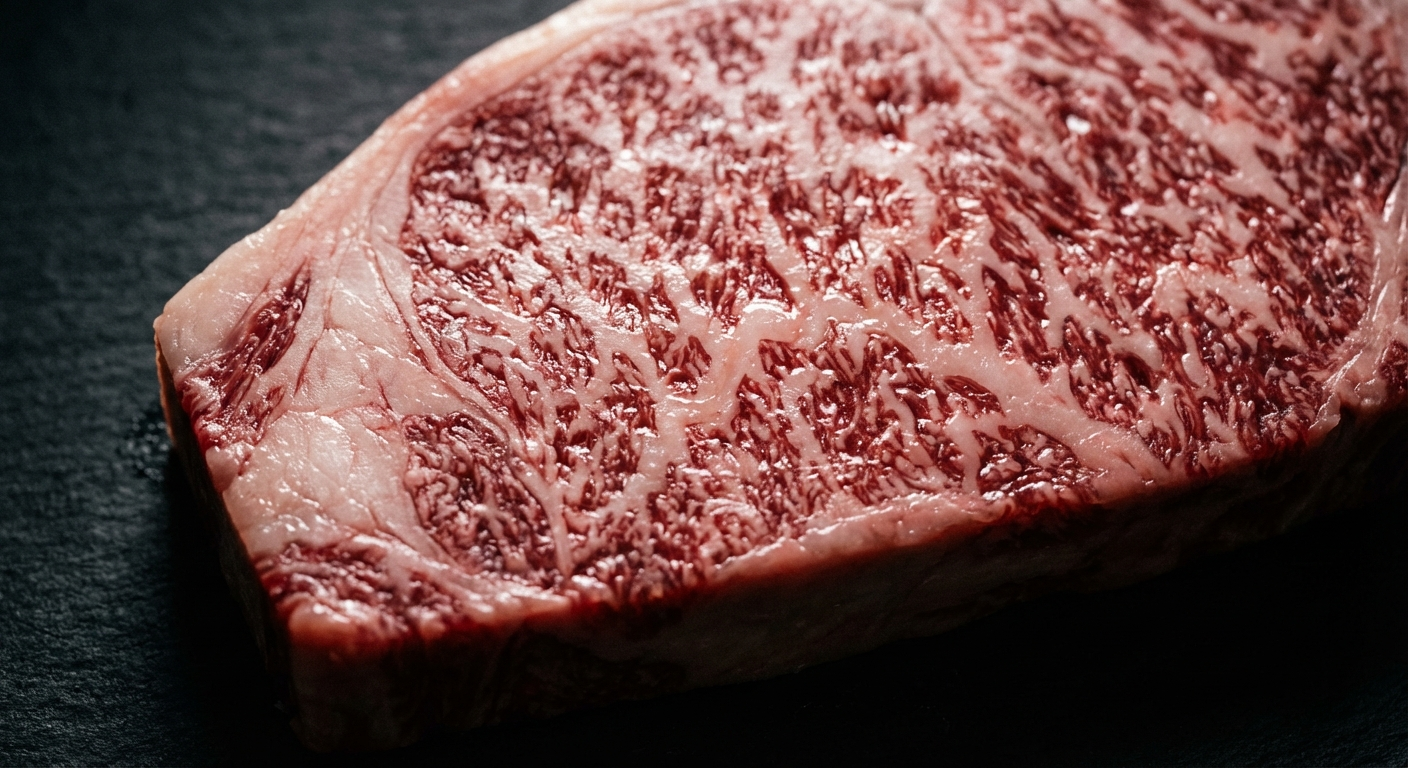
Both brands have strict certification requirements, but Kobe’s are notably more restrictive:
Kobe Beef Certification Requirements
- Must be Tajima-gyu cattle (specific Tajima bloodline within Japanese Black)
- Born AND raised in Hyogo Prefecture
- Processed at designated slaughterhouses within Hyogo Prefecture
- Yield grade A or B
- BMS score of 6 or higher (though most achieve 8+)
- Carcass weight of 499.9 kg or less
- Fine meat texture and excellent firmness
- Must be a steer (castrated male) or heifer (never-bred female)
Miyazaki Wagyu Certification Requirements
- Must be Japanese Black cattle
- Born AND raised in Miyazaki Prefecture
- Processed at approved facilities
- Quality grade 4 or higher (for “Miyazaki Beef” brand designation)
- For “Miyazaki Wagyu Olympics Champion Beef” designation, additional quality criteria apply
Key difference: Kobe’s certification is more restrictive on genetics (Tajima-gyu only vs any Japanese Black), carcass weight, and slaughter location. This extreme gatekeeping is partly why production numbers are so low — and prices so high.
Marbling and BMS Scores
Both prefectures consistently produce A5-grade beef, but the distribution of peak marbling scores tells an interesting story:
| BMS Score | Kobe Beef | Miyazaki Wagyu | Significance |
|---|
| BMS 6–7 | ~15% of certified | ~5% | Minimum Kobe threshold; rare in Miyazaki premium |
| BMS 8–9 | ~40% | ~30% | Solid A5 territory |
| BMS 10–11 | ~35% | ~45% | Premium A5 — Miyazaki excels here |
| BMS 12 | ~10% | ~20% | Peak marbling — Miyazaki leads significantly |
Miyazaki’s higher percentage at BMS 11–12 is not accidental. The prefecture has invested heavily in selective breeding programs targeting peak marbling, and the Wagyu Olympics results validate that investment. When you see those jaw-dropping images of beef that looks almost entirely white with thin pink veins, it is often Miyazaki.
Kobe beef achieves outstanding marbling, but the Tajima-gyu genetics and carcass weight restrictions mean fewer animals reach the absolute BMS extremes. This is not a flaw — Tajima-gyu cattle produce exceptionally fine-grained marbling that creates a different eating experience than sheer marbling volume.
Flavor Profile Comparison
This is where the comparison gets subjective, but after years of tasting both side by side, clear patterns emerge:
Kobe Beef Flavor
- Sweetness: Kobe’s fat has a notably sweet quality — almost fruity — that is its most distinctive trait
- Delicacy: The flavor is refined and gentle rather than bold. There is elegance in restraint.
- Clean finish: Kobe leaves a remarkably clean aftertaste despite the extreme fat content. No greasy coating.
- Fine-grained marbling: Tajima-gyu genetics produce an exceptionally fine marbling pattern that creates a silky, uniform mouthfeel rather than pockets of richness
- Subtlety: The flavor rewards slow, deliberate chewing. Rush through it and you miss the nuance.
Miyazaki Wagyu Flavor
- Deep umami: Miyazaki’s flavor is richer and more complex, with layers of savory depth that build on the palate
- Buttery intensity: The fat has a lower melting point, creating an almost liquid-silk sensation that coats the mouth
- Long finish: The flavors linger and evolve, revealing new notes — sometimes a slight nuttiness, sometimes a mineral quality
- Bold character: Compared to Kobe, Miyazaki is the louder voice in the room — still refined, but unmistakably assertive
- Peak marbling impact: At BMS 11–12, the sheer volume of intramuscular fat creates a texture closer to foie gras than conventional steak
The simplest way to frame it: Kobe is a whisper, Miyazaki is a declaration. Both are saying extraordinary things — the delivery is different.
Price Comparison
Price is where the Kobe premium really shows. These are typical US import prices for A5 cuts:
| Cut | Kobe (per lb) | Miyazaki (per lb) | Premium |
|---|
| Ribeye | $200–$350 | $140–$220 | Kobe +40–60% |
| Striploin | $180–$300 | $120–$190 | Kobe +50–60% |
| Tenderloin | $250–$400 | $160–$250 | Kobe +50–60% |
| Flat Iron | $120–$200 | $90–$140 | Kobe +30–45% |
| Chuck / Zabuton | $100–$180 | $70–$120 | Kobe +40–50% |
The consistent 30–60% Kobe premium is driven almost entirely by scarcity and brand recognition. At equivalent BMS scores, there is no quality justification for the price gap. Kobe beef is not 40% better than Miyazaki — it is 40% rarer and 40% more famous.
This makes Miyazaki one of the best value propositions in the ultra-premium Japanese wagyu space. You get competition-winning quality at prices significantly below the Kobe ceiling.
Availability in the US
If you are buying Japanese wagyu in the United States, Miyazaki is substantially easier to source:
- Miyazaki: Multiple USDA-approved importers carry Miyazaki A5. It is the most consistently available prefecture in the US market, with reliable supply of ribeye, strip, tenderloin, and secondary cuts. Retailers like The Meatery maintain regular Miyazaki inventory.
- Kobe: Extremely limited US availability. Only a handful of certified retailers and restaurants can legally sell authentic Kobe beef. Inventory is irregular — when it sells out, restocking can take weeks or months. The Kobe Beef Marketing Association maintains a list of authorized US distributors.
For most American wagyu enthusiasts, Miyazaki is the practical choice. You can actually buy it with reasonable consistency, try different cuts, and develop a real relationship with the product. Kobe is a bucket-list indulgence when the stars align on availability.
The Wagyu Olympics Factor
The Zenkoku Wagyu Noryoku Kyoshinkai (National Wagyu Ability Exposition) is held every five years and is the most rigorous cattle quality competition in Japan. Entries are judged on carcass quality, marbling, meat color, fat quality, and overall excellence. The Prime Minister’s Award is the highest individual honor.
Miyazaki’s record is unprecedented:
- 2007: Prime Minister’s Award (individual champion)
- 2012: Prime Minister’s Award (individual champion)
- 2017: Prime Minister’s Award (individual champion) + team championship
Three consecutive wins is a feat no other prefecture has achieved. It means that when Japan’s own experts evaluate their best cattle under controlled, objective conditions, Miyazaki consistently produces the top animal.
Hyogo Prefecture (Kobe) competes in these events but has not matched Miyazaki’s recent dominance. This does not mean Kobe beef is inferior — competition conditions favor peak individual specimens, not average herd quality — but it does challenge the assumption that Kobe is automatically Japan’s best.
Best Cooking Methods
For Kobe Beef
- Teppanyaki: The classic Kobe preparation. A hot flat-top sear develops crust while the delicate sweet fat caramelizes. The refined flavor shines with minimal seasoning — just flaky salt.
- Shabu-shabu: Thin slices swished through hot dashi for 3–5 seconds. Kobe’s clean flavor profile pairs beautifully with ponzu and sesame dipping sauces.
- Sukiyaki: The sweetness of the sukiyaki broth complements Kobe’s naturally sweet fat. A traditional pairing that has endured for good reason.
For Miyazaki Wagyu
- Yakiniku (charcoal grill): The smokiness of binchotan charcoal adds dimension to Miyazaki’s already complex umami. This is where the bold flavor truly sings.
- Tataki (seared sashimi): Sear the outside, leave the center completely raw. The low-melting-point fat dissolves on the tongue and the full flavor spectrum unfolds.
- Cast iron, screaming hot: Nothing but sea salt and the highest heat your pan can produce. Let Miyazaki’s intensity speak without interference.
Both should be served in small portions (3–4 ounces per person) and cooked no further than medium-rare. A5 wagyu does not benefit from longer cooking — you are rendering out the very marbling you paid premium prices for.
Which Should You Choose?
Choose Kobe beef when:
- It is a once-in-a-lifetime occasion and the name itself carries meaning for you
- You prefer delicate, sweet, refined flavors over bold intensity
- You appreciate the cultural heritage and exclusivity of the brand
- You are serving someone who would recognize and value the Kobe name
- Budget is not the primary concern
Choose Miyazaki wagyu when:
- You want competition-proven, peak-quality Japanese A5 at better value
- You prefer deep, complex umami and bold richness
- You want consistent availability and the ability to reorder reliably
- You are chasing the highest possible BMS scores (11–12)
- You believe results matter more than reputation
The Honest Verdict
Kobe beef earned its reputation legitimately — it was the first Japanese wagyu to gain international recognition, and the quality is genuinely outstanding. But the market has evolved. Miyazaki wagyu has been objectively outperforming Kobe at Japan’s own quality competitions for nearly two decades, at prices 30–60% lower, with significantly better availability.
If you are paying extra for Kobe, you are paying for the name and the scarcity — not for proven superiority. If you are buying Miyazaki, you are getting what Japan’s own experts have repeatedly judged to be the country’s finest beef.
Both are extraordinary. Both justify their price points at different levels. But if you ask which represents the better value for the quality delivered, Miyazaki wins — and it is not particularly close.
Explore authentic Miyazaki A5 wagyu and other premium Japanese beef at The Meatery’s Japanese A5 Wagyu Collection, where every cut comes with full traceability and certificate of authenticity.