Olive Wagyu vs Regular Wagyu: What Makes It Different and Is It Worth the Price?
Olive wagyu is the rarest beef in the world — produced by fewer than 2,000 cattle per year on a single Japanese island. But does feeding cattle dried olive pulp actually create a meaningfully different steak? Here is the honest comparison.
Olive wagyu occupies a unique position in the world of premium beef. It is not just another regional brand or marketing label — it is a fundamentally different approach to feeding wagyu cattle that produces measurable changes in fat composition. Whether those changes justify prices that can exceed $300 per pound depends on what you value in a steak.
This guide compares olive wagyu against standard Japanese A5 wagyu across every dimension that matters: production, fat chemistry, flavor, texture, price, and availability. No hype, just facts and honest tasting notes from someone who has sold both for years.
What Is Olive Wagyu?

Olive wagyu (sometimes marketed as “Sanuki Olive Wagyu” or “Olive Sanuki Beef”) comes exclusively from Japanese Black cattle raised on Shodoshima Island in Kagawa Prefecture, on the Seto Inland Sea. These cattle receive a diet supplemented with dried, toasted olive pulp — the byproduct of Shodoshima's olive oil production.
The concept was developed by cattle farmer Masaki Ishii, who spent years experimenting with olive feed beginning around 2006. The idea was born from two realities: Shodoshima produces the majority of Japan's domestic olive oil, and the pressing process leaves behind tons of olive pulp waste. Ishii discovered that roasting and drying this pulp, then mixing it into cattle feed, produced beef with measurably different fat composition.
Key facts about olive wagyu production:
- Location: Exclusively Shodoshima Island, Kagawa Prefecture
- Annual production: Approximately 1,500–2,000 head
- Feed supplement: Toasted dried olive pulp mixed into standard grain ration
- Breed: 100% Japanese Black (Kuroge Washu) — same as all premium Japanese wagyu
- Certification: Kagawa Prefecture Olive Beef Certification required
- Feeding period: Olive supplement fed during the final finishing months
The cattle are genetically identical to other Japanese Black wagyu. The only variable is the olive-supplemented diet. This makes olive wagyu one of the clearest natural experiments in how feed affects beef quality.
Fat Chemistry: The Oleic Acid Difference
The most important and scientifically verified difference between olive wagyu and regular wagyu is the fat composition. Specifically, olive wagyu has significantly higher oleic acid content.
Oleic acid is a monounsaturated omega-9 fatty acid — the same fat that makes olive oil heart-healthy and gives it that smooth, buttery mouthfeel. In beef, higher oleic acid means:
- Lower melting point — the fat literally begins to melt at a lower temperature
- Smoother texture — the fat feels silkier on the palate
- Sweeter flavor — oleic acid contributes to perceived sweetness
- Longer shelf stability — monounsaturated fats resist oxidation better than saturated fats
| Fat Metric | Olive Wagyu | Regular Japanese A5 | USDA Prime |
|---|
| Oleic acid content | 62–68% | 50–55% | 38–45% |
| Fat melting point | ~72°F (22°C) | ~77°F (25°C) | ~95°F (35°C) |
| Total monounsaturated fat | ~58% | ~50% | ~42% |
| Saturated fat ratio | ~35% | ~40% | ~48% |
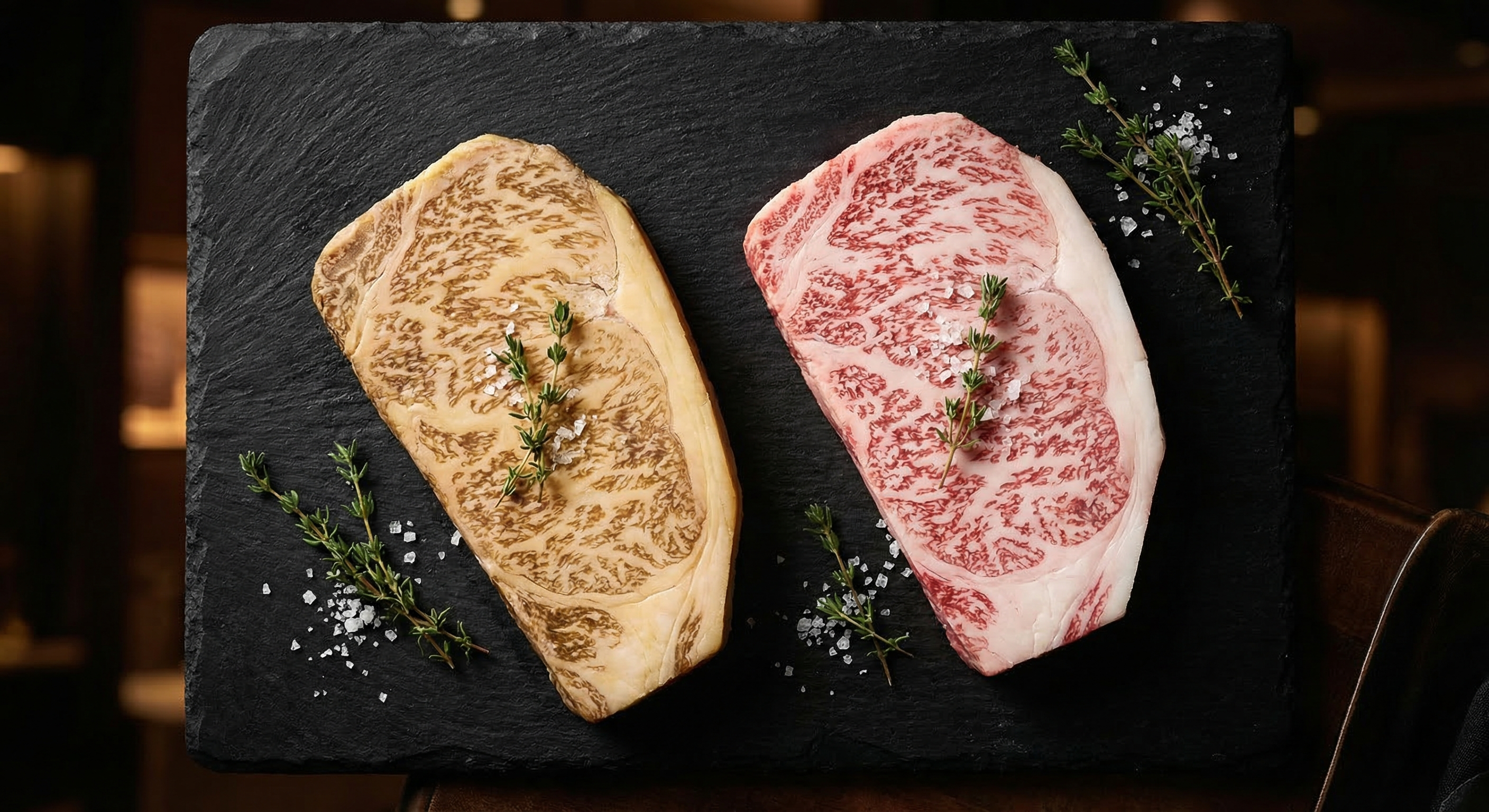
That 10–15 percentage point increase in oleic acid is not trivial. It shifts the fat profile closer to olive oil than to conventional beef tallow. At room temperature, olive wagyu fat is noticeably softer than regular A5 fat — you can literally see the difference when comparing two steaks side by side in a display case.
For context, regular Japanese A5 wagyu already has exceptional oleic acid levels compared to conventional beef. Olive wagyu takes an already premium fat profile and pushes it further in the same direction.
Marbling: BMS Scores Compared
Here is where expectations sometimes need correcting. Olive wagyu does not automatically score higher on the BMS (Beef Marbling Standard) scale than regular A5 wagyu. Both are graded by the same Japanese Meat Grading Association standards.
| Grade Metric | Olive Wagyu | Regular A5 Wagyu |
|---|
| BMS range (A5 grade) | 8–12 | 8–12 |
| Typical BMS | 9–11 | 9–11 |
| Visual marbling pattern | Fine, dense webbing | Fine, dense webbing |
| Fat color | Slightly more golden/ivory | White to cream |
The marbling quantity is essentially identical. Where olive wagyu differs is the quality of the fat within those marbling lines. The same BMS 10 score can feel different on the palate depending on fat composition. An olive wagyu BMS 10 will feel slightly more luxurious than a regular BMS 10 because the fat melts faster and coats the palate more smoothly.
One visual difference: olive wagyu fat sometimes has a subtly warmer, more ivory or golden tone compared to the pure white fat in regular A5. This is not always obvious, but trained eyes can spot it.
Flavor and Texture: The Tasting Comparison
This is what everyone wants to know. In side-by-side blind tastings, here is what consistently stands out:
Olive Wagyu Flavor Profile
- First bite: Immediate, intense melt. The fat liquefies almost on contact with your tongue.
- Mid-palate: Sweeter than regular A5, with a delicate, almost floral note. Some describe hints of toasted nuts.
- Finish: Clean and surprisingly quick. The fat dissipates cleanly without the lingering richness that can make regular A5 feel heavy.
- Texture: Exceptionally smooth — even by wagyu standards. The lower-melting-point fat creates what can only be described as a liquid silk sensation.
Regular A5 Wagyu Flavor Profile
- First bite: Rich, buttery melt. Still extraordinary, but the fat takes a beat longer to fully render on the palate.
- Mid-palate: Deep umami, classic beefy richness. The sweetness is present but less pronounced.
- Finish: Longer, more lingering. The richness stays with you — which is either luxurious or slightly heavy depending on your preference and portion size.
- Texture: Tender and buttery, with slightly more “presence” than olive wagyu. You are more aware of the fat as a separate element.
The Honest Assessment
The difference is real but subtle. In a blind tasting with two A5 ribeye steaks of similar BMS scores, most experienced tasters can identify the olive wagyu by its cleaner finish and slightly sweeter character. But it is not a transformative, night-and-day difference. It is more like comparing two exceptional wines from the same region — both outstanding, with nuanced distinctions that reward attention.
If you have never had Japanese A5 wagyu at all, the difference between olive wagyu and regular A5 will be nearly imperceptible because the entire A5 experience is so far removed from normal beef. The distinction becomes meaningful only once your palate is calibrated to A5 quality.
Price Comparison: The Scarcity Premium
Olive wagyu commands a significant premium over regular Japanese A5:
| Cut | Olive Wagyu (per lb) | Regular A5 (per lb) | Premium |
|---|
| Ribeye | $250–$400 | $120–$220 | +60–100% |
| Striploin | $200–$350 | $100–$180 | +70–100% |
| Tenderloin | $280–$450 | $150–$250 | +60–80% |
| Flat iron / Chuck | $150–$250 | $80–$130 | +80–100% |
The premium is driven almost entirely by scarcity, not by a proportional improvement in quality. With only ~1,800 head per year versus hundreds of thousands for regular A5, olive wagyu is a collector's item as much as a food product.
Value analysis: If you are purely optimizing for eating quality per dollar, regular Japanese A5 at BMS 10+ delivers 90–95% of the olive wagyu experience at 50–60% of the price. The olive wagyu premium pays for rarity, story, and those subtle but genuine fat quality differences.
Availability: Where to Find Authentic Olive Wagyu
Olive wagyu availability is extremely limited. In the US market, only a handful of importers carry authentic Kagawa Prefecture olive wagyu at any given time. Stock rotates unpredictably and sells out quickly.
Trusted US sources:
- The Meatery — imports verified Kagawa olive wagyu with full traceability documentation
- Crowd Cow — occasional olive wagyu drops, sell out rapidly
- Holy Grail Steak — premium Japanese imports including limited olive wagyu
Red flags for fake olive wagyu:
- Price below $180/lb for any steak cut
- No Kagawa Prefecture certification number
- Vague origin listed as “Japan” without specifying Kagawa/Shodoshima
- Available in unlimited quantities (real olive wagyu is perpetually scarce)
- Labeled “olive-fed wagyu” without official Sanuki Olive Beef certification
Cooking: Does Olive Wagyu Require Different Preparation?
The lower fat melting point in olive wagyu does affect optimal cooking approach, but the adjustments are minor:
For Olive Wagyu
- Temperature: Slightly lower searing heat than regular A5. The fat renders faster, so you risk over-rendering with extreme heat.
- Time: Even shorter cook times. The fat begins melting almost immediately, so 30–45 seconds per side on a hot surface is often sufficient.
- Portions: 2–3 oz maximum. The ultra-smooth fat means richness hits faster.
- Best methods: Light teppanyaki sear, tataki (seared sashimi), or raw preparations like carpaccio where the fat quality can shine.
For Regular A5 Wagyu
- Temperature: Standard high-heat sear on cast iron or teppan.
- Time: 45–60 seconds per side for thin-cut steaks.
- Portions: 3–4 oz is comfortable for most diners.
- Best methods: Teppanyaki, yakiniku (charcoal grill), shabu-shabu, sukiyaki — more versatile across preparation styles.
One notable advantage of olive wagyu in raw or barely-cooked preparations: the lower melting point means the fat literally dissolves on your tongue at body temperature. In sashimi-style service, olive wagyu fat disappears more completely than regular A5 fat, leaving an incredibly clean finish.
The Verdict: Who Should Buy Olive Wagyu?
Olive wagyu is for you if:
- You have already experienced regular A5 wagyu multiple times and want to explore the peak
- You value rarity and the story behind your food
- You appreciate subtle flavor distinctions and have a trained palate
- You are hosting a once-in-a-lifetime dining experience where no expense is spared
- You want the cleanest, smoothest fat quality available in any beef worldwide
Regular A5 wagyu is the better choice if:
- You are trying Japanese A5 for the first time — the olive difference will be lost on an uncalibrated palate
- You want the best eating quality per dollar spent
- You prefer deeper umami and more lingering richness over cleaner, sweeter notes
- You want reliable availability and consistent sourcing
- You are cooking for guests who may not appreciate the subtle distinction
The bottom line: Olive wagyu is the world's rarest beef for a reason — it is genuinely different, not just a marketing exercise. The elevated oleic acid content creates measurable and tasteable improvements in fat quality. But “different” and “better” are not the same thing. Regular Japanese A5 wagyu at BMS 10+ is already operating at the absolute frontier of beef quality. Olive wagyu pushes a few inches further in one specific direction — fat smoothness and sweetness — at double the price.
For most people, regular A5 is the move. For collectors, enthusiasts, and bucket-list chasers, olive wagyu is an experience worth having at least once.
Browse authenticated Japanese A5 and olive wagyu at The Meatery's Japanese A5 Wagyu Collection, with full certification and traceability on every cut.