Wagyu Brisket vs Regular Brisket: Is the Premium Worth It?
Wagyu brisket and regular brisket cook differently, taste differently, and cost differently. Here is a detailed comparison covering marbling, smoke behavior, texture, and whether the premium price makes sense for your cook.
Brisket is the proving ground of low-and-slow barbecue. It's the cut that separates weekend grillers from dedicated pitmasters — and the rise of wagyu brisket has added a new dimension to that challenge. But is wagyu brisket genuinely better than a well-sourced USDA Choice or Prime brisket, or is it marketing hype on a $200+ packer?
This comparison breaks down everything that actually matters: marbling differences, how each handles smoke and heat, what the finished product tastes like, and whether the price premium delivers proportional value. No vague claims — just data, experience, and honest assessments.
Understanding the Two Categories
Before diving into specifics, it's worth defining exactly what we're comparing. "Regular brisket" typically means USDA Select, Choice, or Prime graded from conventional beef cattle — primarily Angus or Angus-cross breeds. "Wagyu brisket" refers to brisket from cattle with wagyu genetics, which in the American market usually means crossbred animals (50-75% wagyu blood) or, rarely, fullblood wagyu.
The critical distinction is genetics. Wagyu cattle deposit intramuscular fat at rates conventional breeds simply cannot match. In a brisket — a naturally tough cut from the chest that relies on collagen breakdown and fat rendering to become tender — that extra marbling changes the entire cooking equation.
USDA Grading Context
Most wagyu briskets grade well above USDA Prime. Where Prime briskets sit at roughly BMS 5-6 on the Japanese marbling scale, American wagyu briskets typically hit BMS 6-9. A USDA Choice brisket — the workhorse of competition barbecue — sits at BMS 3-4. That gap matters enormously for a 12-16 hour cook.
Marbling and Fat Distribution
This is where the two products diverge most dramatically.
Regular Brisket (Choice/Prime)
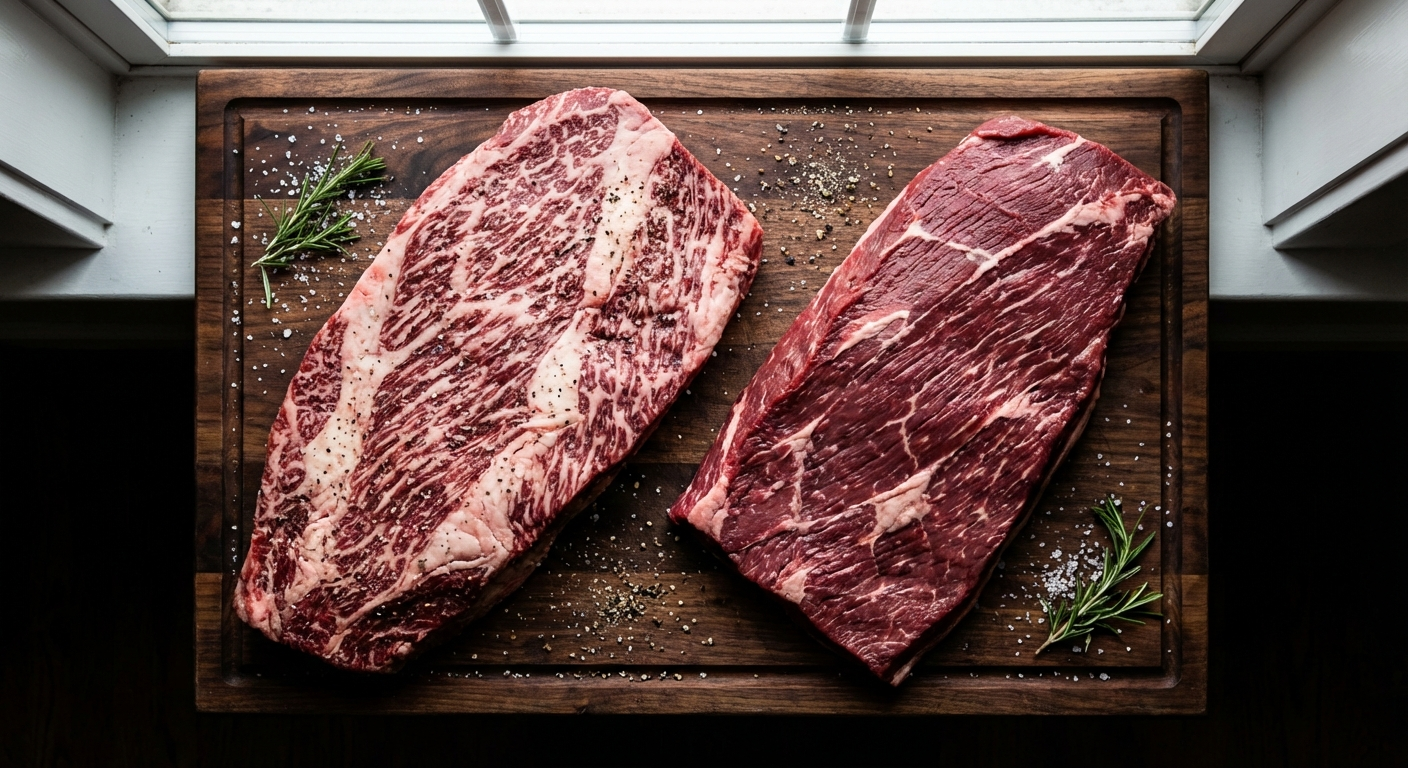
A good USDA Choice brisket has moderate marbling concentrated unevenly through the flat and point. The flat — the leaner half — often shows minimal intramuscular fat, while the point section carries more marbling and a thick fat seam between the two muscles. USDA Prime briskets show noticeably more consistent marbling across both sections, but the flat still tends to be the weak link.
Key characteristics:
- Intramuscular fat: 5-12% depending on grade and section
- Fat distribution: Uneven — point is significantly fattier than flat
- Fat cap: Thick external fat cap (1/4" to 1" typical)
- Intermuscular seam: Prominent fat layer between flat and point
Wagyu Brisket
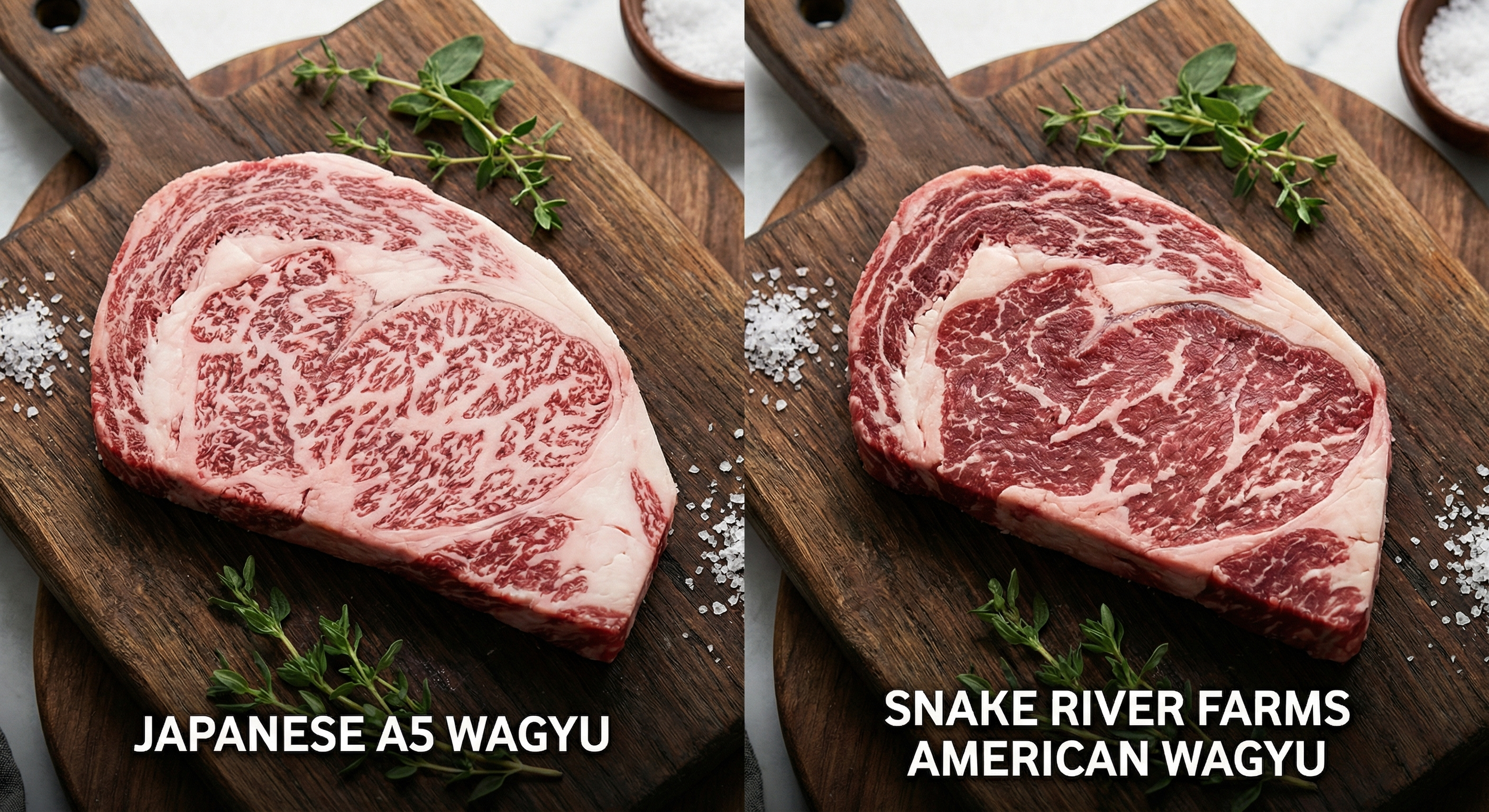
The first thing you notice unwrapping a wagyu brisket is the marbling in the flat. Where a Choice flat looks deep red with occasional fat streaks, a wagyu flat shows dense, web-like intramuscular fat throughout. The point section is even more dramatic — nearly as marbled as a wagyu ribeye in some specimens.
Key characteristics:
- Intramuscular fat: 15-30%+ depending on bloodline and grading
- Fat distribution: Significantly more uniform across flat and point
- Fat cap: Often thinner than conventional briskets
- Fat quality: Lower melting point, more oleic acid (renders more easily)
Why This Matters for Brisket
Brisket is a collagen-heavy cut that requires sustained heat (typically 225-275°F) over many hours to convert tough connective tissue into gelatin. During this process, intramuscular fat renders and bastes the meat from within. More marbling means more internal basting, which means a wider margin of error. A wagyu brisket flat is far more forgiving than a Choice flat precisely because there's more fat protecting the lean muscle fibers from drying out.
Cooking Differences: What Changes in Practice
If you cook wagyu brisket exactly like regular brisket, you'll get a good result — but you'll miss the opportunity to optimize for the cut's unique properties.
Temperature and Time
| Factor | Regular Brisket (Choice) | Regular Brisket (Prime) | Wagyu Brisket |
|---|
| Cook temp range | 225-250°F | 225-275°F | 250-285°F |
| Cook time (14lb packer) | 14-18 hours | 12-16 hours | 10-14 hours |
| Stall duration | 2-4 hours | 2-3 hours | 1-2 hours (often shorter) |
| Target internal temp | 200-205°F | 200-205°F | 195-203°F |
| Rest time | 1-4 hours | 1-4 hours | 2-6 hours (benefits from longer rest) |
Wagyu brisket cooks faster because the higher fat content conducts heat more efficiently through the meat. The stall — that plateau around 150-170°F where evaporative cooling slows the cook — is typically shorter and less dramatic with wagyu because the fat renders more readily at lower temperatures.
The Wrap Decision
Many pitmasters wrap brisket in butcher paper or foil during the stall (the "Texas crutch"). With regular brisket, wrapping is often essential to push through the stall and prevent the flat from drying out. With wagyu brisket, wrapping is more optional. The extra marbling provides enough internal moisture that many experienced cooks run wagyu briskets unwrapped for the entire cook, relying on the fat to protect the meat.
If you do wrap wagyu brisket, use butcher paper over foil. Foil traps too much moisture and can make the already-rich wagyu brisket feel greasy. Butcher paper lets some moisture escape while still accelerating the cook.
Trimming Approach
Counterintuitively, wagyu brisket often needs less trimming than regular brisket. The external fat cap on wagyu briskets tends to be thinner and renders more completely during the cook. With regular brisket, you typically trim the fat cap to about 1/4 inch to ensure even rendering. With wagyu, you can leave more of the cap intact because the lower-melting-point fat breaks down more thoroughly.
Flavor and Texture: The Eating Experience
This is where subjective preference meets measurable differences.
Regular Brisket
A well-cooked USDA Choice brisket delivers classic barbecue flavor: deep beef taste amplified by smoke, bark, and rendered fat. The point is rich and succulent. The flat, when cooked correctly, is tender with a clean beef flavor and a satisfying pull-apart texture. At its best, a Prime brisket hits the sweet spot of beefiness, smoke integration, and moisture.
The honest reality: the flat on a Choice brisket can be dry. Even experienced pitmasters battle flat moisture. It's the most common failure point in brisket cooking, and no amount of technique fully compensates for a flat with BMS 2-3 marbling.
Wagyu Brisket
Wagyu brisket delivers a distinctly different eating experience. The texture is noticeably more tender — almost buttery in the point, silky-smooth in the flat. The beef flavor is richer, with a natural sweetness from the higher oleic acid content. Smoke absorption is slightly different too; the fat carries smoke compounds differently, creating a more integrated smoke flavor rather than the bark-forward profile of leaner briskets.
The flat on a wagyu brisket is revelatory. Where a Choice flat is the consolation prize after you've eaten the point, a wagyu flat stands on its own as a premium cut. Slices from the flat are juicy, tender, and rich in a way that Choice flats simply cannot achieve.
One important note: wagyu brisket can feel excessively rich to some palates. If you're accustomed to the leaner, more straightforward beefy profile of a traditional brisket, the first few bites of wagyu brisket are incredible but the richness can become fatiguing over a full meal. This is subjective but worth noting.
Price Comparison: The Real Math
This is where most people make their decision.
| Product | Price per Pound (2026) | Typical Packer Weight | Total Cost |
|---|
| USDA Select Brisket | $3-5 | 12-16 lbs | $36-80 |
| USDA Choice Brisket | $5-8 | 12-16 lbs | $60-128 |
| USDA Prime Brisket | $8-14 | 12-16 lbs | $96-224 |
| American Wagyu Brisket | $14-22 | 14-18 lbs | $196-396 |
| Fullblood Wagyu Brisket | $25-40+ | 10-14 lbs | $250-560+ |
The price gap is significant. An American wagyu packer brisket costs roughly 2-3 times what a Prime brisket costs, and 3-5 times what a Choice brisket costs. For a single cook feeding 8-12 people, you're looking at roughly $80-120 for Choice vs $250-350 for wagyu.
Cost Per Serving Analysis
When you factor in yield (wagyu briskets lose less moisture during cooking due to fat retention), the per-serving cost gap narrows slightly. A 15-pound wagyu brisket might yield 9-10 pounds of sliced meat, while a 15-pound Choice brisket might yield 7-8 pounds. Still, wagyu costs substantially more per serving — roughly $25-35 per person vs $10-15 for Choice.
When Wagyu Brisket Makes Sense
Not every cook calls for wagyu brisket. Here's an honest assessment of when the premium is justified:
Worth the Premium
- Special occasions: Anniversary dinners, milestone celebrations, competition cooks where you want the best possible outcome
- Small gatherings (4-8 people): The per-person cost is manageable and each guest gets a memorable experience
- Flat-focused serving: If you primarily serve sliced flat, wagyu transforms the weakest part of conventional brisket into a standout
- Experienced cooks: You'll appreciate and optimize for the differences. Less experienced cooks may not get the extra value from the premium product
- Competition barbecue: When turn-in boxes need perfect slices, wagyu brisket delivers consistently superior flat slices with visible marbling
Stick with Choice/Prime
- Large parties (15+ guests): The cost math doesn't work. Two Prime packers deliver more food for less money
- Chopped/burnt ends: If you're making chopped brisket sandwiches or burnt ends, the subtle texture differences of wagyu are lost in the preparation
- First-time brisket cooks: Learn on Choice. You need to understand the fundamentals before the premium product adds value
- Budget-conscious cooks: A well-cooked Choice brisket is genuinely excellent. It's the standard for a reason
Sourcing Tips for Both
Wherever you land on the wagyu vs regular question, sourcing quality matters more than the label.
For Regular Brisket
- Grade matters: USDA Prime is worth the upgrade from Choice if your budget allows. The marbling difference in the flat is noticeable
- Source: Costco, Restaurant Depot, and local butchers for Prime. Grocery stores for Choice
- Weight: Look for 14-16 pound packers with a thick, uniform flat. Avoid anything under 12 pounds — the flat will be too thin
- Feel test: A good brisket should bend easily when held from the middle. Stiff briskets tend to be leaner
For Wagyu Brisket
- Bloodline percentage: Ask about wagyu genetics. 50% crossbred ("F1") is the minimum. F2 (75%) and higher show significantly more marbling
- Reputable suppliers: Snake River Farms, Crowd Cow, and specialty butchers with documented wagyu programs
- Grading documentation: Legitimate wagyu briskets come with BMS or equivalent marbling scores. If the seller can't tell you the marbling grade, be skeptical
- Avoid "wagyu-style": This label is meaningless. True wagyu brisket comes from animals with documented wagyu genetics
The Bottom Line
Wagyu brisket is a genuinely superior product in measurable ways: more marbling, more forgiving cook, better flat, richer flavor. It is not a gimmick or marketing play — the differences are real and significant, especially in the flat section where conventional brisket struggles most.
But "superior" doesn't always mean "worth it." A skilled pitmaster with a well-sourced USDA Prime brisket produces outstanding barbecue. The gap between a perfect Prime brisket and a perfect wagyu brisket is much smaller than the gap between a poorly cooked wagyu brisket and a well-cooked Prime brisket. Technique still matters more than genetics.
If you've never tried wagyu brisket, it's worth experiencing at least once. If nothing else, it will permanently change how you think about what brisket can be. Whether you make it your standard or save it for special occasions depends on your budget, your audience, and how much that elevated flat means to you.