Wagyu Chuck vs Wagyu Ribeye: When the Budget Cut Wins
Wagyu chuck costs 40-50% less than ribeye. Here's when the budget cut delivers comparable flavor and when you should splurge on the premium option.
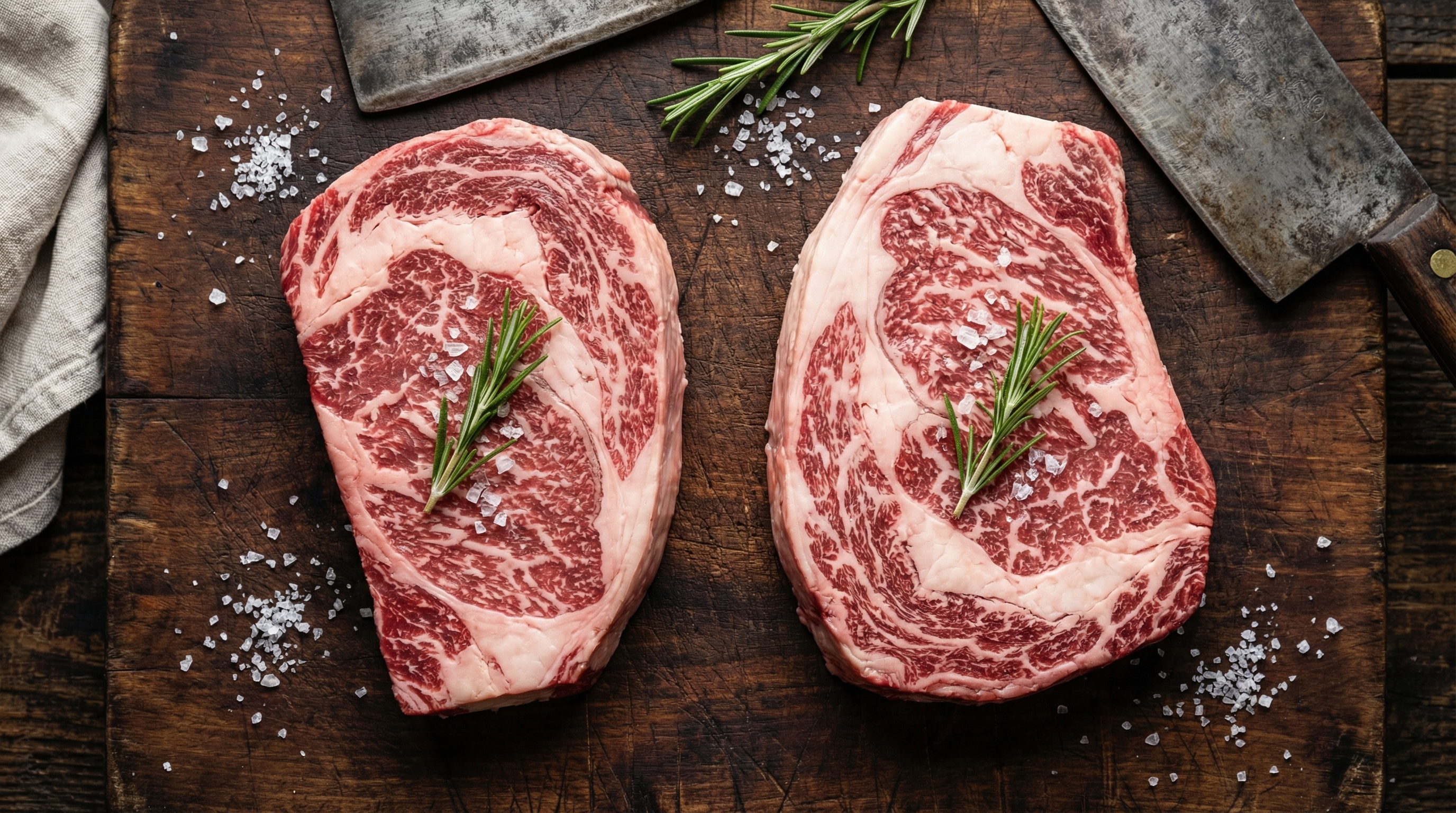
Wagyu ribeye is the gold standard for marbled steak. But wagyu chuck — especially the chuck eye — offers remarkably similar marbling and flavor at roughly half the price. The question isn't whether chuck can compete with ribeye (it can), but when the cheaper cut delivers comparable value and when the premium is worth paying.
If you're buying American wagyu, chuck typically runs $14–$18/lb while ribeye costs $28–$35/lb. For A5 Japanese wagyu, chuck starts around $30/oz vs $50–$80/oz for ribeye. That's a significant price gap for cuts that come from adjacent primal sections and share similar intramuscular marbling.
The Core Difference: Location and Movement
Both cuts come from the front end of the steer, but they're separated by just a few ribs:
- Wagyu ribeye comes from ribs 6–12, the classic rib primal. This area bears minimal weight and moves little, resulting in exceptional tenderness and even marbling throughout the muscle.
- Wagyu chuck (specifically chuck eye and chuck roll) comes from ribs 1–5, the shoulder region. This area supports more weight and movement, creating slightly more connective tissue but often comparable marbling in well-bred wagyu cattle.
In conventional beef, this anatomical difference creates a dramatic quality gap — chuck requires slow cooking while ribeye is steak royalty. In wagyu, the genetic predisposition to extreme intramuscular fat distribution narrows that gap considerably. A well-marbled American wagyu chuck eye can rival a USDA Prime ribeye in visual appearance.
Marbling Comparison: Closer Than You Think
Here's where wagyu genetics shine.
American Wagyu
- Ribeye: Typically BMS 6–9, with abundant fine intramuscular marbling throughout. The spinalis (ribeye cap) often reaches BMS 10+ levels.
- Chuck eye: Often BMS 5–8, with marbling concentrated in the longissimus muscle (the "eye"). Less marbling in surrounding muscles, but the prime eating portion rivals ribeye.
The chuck eye is sometimes called the "poor man's ribeye" because it's cut from the continuation of the same muscle group, just forward of rib 6. In a well-marbled wagyu carcass, the visual difference between chuck eye and ribeye can be negligible.
A5 Japanese Wagyu
- Ribeye: BMS 10–12, with extraordinary even marbling creating the signature snowflake pattern.
- Chuck: BMS 8–10, with excellent marbling but slightly less uniform distribution. Still far exceeds any conventional beef cut.
At the A5 level, even "inferior" cuts demonstrate marbling that would be considered world-class in any other beef context. The price gap reflects scarcity and demand more than drastic quality differences.
Tenderness: The Real Trade-Off
This is where chuck can't fully match ribeye.
Ribeye Advantages
- Inherent tenderness: The longissimus dorsi muscle does minimal work, creating naturally tender meat even before factoring in marbling.
- Minimal connective tissue: Very little silverskin or intramuscular collagen. What you see is what you eat.
- Multiple textures: The combination of the eye, spinalis cap, and intramuscular fat creates a complex textural experience in each bite.
Chuck Characteristics
- Slightly firmer: More connective tissue throughout, requiring either slow cooking or higher-heat searing with slightly longer resting.
- Variable texture: Chuck roasts and shoulder steaks contain multiple muscle groups with different grain directions. Chuck eye is more uniform but still slightly chewier than ribeye.
- Responds well to heat: The extra connective tissue breaks down beautifully when cooked properly, creating a rich, gelatinous mouthfeel that complements wagyu fat.
Bottom line: Ribeye is more tender bite-for-bite. But in wagyu specifically, the extreme marbling in chuck compensates significantly. A BMS 7 wagyu chuck eye will be more tender than a USDA Choice ribeye.
Flavor Profile: Different but Not Lesser
Ribeye is prized for its rich, beefy flavor enhanced by abundant marbling. Chuck offers a slightly different but equally compelling flavor experience.
Ribeye Flavor
- Rich and buttery: The high fat-to-meat ratio creates a luxurious, almost decadent flavor.
- Balanced umami: The spinalis cap (ribeye cap) is often considered the most flavorful part of the entire steer.
- Clean finish: High-quality wagyu fat has a low melting point and doesn't coat the palate — it enhances without overwhelming.
Chuck Flavor
- Deeper beef flavor: The working muscle develops more myoglobin and creates a more pronounced, earthy beef taste.
- Slightly gamier: Not in a negative way — more complex, less one-dimensional than ribeye's pure richness.
- Fat interplay: The combination of intramuscular wagyu fat and broken-down connective tissue creates a savory, almost braised quality even when grilled.
If ribeye is a butter-poached filet, chuck is a perfectly seared bistro steak. Neither is objectively better — they're different flavor experiences that appeal to different preferences.
Cooking Methods: When Each Cut Shines
This is where strategic buying makes the biggest difference.
Best Uses for Wagyu Ribeye
- Simple high-heat searing: Salt, pepper, cast iron, 2 minutes per side. The cut is so naturally tender and well-marbled that technique barely matters.
- Reverse sear: Low oven (200–225°F) to 115°F internal, then sear. Maximizes the Maillard crust while keeping the interior perfectly medium-rare.
- Shabu-shabu or hot pot: Thinly sliced A5 ribeye cooked briefly in simmering broth is a traditional Japanese preparation.
- Raw applications: Carpaccio, tartare, or sashimi-style — the tenderness supports minimal cooking.
Best Uses for Wagyu Chuck
- Sous vide + sear: 137°F for 2–3 hours breaks down connective tissue while preserving moisture. Finish with a hard sear.
- Hot and fast grilling: Chuck eye steaks respond well to 500°F+ direct heat. The exterior caramelizes while the interior stays juicy.
- Braising: Chuck roast braised low and slow (275°F, 3–4 hours) turns into fork-tender, impossibly rich pot roast. The wagyu genetics make this a luxury comfort food.
- Smoking: Chuck eye can be smoked like a ribeye (225°F to 125°F internal) — the smoke complements the deeper beef flavor.
Key insight: Ribeye forgives bad technique. Chuck rewards good technique. If you're confident in your cooking skills, chuck offers more upside per dollar spent.
Price vs Value: The Math That Matters
Let's break down the real-world cost difference.
American Wagyu (BMS 6–8)
| Cut | Price/lb | 16 oz Steak Cost | Typical Marbling |
|---|---|---|---|
| Ribeye | $28–$35 | $28–$35 | BMS 6–9 |
| Chuck Eye | $14–$18 | $14–$18 | BMS 5–7 |
| Chuck Roast | $10–$14 | $10–$14 (per lb) | BMS 4–6 |
A5 Japanese Wagyu
| Cut | Price/oz | 6 oz Portion Cost | Typical BMS |
|---|---|---|---|
| Ribeye | $50–$80 | $300–$480 | BMS 10–12 |
| Chuck | $30–$45 | $180–$270 | BMS 8–10 |
Value proposition: If you're buying American wagyu for regular consumption, chuck cuts deliver 70–80% of the ribeye experience at 50% of the cost. If you're splurging on A5 for a special occasion, the ribeye premium makes more sense — you're already spending $300+, might as well get the absolute best.
When to Choose Wagyu Chuck
Chuck is the smart buy when:
- You're cooking for a group: Serving 6+ people? Chuck roast or multiple chuck eye steaks cost significantly less than ribeyes while still delivering a premium wagyu experience.
- You have time and technique: Sous vide, reverse sear, or braising chuck unlocks value that quick-searing ribeye doesn't require.
- You prefer deeper beef flavor: Some steak enthusiasts find ribeye too rich and buttery — chuck offers more savory complexity.
- You're new to wagyu: Starting with chuck lets you experience marbled beef at a lower entry price. If you love it, upgrade to ribeye next time.
- You're making ground wagyu: Grinding chuck for burgers, meatballs, or Bolognese captures all the fat benefits without requiring tenderness. Far more economical than grinding ribeye.
When to Choose Wagyu Ribeye
Ribeye is worth the premium when:
- You want zero-effort luxury: Season, sear, eat. Ribeye requires minimal skill to achieve restaurant-quality results.
- You're serving non-experts: Guests unfamiliar with wagyu will appreciate the universally recognized ribeye cut and its consistent tenderness.
- You're buying A5 Japanese: At that price point, the difference between chuck and ribeye is marginal percentage-wise. Get the best.
- You're eating it raw or barely cooked: Carpaccio, tartare, or blue-rare preparations demand the inherent tenderness only ribeye (or tenderloin) can provide.
- It's a special occasion: Anniversaries, celebrations, or milestone meals justify the best. Ribeye is the iconic choice.
Availability: Why Chuck Eye Is Harder to Find
Here's a dirty secret of butchery: there are only two chuck eye steaks per cow.
The chuck eye is specifically the continuation of the ribeye muscle forward of the 5th rib. Once you move further into the chuck, you're dealing with chuck roast, flat iron, or denver steaks — different muscles with different characteristics.
Ribeye, by contrast, spans ribs 6–12, yielding 10–14 steaks depending on thickness. This scarcity makes chuck eye a "butcher's secret" — many retailers simply cut the entire chuck into roasts rather than trying to isolate and sell two premium steaks.
Pro tip: If you have a relationship with a butcher or buy directly from a wagyu ranch, ask specifically for chuck eye steaks. They may not be advertised, but they're often available at request.
The Verdict: Budget vs Premium
Wagyu chuck isn't a compromise — it's a strategic choice.
If you're eating wagyu weekly or feeding a family, chuck delivers exceptional value. The slight reduction in tenderness is easily offset by proper cooking technique, and the deeper flavor profile can actually be preferable for everyday steaks.
If you're buying wagyu once a year or celebrating something special, ribeye is the iconic experience. The effortless tenderness and universally appealing flavor justify the premium.
For regular wagyu consumers: Buy chuck 70% of the time, ribeye 30%.
For occasional splurges: Buy ribeye 90% of the time, experiment with chuck 10%.
For budget-conscious newcomers: Start with chuck. Upgrade to ribeye if you want more.
Frequently Asked Questions
Is wagyu chuck eye the same as ribeye?
No, but they're closely related. Chuck eye comes from the 5th rib (shoulder), while ribeye comes from ribs 6–12. The chuck eye is the continuation of the same muscle (longissimus dorsi) that forms the ribeye, which is why it has similar marbling and flavor. However, chuck eye has slightly more connective tissue and is marginally less tender. In high-quality American wagyu, the difference is minimal — chuck eye delivers 80–90% of the ribeye experience at roughly half the price.
Can you cook wagyu chuck like ribeye?
Yes, with slight modifications. Wagyu chuck eye responds well to the same high-heat searing techniques used for ribeye — season generously, sear 2–3 minutes per side in a screaming-hot cast iron pan, rest 5–10 minutes. The main difference is that chuck benefits from slightly longer resting times to allow connective tissue to relax. For chuck roast (not chuck eye steaks), sous vide or slow braising produces better results than quick searing.
Why is wagyu chuck so much cheaper than ribeye?
Three reasons: (1) Chuck comes from a working muscle (shoulder) that's slightly tougher than ribeye, which comes from a non-weight-bearing rib section. (2) Ribeye is universally recognized as a premium cut, creating higher demand and thus higher prices. (3) Chuck eye steaks are scarce (only 2 per cow), so most chuck gets sold as roasts at lower per-pound prices. The quality gap is smaller than the price gap suggests, especially in well-marbled wagyu.
What's the best way to cook wagyu chuck roast?
Low and slow. Sear the roast on all sides in a Dutch oven, then braise at 275°F for 3–4 hours in beef stock, red wine, aromatics (onion, garlic, thyme), and a splash of soy sauce. The wagyu genetics create exceptional marbling even in the shoulder, so the result is fork-tender, richly marbled pot roast that rivals short rib in texture. Alternatively, smoke it at 225°F to an internal temp of 203°F for a wagyu-style brisket experience.
Is American wagyu chuck better than USDA Prime ribeye?
Depends on what you value. American wagyu chuck (BMS 5–7) will have significantly more marbling than USDA Prime ribeye (which maxes out around BMS 4–5). The wagyu chuck will deliver richer flavor and a more luxurious mouthfeel. However, USDA Prime ribeye will be slightly more tender due to the inherent tenderness of the ribeye cut itself. For most steak enthusiasts, the marbling advantage of wagyu chuck outweighs the slight tenderness edge of Prime ribeye — especially at similar price points.
Where can I buy wagyu chuck eye steaks?
Chuck eye steaks are rarely displayed in retail cases because there are only two per cow. Your best options: (1) Ask your local butcher specifically — they can cut them to order even if not advertised. (2) Buy directly from American wagyu ranches online (Snake River Farms, Lone Mountain Wagyu, Holy Grail Steak Co.). (3) Purchase a whole wagyu chuck roast and cut your own steaks from the eye portion. (4) Join a meat CSA or buying club that offers specialty cuts.
Can you grind wagyu chuck for burgers?
Absolutely — this is one of the best uses for wagyu chuck. The marbling creates exceptionally juicy, flavorful burgers without the premium price of grinding ribeye or short rib. Aim for 20–25% fat content (wagyu chuck often hits this naturally). Form loose patties, season generously with salt, and cook over high heat to medium-rare. The result is a steakhouse-quality burger at a fraction of the cost of grinding premium cuts. Many high-end burger joints use wagyu chuck specifically for this reason.