Wagyu Tallow vs Beef Tallow: Is the Upgrade Worth It?
Wagyu tallow commands a premium over regular beef tallow, but the differences in flavor, fat composition, and cooking performance are real. Here is exactly how they compare.
Tallow has made a serious comeback. Once dismissed as old-fashioned cooking fat, rendered beef fat is now everywhere — from restaurant kitchens to skincare products. And at the top of the tallow hierarchy sits wagyu tallow, commanding prices three to five times higher than standard beef tallow. The question every cook and pitmaster eventually asks: is wagyu tallow actually different, or just marketing?
The short answer is yes, it is different — meaningfully so. But whether that difference justifies the price depends entirely on how you plan to use it. Let us break down every relevant comparison.
What Is Tallow and How Is It Made?
Tallow is rendered fat from beef — specifically the harder, shelf-stable fat that solidifies at room temperature. Both wagyu and conventional tallow are produced through the same basic process: trimming fat from the animal, cutting it into small pieces, and slowly heating it until the fat liquefies and separates from any connective tissue or protein. The liquid fat is strained and cooled, producing a clean, solid cooking fat.
The critical difference is the starting material. Conventional beef tallow typically comes from commodity cattle breeds — Angus, Hereford, or mixed breeds raised on feedlots for 120-150 days. Wagyu tallow comes from Japanese-lineage cattle bred for extreme intramuscular fat deposition and fed for 28-32 months. That genetic and dietary difference changes the fat itself at a molecular level.
Sources of Fat
Most commercial tallow is rendered from suet (kidney fat) and trim fat from around the outside of cuts. Wagyu tallow can come from these sources too, but the premium stuff is often rendered from the generous marbling trim — the intramuscular fat that makes wagyu special. This distinction matters because intramuscular fat has a different fatty acid profile than subcutaneous (external) fat.
Fat Composition: The Science Behind the Difference
This is where wagyu tallow genuinely separates from conventional beef tallow, and it is not subtle.
Fatty Acid Profiles
| Fatty Acid | Wagyu Tallow | Regular Beef Tallow | Why It Matters |
|---|
| Oleic acid (C18:1) | 45-55% | 35-42% | Monounsaturated — heart-health associations |
| Palmitic acid (C16:0) | 22-26% | 25-30% | Saturated — higher in regular tallow |
| Stearic acid (C18:0) | 8-12% | 18-25% | Saturated — makes regular tallow harder |
| Palmitoleic acid (C16:1) | 4-6% | 2-3% | Monounsaturated — contributes to softer texture |
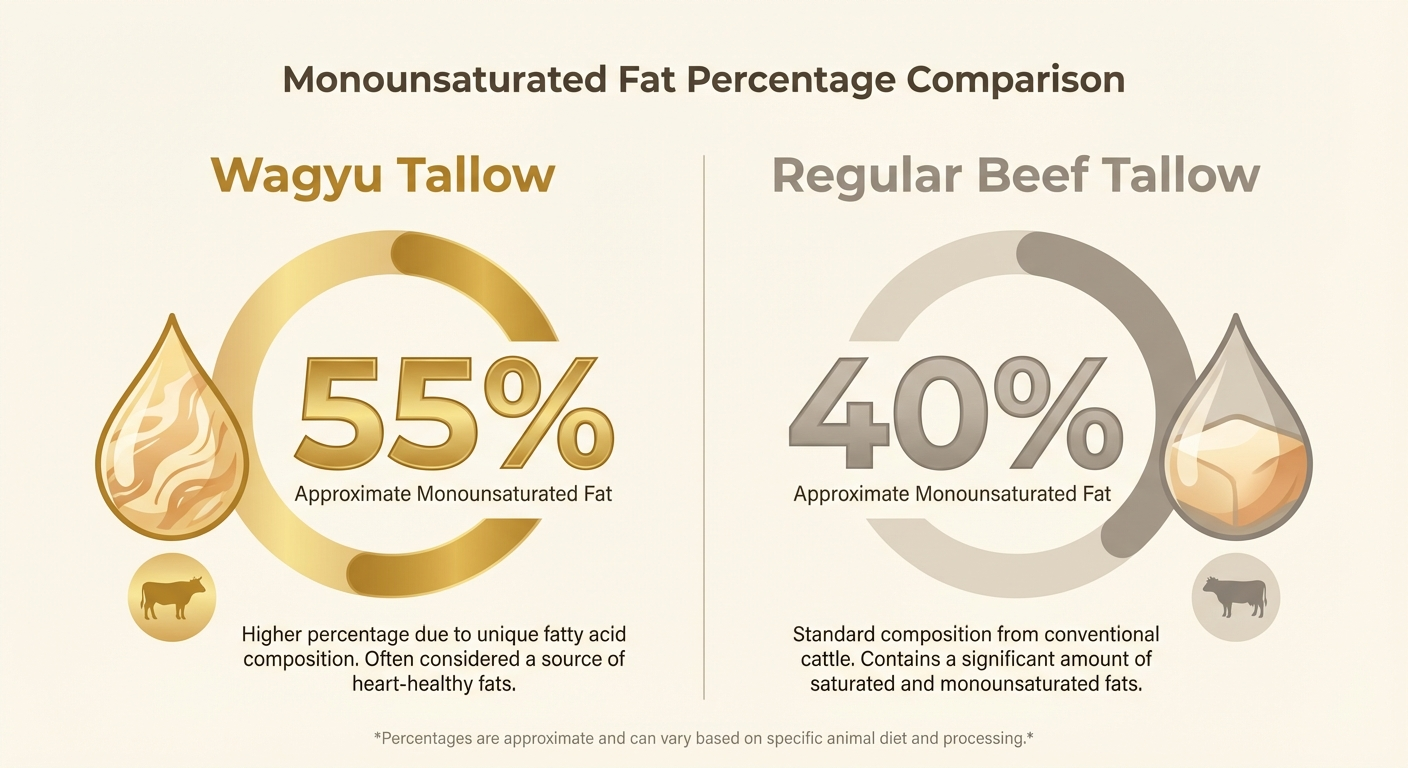
| Total monounsaturated | 50-60% | 38-45% | Wagyu significantly higher |
| Total saturated | 35-42% | 48-55% | Regular tallow significantly higher |
The headline number: wagyu tallow contains roughly 50-60% monounsaturated fatty acids versus 38-45% for regular beef tallow. That is a substantial gap. The oleic acid content in wagyu tallow approaches that of olive oil, which is why some nutrition researchers have taken interest in wagyu fat as a potentially healthier animal fat option.
The practical impact of this fatty acid profile goes beyond nutrition. It directly affects how the tallow behaves in your kitchen.
Texture and Melting Point
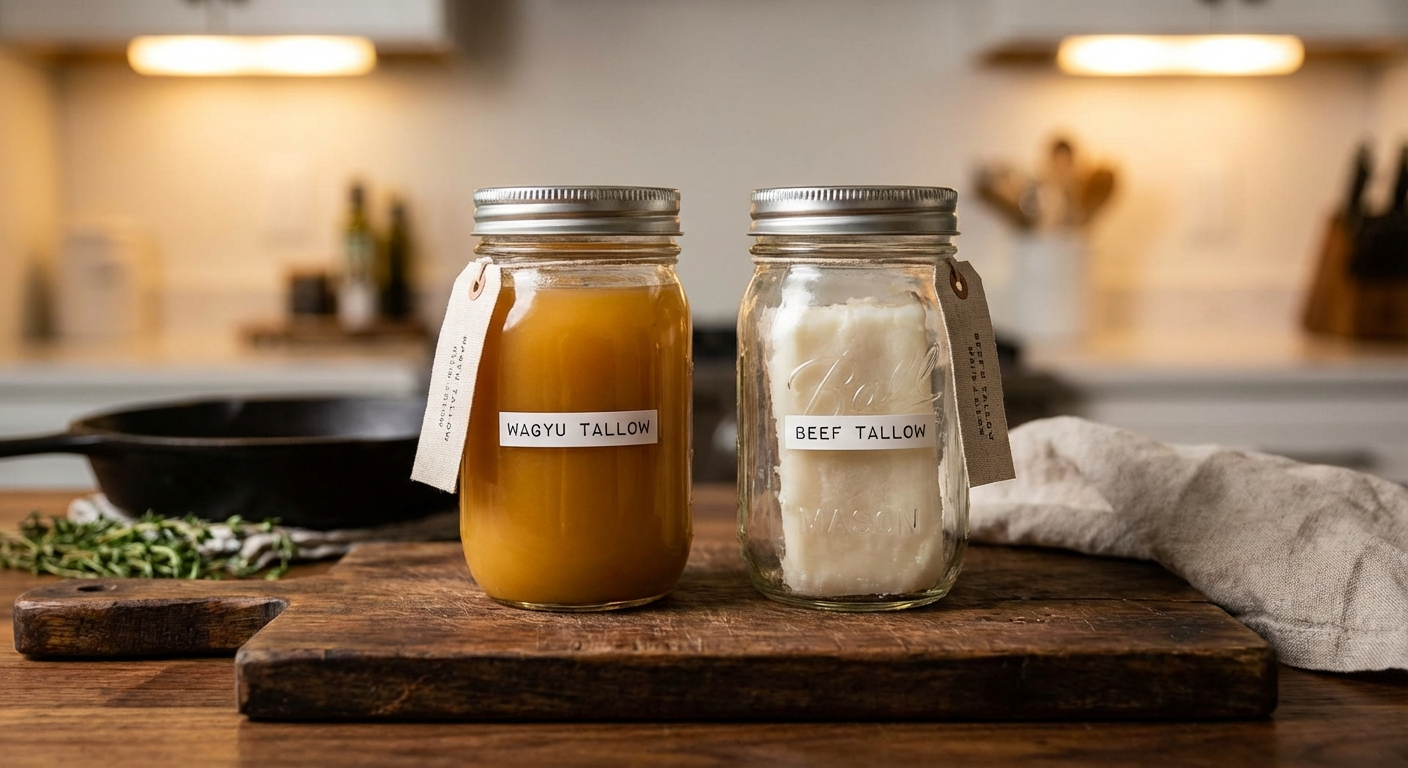
Pick up a jar of wagyu tallow and a jar of regular beef tallow. The difference is immediately obvious before you even open them.
Regular beef tallow at room temperature is hard — almost brittle. You can tap it with a spoon and it clinks. This is because of its higher stearic acid content, a long-chain saturated fat that forms rigid crystalline structures at room temperature.
Wagyu tallow at room temperature is noticeably softer. It has a creamy, almost spreadable consistency — closer to a firm butter than a hard fat. Some wagyu tallows, especially those rendered from heavily marbled trim at warmer room temperatures, are nearly scoopable straight from the jar.
Melting Points Compared
| Fat | Melting Point | Texture at 72°F |
|---|
| Wagyu tallow | 77-95°F (25-35°C) | Soft, creamy, scoopable |
| Regular beef tallow | 104-113°F (40-45°C) | Hard, waxy, brittle |
| Lard (pork) | 97-104°F (36-40°C) | Firm but yielding |
| Butter | 90-95°F (32-35°C) | Soft, spreadable |
Wagyu tallow melts at or near body temperature. This is the same property that makes wagyu steak feel like it dissolves on your tongue — the fat literally melts on contact. Regular beef tallow needs significantly more heat to liquefy, which is why it feels waxy or coating in your mouth rather than silky.
Flavor and Aroma: The Real Test
Flavor is where wagyu tallow earns its reputation, and it is the hardest difference to convey in text.
Wagyu Tallow Flavor
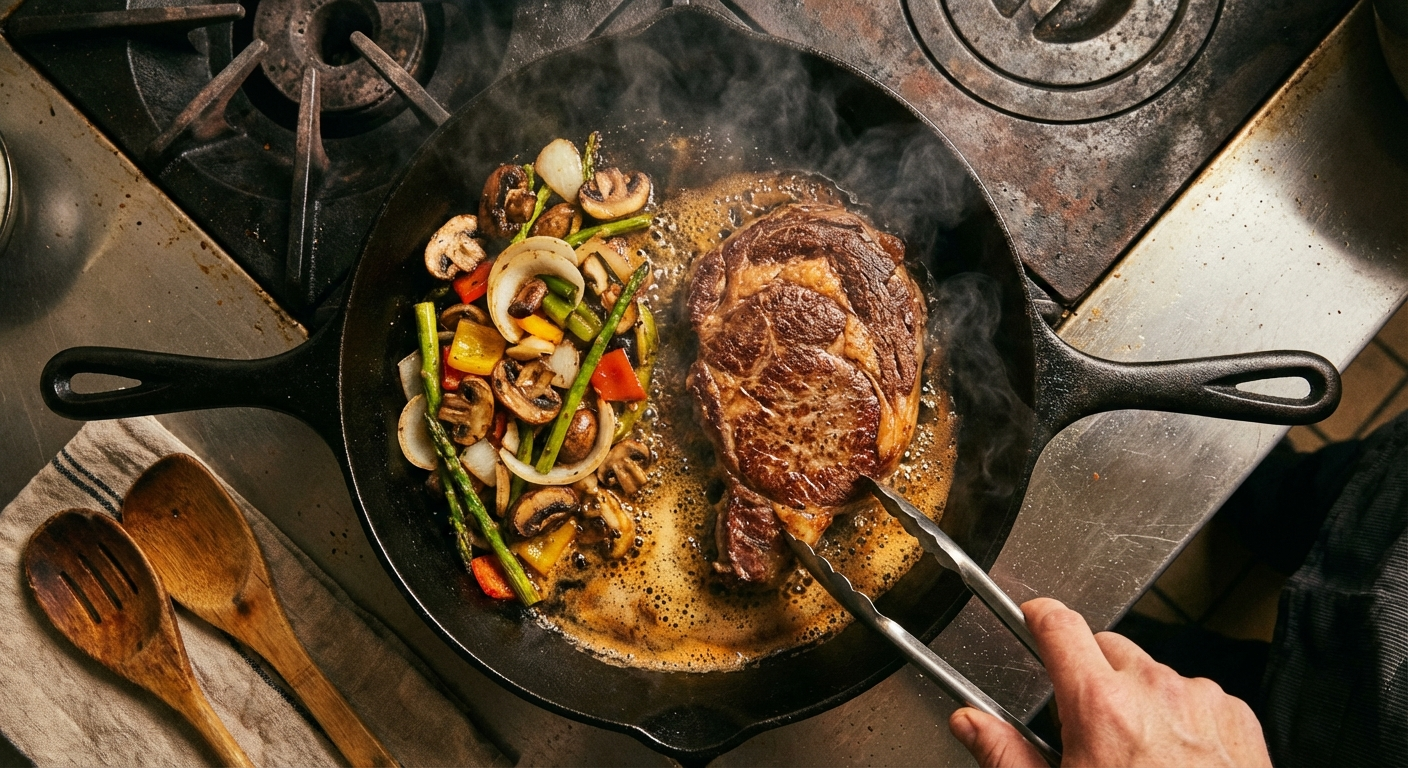
Rich, deeply beefy, with a pronounced umami quality that regular tallow simply does not match. There is a sweetness — not sugar-sweet, but a rounded, savory sweetness that enhances everything it touches. The aroma when melted is intoxicating: clean, buttery, with an almost nutty undertone. Many chefs describe it as "liquid gold" and that is not entirely hyperbole.
The extended feeding period of wagyu cattle (28-32 months versus 16-18 months for conventional beef) develops more complex flavor compounds in the fat. More time on feed means more amino acid development, more Maillard reaction precursors, and a deeper, more layered fat.
Regular Beef Tallow Flavor
Clean, mild, and neutrally beefy. Good quality beef tallow from grass-fed or well-raised cattle has a pleasant, straightforward beef flavor. It works. But it lacks the depth, the umami punch, and the sweetness of wagyu tallow. Think of it as the difference between a decent table wine and a properly aged reserve — both are wine, but the complexity is on different levels.
Smoke Point and Cooking Performance
Both tallows are excellent high-heat cooking fats, but their performance characteristics differ.
| Property | Wagyu Tallow | Regular Beef Tallow |
|---|
| Smoke point | 400-420°F (204-216°C) | 400-420°F (204-216°C) |
| Flash point | ~550°F | ~550°F |
| Time to melt in pan | Faster (lower melting point) | Slower (higher melting point) |
| Coating behavior | Thinner, more even coat | Thicker, can pool unevenly |
| Residual flavor on food | Rich, enhanced umami | Mild, neutral beef |
| Frying stability | Excellent | Excellent |
The smoke points are essentially identical — both around 400-420°F, making them excellent for searing, frying, and high-heat roasting. The practical cooking difference is in how they melt and coat. Wagyu tallow melts faster, spreads more evenly in a pan, and creates a thinner, more uniform coating on food. Regular tallow can be slightly clumpy and uneven until fully heated.
Best Cooking Uses for Each
Where Wagyu Tallow Shines
- Searing steaks: Adds depth and richness to the crust
- Basting brisket: The gold standard for competition pitmasters
- French fries: Produces an incredibly rich, savory fry
- Finishing fat: Drizzle over grilled vegetables or rice
- Burger smash: Creates a flavor-packed crust on smash burgers
- Yorkshire puddings: Produces lighter, more flavorful results
Where Regular Tallow Works Fine
- Deep frying: When you need volume, regular tallow is cost-effective
- Seasoning cast iron: Both work equally well
- General sautéing: When the fat is background, not the star
- Roasting potatoes: Good results either way
- Soap and candle making: Regular tallow is standard
Price Comparison: The Premium Question
This is where the conversation gets honest.
| Product | Typical Price | Price Per Ounce |
|---|
| Wagyu tallow (premium brand, 8oz) | $18-30 | $2.25-3.75 |
| Wagyu tallow (bulk, 32oz) | $40-65 | $1.25-2.00 |
| Regular beef tallow (premium, 14oz) | $8-14 | $0.57-1.00 |
| Regular beef tallow (bulk, 32oz) | $12-20 | $0.37-0.62 |
| Grass-fed beef tallow (14oz) | $10-18 | $0.71-1.28 |
Wagyu tallow costs roughly three to five times more than regular beef tallow. A 32-ounce tub of quality wagyu tallow runs $40-65, while the same volume of regular beef tallow costs $12-20. That is a real premium, and it adds up fast if you use tallow regularly.
Is the Price Justified?
For everyday cooking where tallow is a background fat — frying eggs, sautéing vegetables, general kitchen use — regular beef tallow delivers 90% of the performance at a fraction of the cost. The answer is no for these uses.
For applications where the fat IS the flavor — basting a competition brisket, making wagyu-fat fries for a special dinner, finishing a seared steak — wagyu tallow delivers a noticeably superior result. The answer is yes for these uses.
The smartest approach: keep both in your kitchen. Regular tallow for daily use, wagyu tallow for moments when the fat needs to perform.
Nutritional Comparison
Both tallows are calorie-dense fats. The meaningful nutritional difference is in the type of fat, not the amount.
| Per 1 Tablespoon (14g) | Wagyu Tallow | Regular Beef Tallow |
|---|
| Calories | 115-120 | 115-120 |
| Total fat | 13g | 13g |
| Saturated fat | 5-6g | 6.5-7.5g |
| Monounsaturated fat | 6.5-7.5g | 5-6g |
| Polyunsaturated fat | 0.5-1g | 0.5-1g |
| Cholesterol | 13mg | 13mg |
| Vitamin E | Trace | Trace |
The calories are identical. The difference is in the saturated-to-monounsaturated ratio. Wagyu tallow tilts toward monounsaturated fats (the kind found in olive oil and avocados), while regular tallow tilts toward saturated fats. Whether this distinction matters for your health depends on your overall diet and your doctor's guidance — but from a pure fat-composition standpoint, wagyu tallow has a more favorable profile.
Shelf Life and Storage
Both tallows are remarkably shelf-stable compared to other cooking fats, which is one reason tallow was the default cooking fat for centuries before refrigeration.
- Room temperature (sealed): Both last 6-12 months in a cool, dark place
- Refrigerated: Both last 12-18 months
- Frozen: Both last 2+ years
One practical note: wagyu tallow's lower melting point means it softens faster in warm kitchens. If your kitchen runs hot in summer, refrigerate wagyu tallow to maintain a firm texture. Regular beef tallow stays solid at higher temperatures thanks to its higher stearic acid content.
How to Render Your Own
If you cook wagyu at home, you are likely trimming fat before cooking. Do not throw it away — render it.
Simple Home Rendering Process
- Collect trimmings: Save wagyu fat trimmings in a freezer bag until you have at least 1 pound
- Cut small: Dice the frozen fat into half-inch cubes (frozen fat is easier to cut)
- Low and slow: Place in a heavy pot over the lowest heat setting. Add 2 tablespoons of water to prevent scorching
- Render: Cook for 2-4 hours, stirring occasionally, until the fat is liquid and any solid bits (cracklings) are golden brown
- Strain: Pour through a fine-mesh strainer lined with cheesecloth into a clean jar
- Cool: Let it solidify at room temperature, then refrigerate
Home-rendered wagyu tallow from your own trimmings is essentially free and often better than commercial products because it is fresher and you control the process.
The Bottom Line
Wagyu tallow and regular beef tallow are both excellent cooking fats that outperform most seed oils for high-heat applications. The differences between them are real and measurable: wagyu tallow has more monounsaturated fat, a lower melting point, softer texture, and significantly more flavor depth.
Whether those differences matter depends on the application. For competition BBQ, premium French fries, steak finishing, and dishes where the fat is a featured ingredient — wagyu tallow is a genuine upgrade. For everyday cooking, cast iron seasoning, and bulk frying — regular beef tallow is the smart choice.
The best kitchens keep both on hand. Use the premium stuff where it counts and the regular stuff everywhere else. That is the practical answer to the wagyu tallow question.