Wagyu vs Bison: Two Premium Proteins, Completely Different Experiences
Wagyu and bison sit at opposite ends of the premium meat spectrum — one maximizes marbling, the other minimizes it. Here is how they actually compare and when to choose each.
Wagyu and bison are both marketed as "premium" proteins, but they represent fundamentally opposite approaches to what makes meat exceptional. Wagyu is engineered for maximum intramuscular fat. Bison is prized precisely because it has almost none. Comparing them reveals what you actually value in your protein — and when each one makes sense on your plate.
This isn't about crowning a winner. It's about understanding two radically different animals, production philosophies, and eating experiences so you can make better buying decisions.
The Animals: Genetics and Biology
These two species couldn't be more different in their evolutionary design.
Wagyu Cattle (Bos taurus)
Wagyu — specifically Japanese Black (Kuroge Washu) — were selectively bred for centuries in Japan with one overriding goal: maximize intramuscular fat deposition. The result is an animal with a genetic predisposition for extreme marbling. When raised properly (28-32 months, grain-finished, low-stress environments), wagyu cattle deposit fat within the muscle fibers at levels 5-8 times higher than conventional beef breeds.
Key biological traits:
- Intramuscular fat: 25-40%+ in A5-grade animals
- Fat melting point: ~77°F (25°C) — lower than body temperature
- Oleic acid content: 50-55% of total fat (similar to olive oil)
- Mature weight: 1,300-1,800 lbs
American Bison (Bison bison)
Bison are wild-adapted ruminants that evolved on the Great Plains for efficiency, not marbling. They convert rough forage into lean, nutrient-dense muscle. Even when grain-finished (which some producers do), bison simply don't marble like cattle — their genetics resist fat deposition within the muscle fibers.
Key biological traits:
- Intramuscular fat: 2-5% (even grain-finished)
- Fat type: Higher ratio of omega-3 to omega-6 fatty acids
- Iron content: 3.42mg per 100g (vs 2.6mg for beef)
- Mature weight: 1,000-2,000 lbs (bulls can exceed 2,200 lbs)
Where wagyu was shaped by human selection over centuries, bison was shaped by the prairie. One was designed to be the most indulgent meat possible. The other was designed to survive blizzards.
Marbling and Fat Content: The Core Difference
This is where the comparison gets stark.
| Metric | Japanese A5 Wagyu | American Wagyu | Bison | USDA Prime Beef |
|---|
| Intramuscular fat | 25-40% | 12-20% | 2-5% | 8-13% |
| Total fat (3oz serving) | 20-28g | 14-18g | 2-4g | 10-14g |
| BMS equivalent | 8-12 | 5-8 | 1-2 | 4-5 |
| Visual marbling | Extreme white webbing | Moderate to heavy | Minimal to none | Moderate |
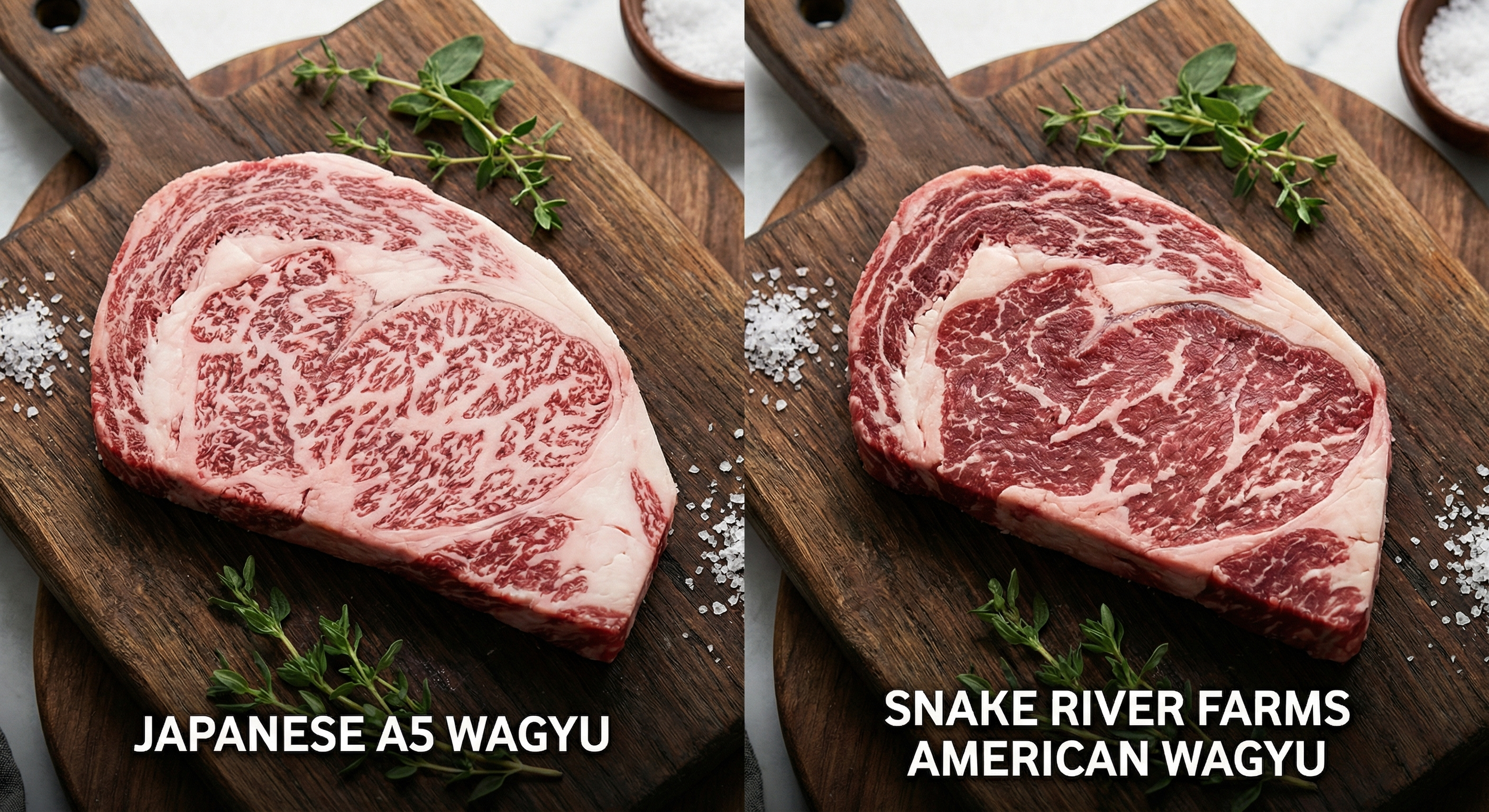
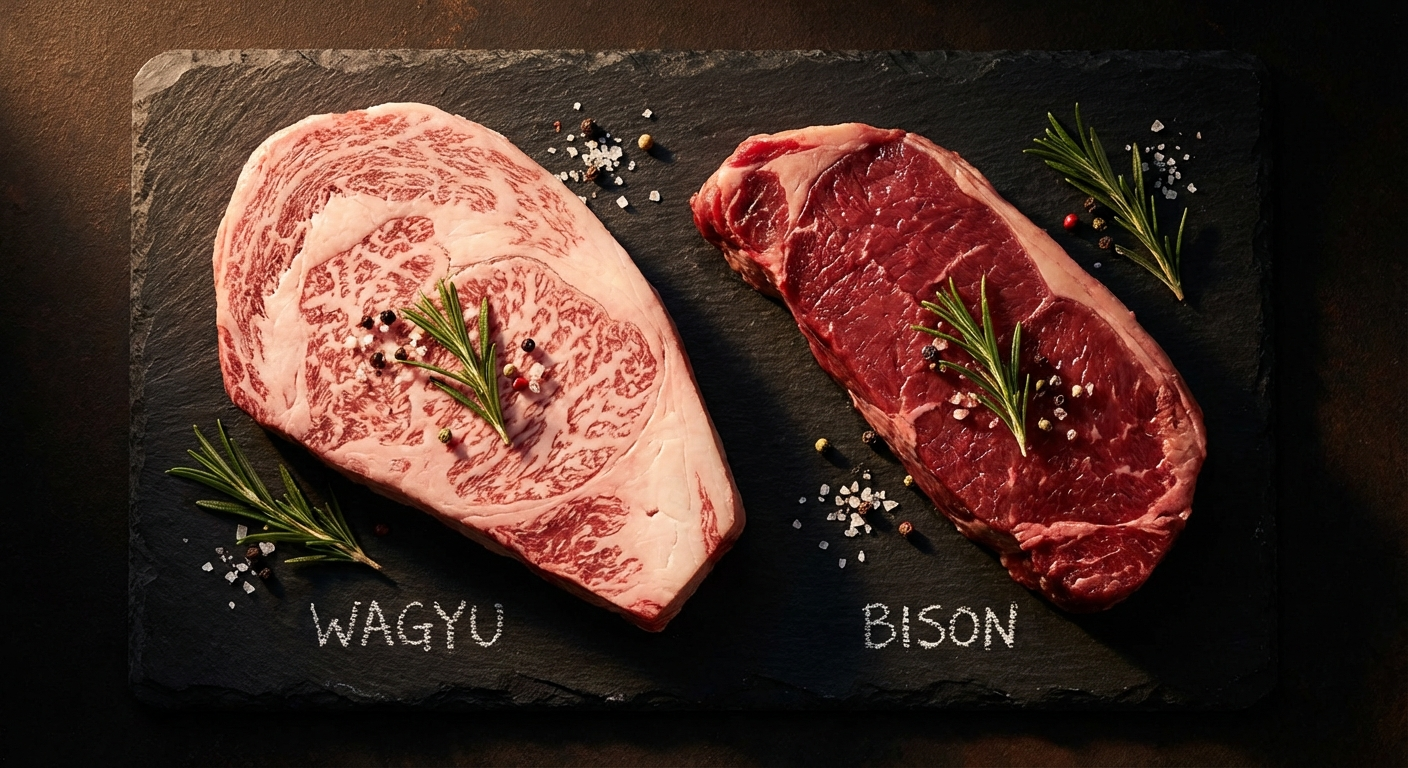
A5 wagyu can contain 10-20 times the intramuscular fat of bison. That's not a subtle difference — it's two entirely different products. Looking at a wagyu ribeye next to a bison ribeye, one appears almost white with pink veins while the other is deep ruby red with barely visible fat streaking.
Nutritional Profile: Health Conscious vs Indulgent
If nutrition drives your decisions, this comparison matters.
Per 3-ounce cooked serving:
| Nutrient | A5 Wagyu | Bison |
|---|
| Calories | 250-330 | 120-150 |
| Protein | 18-22g | 22-24g |
| Total fat | 20-28g | 2-4g |
| Saturated fat | 8-12g | 1-2g |
| Iron | 2.5mg | 3.4mg |
| Cholesterol | 70-80mg | 60-70mg |
| Omega-3 fatty acids | Low-moderate | Higher ratio |
Bison wins on: Lower calories, higher protein-per-calorie, less saturated fat, more iron, better omega-3/omega-6 ratio. Bison is one of the leanest red meats available — comparable to skinless chicken breast in fat content but with significantly more iron and B12.
Wagyu wins on: Oleic acid content. Despite its high fat content, wagyu fat is rich in monounsaturated oleic acid (the same fat in olive oil), which research suggests may have neutral or beneficial effects on cholesterol. Wagyu fat is metabolically different from conventional beef fat.
For athletes, weight-conscious diners, or anyone prioritizing protein density, bison is the clear choice. For those who view food as experience and eat premium meat in small portions, wagyu's nutritional profile is less concerning.
Flavor Profile: Rich Indulgence vs Clean Mineral Depth
Wagyu Flavor
A5 wagyu delivers an experience closer to foie gras or cultured butter than conventional steak. The extreme marbling creates:
- Sweet, buttery richness — the low-melting-point fat coats your palate immediately
- Subtle umami — a deep savory note that builds rather than hits
- Silky mouthfeel — at BMS 10+, the beef literally dissolves on the tongue
- Clean finish — despite the fat content, quality wagyu doesn't leave a greasy aftertaste
- Delicate beef flavor — the fat dominates, so the "beefy" character is refined rather than assertive
Wagyu is a sensory event. Three to four ounces is a full portion because the richness saturates your palate quickly.
Bison Flavor
Bison delivers what many describe as "what beef used to taste like" — but that undersells it. The flavor profile includes:
- Deep, mineral-rich meatiness — more iron-forward than beef, with an almost wild character
- Clean, sweet protein — without heavy marbling, the lean muscle flavor comes through clearly
- Slightly sweet finish — grass-fed bison especially has a natural sweetness
- No gaminess (when properly handled) — well-raised bison is smoother than elk or venison
- Satisfying chew — proper texture that rewards each bite
Bison is honest protein. The flavor comes from the muscle itself, not the fat. A well-cooked bison ribeye at 8-12 ounces is a deeply satisfying steak dinner.
Cooking: Where Technique Matters Most
The cooking approach for these two proteins couldn't be more different — and getting it wrong ruins both.
Cooking Wagyu
- Temperature: Rare to medium-rare max (120-130°F internal). The fat should melt, not render out.
- Method: Quick sear on screaming-hot cast iron or teppanyaki plate. 60-90 seconds per side for 1-inch steaks.
- Seasoning: Flaky salt only. The fat carries all the flavor you need.
- Portions: 3-4 oz per person. Cut against the grain into thin slices for serving.
- Common mistake: Cooking past medium-rare. This renders out the marbling and leaves you with an expensive, greasy mess.
Cooking Bison
- Temperature: Medium-rare to medium max (130-140°F internal). Without marbling to keep it moist, anything past medium becomes dry and tough.
- Method: Lower heat than you'd use for beef. Bison cooks approximately 30% faster due to less fat insulation.
- Seasoning: Salt, pepper, and herbs complement bison well. The lean meat can handle more seasoning than wagyu.
- Portions: 8-12 oz per person — standard steak portions.
- Common mistake: Overcooking. Bison goes from perfect to dry leather fast. Use a thermometer, pull 5°F early, and rest.
- Pro tip: Add external fat (butter baste, bacon wrap for tenderloin) to compensate for the lack of intramuscular fat.
Price Comparison
| Cut | Japanese A5 Wagyu (per lb) | American Wagyu (per lb) | Bison (per lb) |
|---|
| Ribeye | $150-$250 | $40-$80 | $25-$45 |
| Strip / New York | $120-$200 | $35-$70 | $22-$40 |
| Tenderloin / Filet | $180-$300 | $60-$100 | $30-$55 |
| Ground | $40-$60 | $12-$20 | $10-$16 |
But the real cost is per serving. Because wagyu portions are 3-4 oz and bison portions are 8-12 oz, the per-serving math shifts:
- Japanese A5 serving (4 oz): $38-$63
- Bison serving (10 oz): $16-$28
Wagyu is still 2-3x more expensive per serving, but the gap is smaller than the per-pound price suggests.
Sustainability and Production
Wagyu Production
Conventional wagyu production is resource-intensive. The 28-32 month feeding cycle, grain-heavy diets, and small-batch operations mean higher feed conversion ratios and carbon footprint per pound compared to most proteins. However, the per-serving environmental impact is lower than it appears because portions are small.
Bison Production
Bison has a compelling sustainability story:
- Regenerative grazing: Many bison ranches practice rotational grazing that improves soil health
- Lower inputs: Bison are hardier than cattle, requiring less veterinary intervention and supplemental feeding
- Native species: Raising bison supports conservation of a keystone species
- Grass-based: Most bison spend their lives on pasture, with minimal or no grain finishing
For environmentally conscious protein buyers, bison is the stronger choice.
When to Choose Each
Choose wagyu when:
- You want an indulgent, sensory experience — not just a meal
- Small portions are appropriate (celebration dinner, tasting course)
- You appreciate extreme richness and buttery texture
- The occasion justifies the price
- You're cooking for someone who values culinary luxury
Choose bison when:
- You want high protein with minimal fat
- Clean, mineral-rich, honest meat flavor appeals to you
- You're eating red meat regularly and want a healthier profile
- Sustainability and production ethics matter
- You want a full-size steak dinner without the calorie load
- You prefer the traditional "steak experience" with satisfying chew
The Bottom Line
Wagyu and bison are both exceptional proteins — they're just exceptional at completely different things. Wagyu maximizes fat, flavor density, and indulgence. Bison maximizes leanness, nutrition, and clean protein. Comparing them is like comparing a rich Burgundy to spring water — both have their place, and both serve important roles in a thoughtful diet.
The smart approach: keep both in your rotation. Bison for your weeknight steaks and health-conscious meals. Wagyu for the celebrations, the special occasions, the moments when food becomes an experience rather than fuel.
Explore premium wagyu options at The Meatery's Japanese A5 collection for the indulgent end of the spectrum.