Wagyu vs Certified Angus Beef: Which Premium Steak Is Worth Your Money?
Wagyu and Certified Angus Beef both carry premium price tags, but they deliver fundamentally different eating experiences. Here is exactly how they compare — and when to choose each.
Wagyu and Certified Angus Beef (CAB) sit at different tiers of the premium beef market, yet shoppers constantly compare them. Both cost more than standard grocery store beef. Both promise superior eating quality. But the similarities end there — these are fundamentally different products built on different genetics, different production standards, and different definitions of "premium."
Understanding exactly where they diverge helps you spend your money on the right steak for the right occasion.
What Is Certified Angus Beef?
Certified Angus Beef is a brand, not a breed or grade. The CAB program — run by the American Angus Association since 1978 — is the most successful branded beef program in history. It sets 10 quality specifications that cattle must meet to earn the CAB label:
- Marbling: Must grade Modest or higher (upper two-thirds of USDA Choice or above)
- Maturity: A maturity only (younger cattle)
- Ribeye area: 10-16 square inches
- Hot carcass weight: Under 1,050 lbs
- Fat thickness: Less than 1 inch
- Phenotype: Must be predominantly (51%+) black-hided Angus-type cattle
Here's the critical detail: CAB is not the best Angus beef available. It's a quality floor — the top 30-35% of Angus cattle meet CAB specifications. The best Angus beef (Prime grade) often exceeds CAB requirements, while some CAB qualifies only at the upper Choice level. The CAB Prime program is a separate, more exclusive tier.
What Is Wagyu?
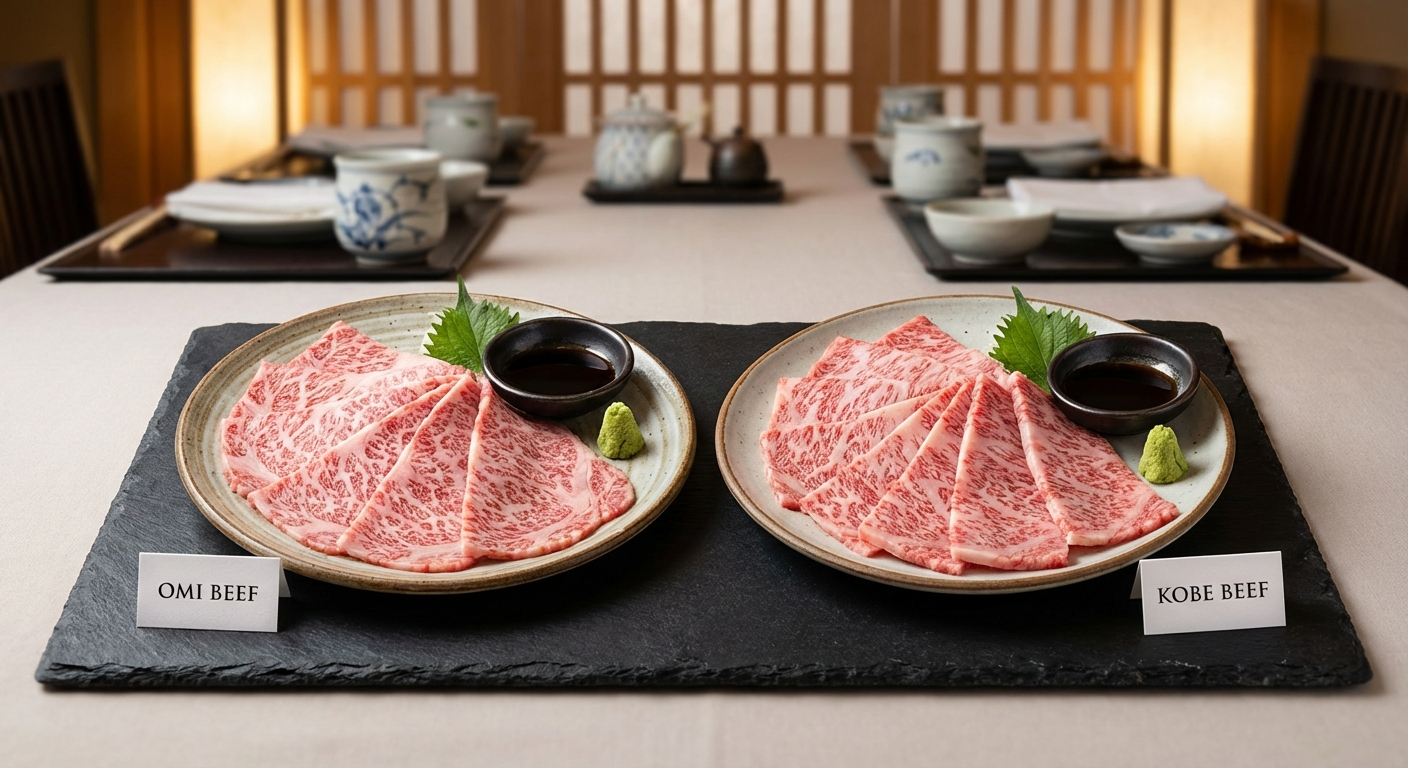
Wagyu refers to four Japanese cattle breeds genetically predisposed to extreme intramuscular fat deposition. The term literally means "Japanese cattle." In the premium beef context, wagyu almost always refers to Japanese Black (Kuroge Washu) — the breed responsible for A5-grade beef with BMS scores of 8-12.
Outside Japan, "wagyu" gets complicated. American Wagyu is typically a cross between Japanese wagyu genetics and domestic breeds (often Angus), ranging from F1 (50% wagyu) to Fullblood (100% wagyu). Australian Wagyu follows a similar pattern, with Fullblood programs producing marbling that competes with Japanese A5.
For this comparison, we'll primarily compare Japanese A5 Wagyu and American Wagyu against CAB, since these are what consumers encounter in the US market.
Marbling: The Core Difference
Marbling is where these two products diverge most dramatically.
| Metric | CAB (Choice+) | CAB Prime | American Wagyu | Japanese A5 Wagyu |
|---|
| Intramuscular fat % | 5-8% | 8-11% | 12-20% | 25-40% |
| USDA grade equivalent | Upper Choice | Prime | Beyond Prime | Far beyond Prime |
| BMS equivalent | 3-4 | 4-5 | 5-8 | 8-12 |
| Visual marbling | Moderate streaking | Abundant streaking | Dense web pattern | White with red veins |
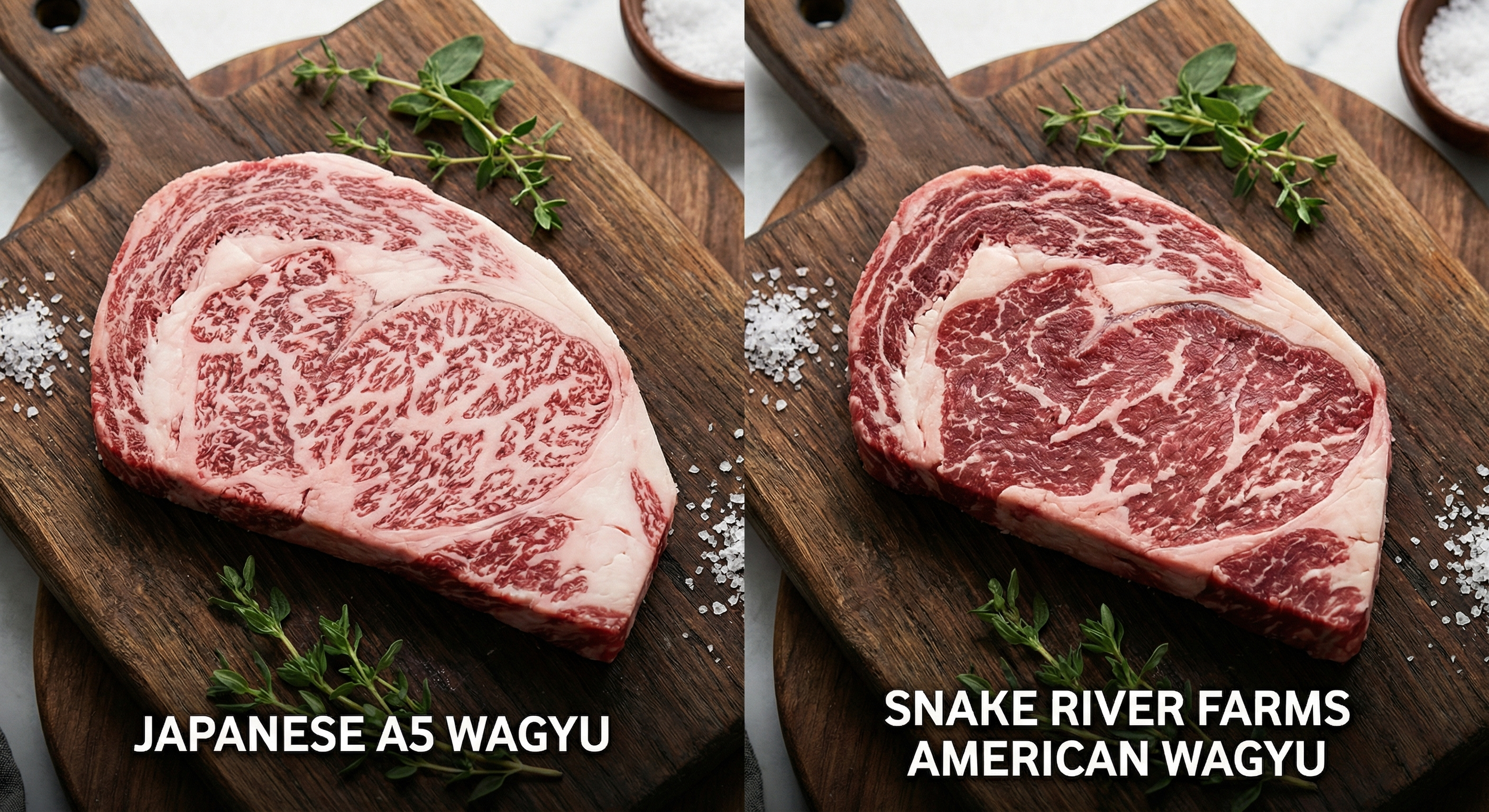
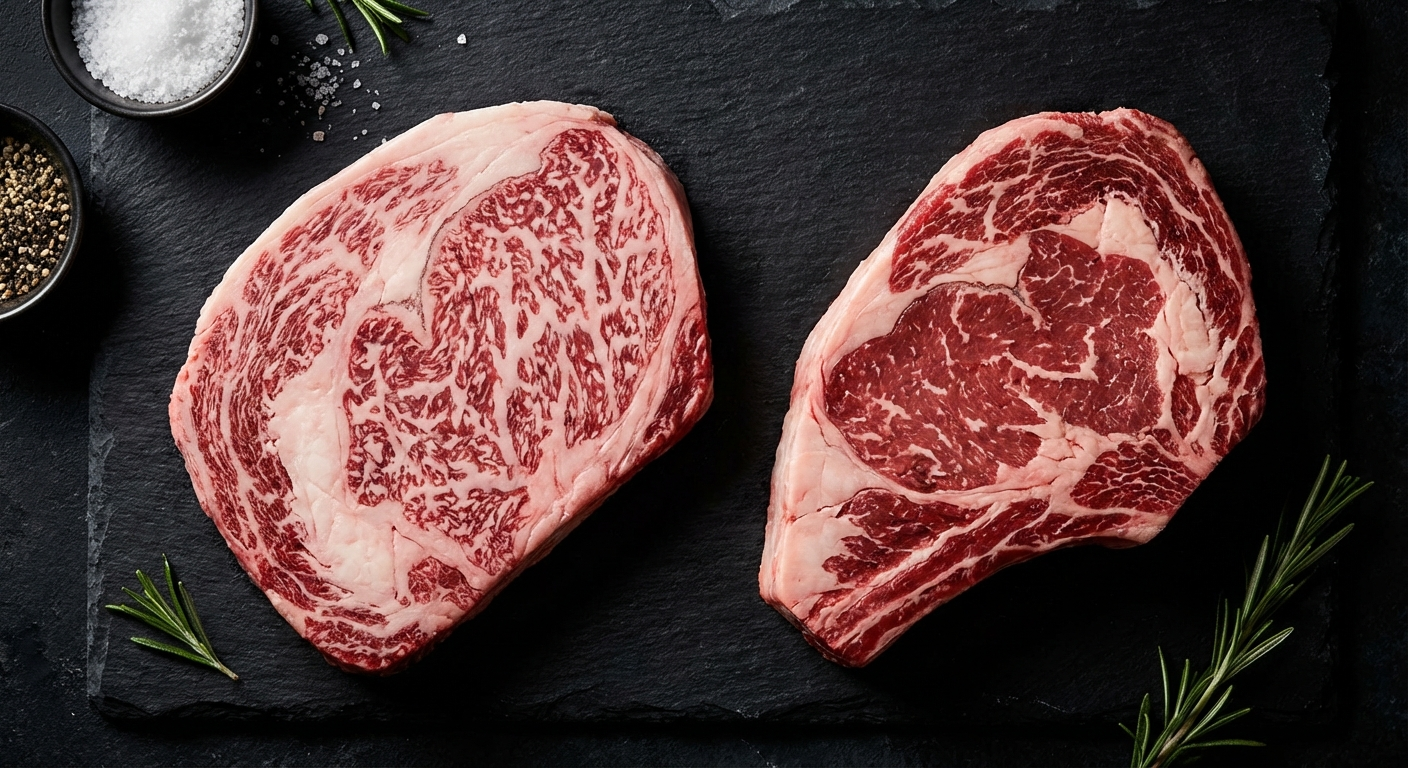
Japanese A5 wagyu contains 3-8 times more intramuscular fat than standard CAB. Even American Wagyu typically contains 2-3 times more. This isn't a subtle difference — it's a completely different product category.
Looking at a CAB ribeye, you see red meat with white streaks running through it. Looking at a Japanese A5 ribeye, you see a white-and-pink canvas where the marbling is so dense the fat forms a fine web that's almost indistinguishable from the muscle fibers.
Flavor and Eating Experience
Certified Angus Beef
CAB delivers the quintessential American steak experience:
- Bold beef flavor — robust, mineral-forward, with clean savory notes
- Satisfying chew — tender but with textural structure that rewards each bite
- Clean finish — the flavor is assertive without being heavy
- Versatile cooking — holds up well to high-heat searing, grilling, broiling, and even braising
- Familiar richness — the marbling provides juiciness and flavor without overwhelming richness
CAB steak is what most Americans picture when they think "great steak." It's the benchmark for quality beef, and for good reason — it delivers consistently excellent flavor at every meal.
Japanese A5 Wagyu
A5 wagyu is an entirely different eating experience:
- Sweet, delicate flavor — subtle umami with an almost floral, sweet fat character
- Melt-on-tongue texture — the fat dissolves at body temperature, requiring almost no chewing
- Extreme richness — intensely buttery, almost foie gras-like in its decadence
- Small portions mandatory — 3-4 oz is a full serving; larger portions become overwhelming
- Lingering finish — the flavors coat the palate and evolve over several seconds
American Wagyu
American Wagyu sits between these two extremes:
- Enhanced beef flavor — more robust than Japanese wagyu, more complex than CAB
- Buttery tenderness — significantly more tender than CAB with a silky mouthfeel
- Balanced richness — richer than conventional beef but manageable in standard portions
- Full steak portions — 8-12 oz is comfortable, unlike the small portions A5 demands
Many steak lovers find American Wagyu to be the sweet spot — it offers the enhanced marbling and tenderness of wagyu genetics while preserving the robust beef flavor Americans love from their Angus heritage.
Nutritional Comparison
Per 3-ounce cooked serving (ribeye):
| Nutrient | CAB (Choice) | American Wagyu | Japanese A5 |
|---|
| Calories | 180-210 | 230-280 | 250-330 |
| Protein | 23-25g | 20-23g | 18-22g |
| Total fat | 10-14g | 15-20g | 20-28g |
| Saturated fat | 4-6g | 6-9g | 8-12g |
| Oleic acid % of fat | 35-40% | 40-50% | 50-55% |
| Iron | 2.8mg | 2.6mg | 2.5mg |
CAB wins on protein-per-calorie and lean nutrition. However, wagyu fat has a significantly different composition — higher oleic acid content (the same monounsaturated fat found in olive oil) gives wagyu fat a health profile that's arguably better than its saturated fat numbers suggest. Research on Japanese wagyu beef's fatty acid composition has shown the oleic acid content approaches that of olive oil.
Price: The Uncomfortable Truth
| Product | Ribeye Price (per lb) | Price Multiple vs CAB |
|---|
| CAB Choice | $16-$24 | 1x (baseline) |
| CAB Prime | $25-$40 | 1.5-2x |
| American Wagyu (F1) | $40-$70 | 2.5-3.5x |
| American Wagyu (Fullblood) | $60-$100 | 3.5-5x |
| Japanese A5 (BMS 8-9) | $100-$160 | 6-8x |
| Japanese A5 (BMS 10-12) | $150-$250 | 8-12x |
Japanese A5 wagyu costs 6-12 times more than CAB per pound. But the portion math changes things: a proper A5 serving is 3-4 oz ($25-$60 per serving) while a CAB steak is 10-16 oz ($10-$24 per serving). Per serving, the gap narrows to roughly 2-3x.
American Wagyu offers the most practical upgrade path from CAB — a solid F1 wagyu ribeye at $50/lb costs about double what a CAB Prime ribeye costs, and the marbling improvement is immediately noticeable.
Production Standards Compared
CAB Production
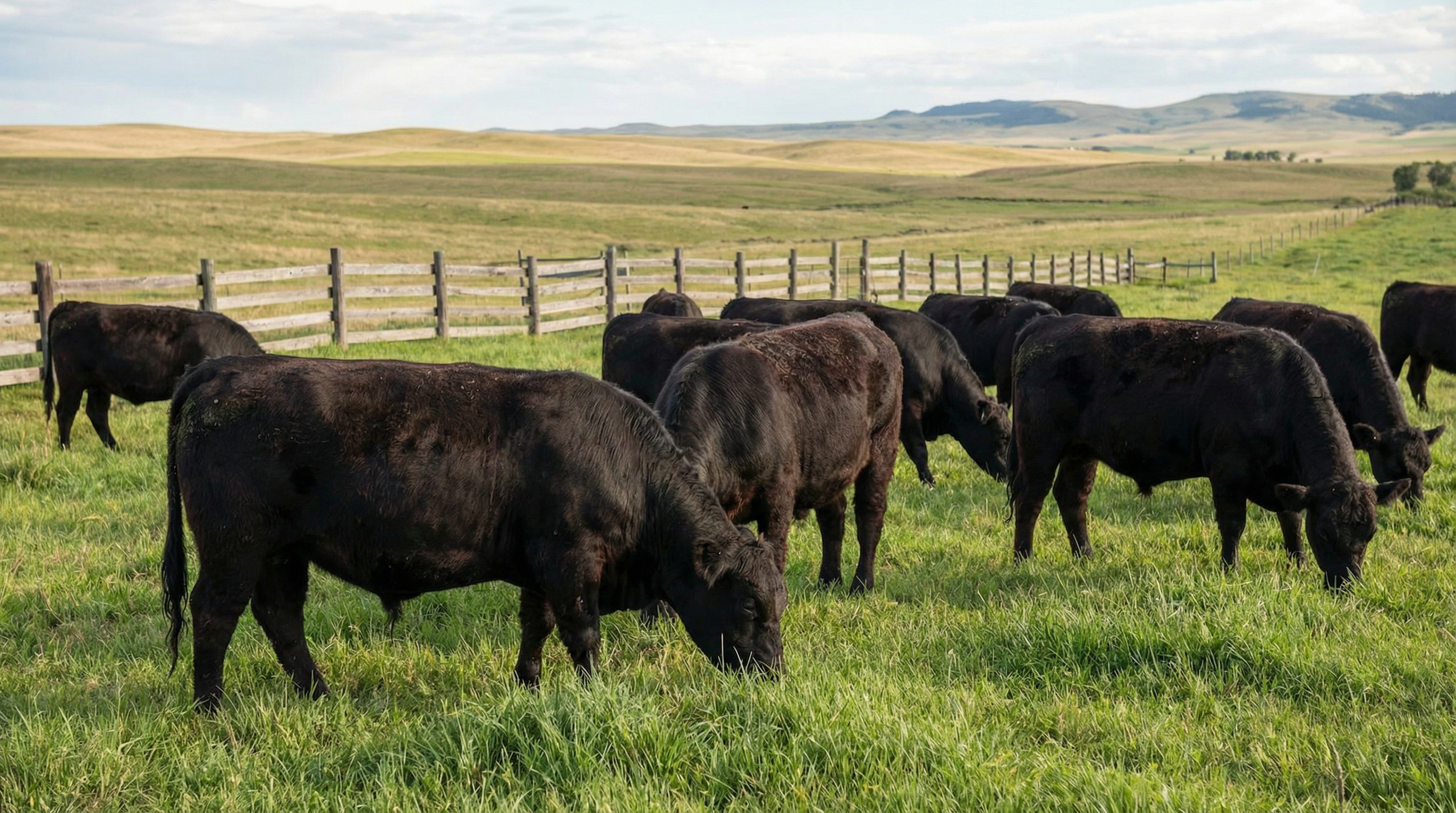
CAB cattle are predominantly Angus or Angus-cross breeds raised across the United States. Production standards focus on carcass quality specifications at processing rather than specific on-farm protocols. Cattle are typically:
- Raised on pasture for 12-16 months
- Finished on grain in feedlots for 120-180 days
- Processed at 18-24 months of age
- Evaluated against the 10 CAB specifications post-harvest
The program is quality-assured at the packing plant level — individual farms don't receive CAB certification. The cattle are evaluated after harvest, and carcasses meeting all 10 specs earn the CAB label.
Japanese Wagyu Production
Japanese wagyu production is an entirely different system:
- Purebred Japanese Black cattle with documented lineage
- 28-32 months of careful raising (vs 18-24 for CAB)
- Proprietary grain-based diets designed to maximize marbling
- Low-stress environments with individual animal tracking
- Every animal is traceable from birth to consumption via a 10-digit ID
- Graded by certified JMGA inspectors on yield and four quality factors
The investment per animal is dramatically higher — longer feeding periods, more specialized diets, smaller operations, and more labor-intensive care all contribute to the final price.
Cooking Methods: Different Steaks, Different Approaches
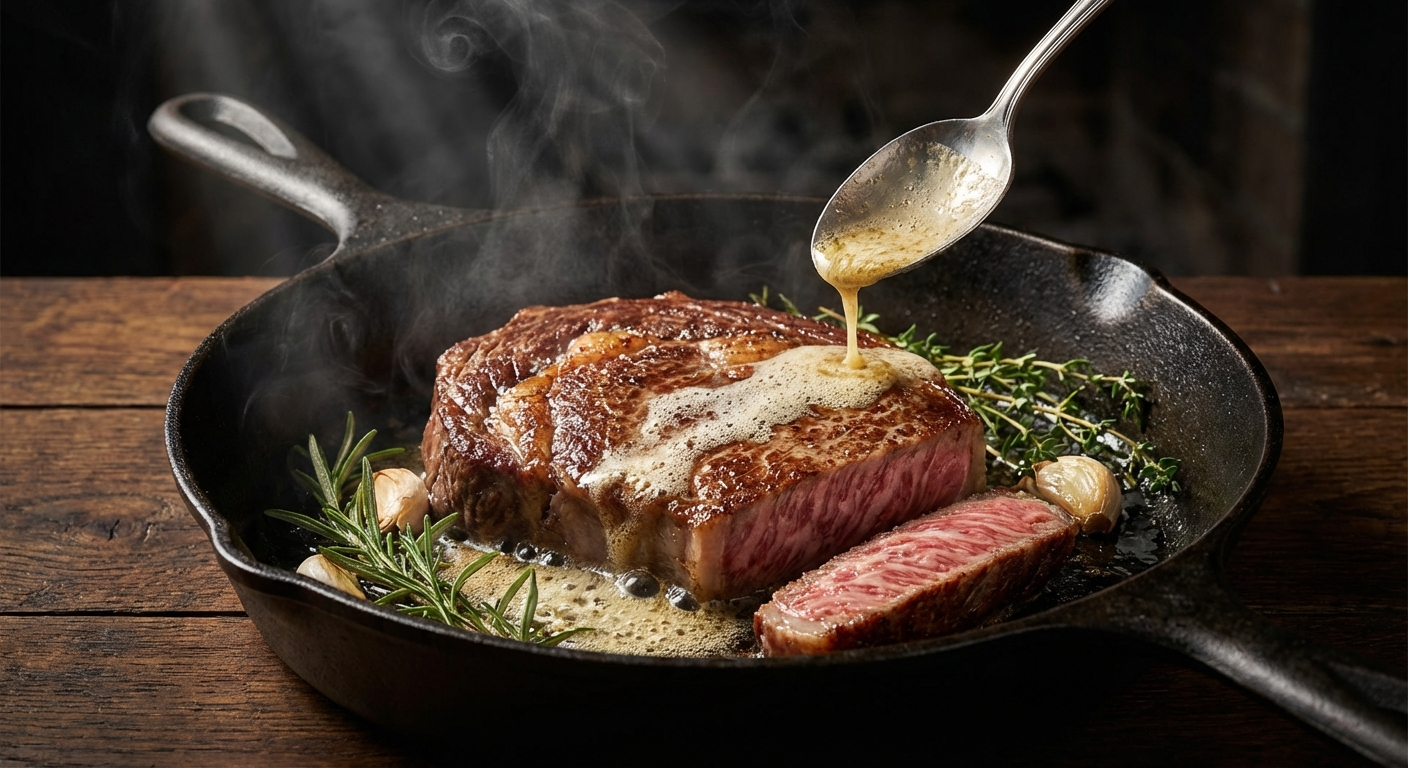
How to Cook CAB
CAB is forgiving and versatile:
- Grill: High heat, 4-5 minutes per side for a 1-inch steak. The moderate fat content means it won't cause excessive flare-ups.
- Cast iron sear: Screaming-hot pan with a tablespoon of high-smoke-point oil. Finish with butter baste.
- Reverse sear: Slow-cook at 250°F until 10°F below target, then sear 60 seconds per side. Ideal for thick cuts.
- Target temp: Medium-rare (130-135°F internal) to medium (140-145°F). CAB has enough marbling to stay juicy at medium.
- Resting: 5-10 minutes. Critical for juice redistribution.
How to Cook Wagyu
Wagyu demands restraint:
- Japanese A5: Sear on screaming-hot surface for 30-60 seconds per side. No oil needed — the fat renders immediately. Target rare to medium-rare maximum. Slice thin against the grain.
- American Wagyu: Treat like a premium steak but with a lighter touch. Sear at high heat, target medium-rare. The extra fat means it's more forgiving than lean cuts but will render excessively if overcooked.
- Never exceed medium: Cooking wagyu past medium literally melts away the marbling you paid for. At well-done temperatures, much of the intramuscular fat renders out, leaving you with an expensive, less-tender steak.
- No added fat: Do not add oil or butter to the pan for A5 wagyu. The marbling provides all the cooking fat you need.
When to Choose CAB Over Wagyu
CAB is the better choice when:
- You want a classic steak dinner — full 12-16 oz portions with bold beef flavor
- You're grilling for a group — consistent quality at a manageable price point
- You prefer robust, mineral-forward flavor — CAB delivers the traditional steak taste wagyu doesn't
- Budget matters — feeding a family of four steaks costs $40-60 with CAB vs $200+ with wagyu
- You're pairing with bold flavors — chimichurri, blue cheese, peppercorn sauce complement CAB's structure
- Weeknight dinner — the daily luxury you can afford without thinking twice
When to Choose Wagyu Over CAB
Wagyu is the better choice when:
- It's a special occasion — birthday, anniversary, celebration dinner
- You want a unique eating experience — something fundamentally different from everyday steak
- You appreciate delicate, complex flavors — the sweet, buttery fat profile is unlike anything else
- You're serving it as a tasting course — small portions as part of a multi-course meal
- You want to impress — the visual marbling of A5 wagyu is genuinely stunning
- Japanese preparations — yakiniku, shabu-shabu, sukiyaki, tataki
The American Wagyu Sweet Spot
For many steak lovers, American Wagyu is the practical winner in this comparison. It bridges the gap between CAB and Japanese A5 by offering:
- 2-3x the marbling of CAB Prime, delivering noticeably more tenderness and richness
- Full steak portions (8-12 oz) without the overwhelming richness of Japanese A5
- Familiar beef flavor enhanced by wagyu genetics rather than replaced by them
- A price premium (2-3x over CAB) that most dedicated steak lovers can justify for special meals
If you've been buying CAB Prime and wondering about the next step up, American Wagyu (particularly F1 Wagyu × Angus) is the natural upgrade before committing to Japanese A5.
Quality Consistency
One underappreciated advantage of CAB: consistency. The 10-specification program means every CAB steak you buy falls within a defined quality window. You know what you're getting. The experience is predictable and reliable — a 12 oz CAB ribeye from your butcher this week will taste very similar to one next month.
Wagyu is more variable. Even within "A5," the range from BMS 8 to BMS 12 represents a significant quality spectrum. American Wagyu varies even more — genetics, feeding programs, and processing all affect the final product. Buying wagyu requires more knowledge and more trust in your supplier. Working with a trusted retailer like The Meatery — where every product lists BMS scores, genetics, and provenance — removes the guesswork from wagyu purchasing.
The Bottom Line
CAB and wagyu aren't competitors — they serve different roles in your beef rotation.
Certified Angus Beef is the best everyday premium steak in America. It's consistent, affordable, versatile, and delivers the bold steak experience most people want most of the time. If you eat steak weekly, CAB should be your baseline.
Wagyu is a luxury ingredient for occasions that call for something extraordinary. Whether it's American Wagyu for a step-up date night or Japanese A5 for a once-a-year celebration, wagyu delivers an eating experience CAB physically cannot match due to the genetic ceiling on Angus marbling.
The smartest approach: buy CAB for your regular steak nights, upgrade to American Wagyu for special dinners, and save Japanese A5 for the moments that truly deserve it. That way, you eat excellent beef every time while keeping wagyu special.
Ready to taste the difference? Browse American Wagyu and Japanese A5 Wagyu at The Meatery, with full provenance and BMS scores on every cut.