Wagyu Brisket vs Texas BBQ Brisket: Is Wagyu Worth the Premium?
Wagyu brisket costs 3-5x more than Texas Prime brisket, but does the extreme marbling actually improve the BBQ experience? Here is the honest comparison from someone who has smoked both dozens of times.
The Rise of Wagyu Brisket in Competition BBQ
Five years ago, wagyu brisket was a novelty that competition pitmasters experimented with but rarely used in actual events. Today, it's winning major KCBS competitions and showing up at high-end BBQ restaurants from Austin to Kansas City. The question is simple: does the 3-5x price premium actually translate to better BBQ, or is this just another luxury food trend that sacrifices tradition for Instagram appeal?
After smoking 40+ wagyu briskets over the past three years (American F1, Australian Fullblood, and even one Japanese A5 that still haunts my dreams), here's the honest breakdown.
The Fundamental Difference: Marbling in the Flat
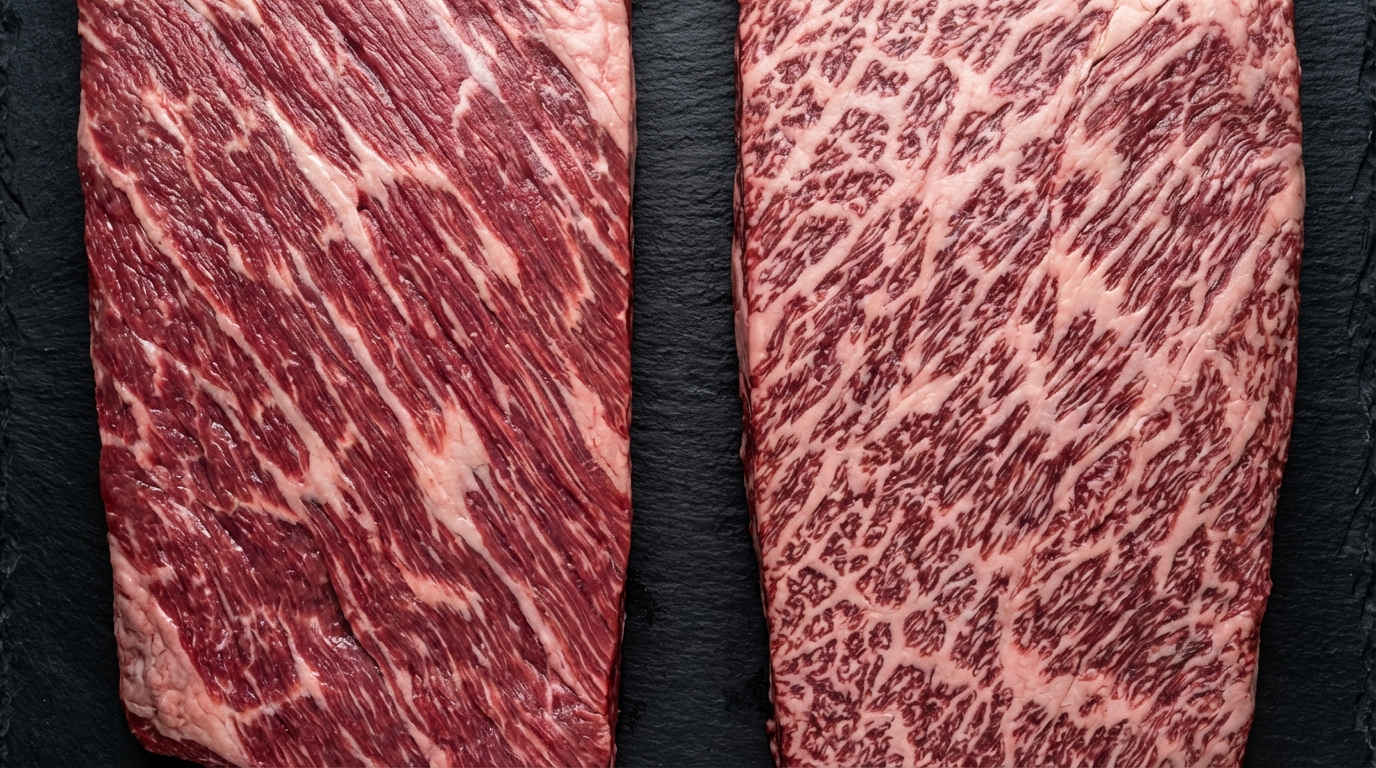
Every experienced pitmaster knows the challenge: the brisket flat is lean. Even USDA Prime flats — the top 2-3% of commodity beef — have limited intramuscular fat. That's why traditional Texas BBQ technique evolved around low-and-slow cooking, strategic wrapping, and careful moisture management. You're fighting against the lean flat to keep it tender and juicy while developing bark.
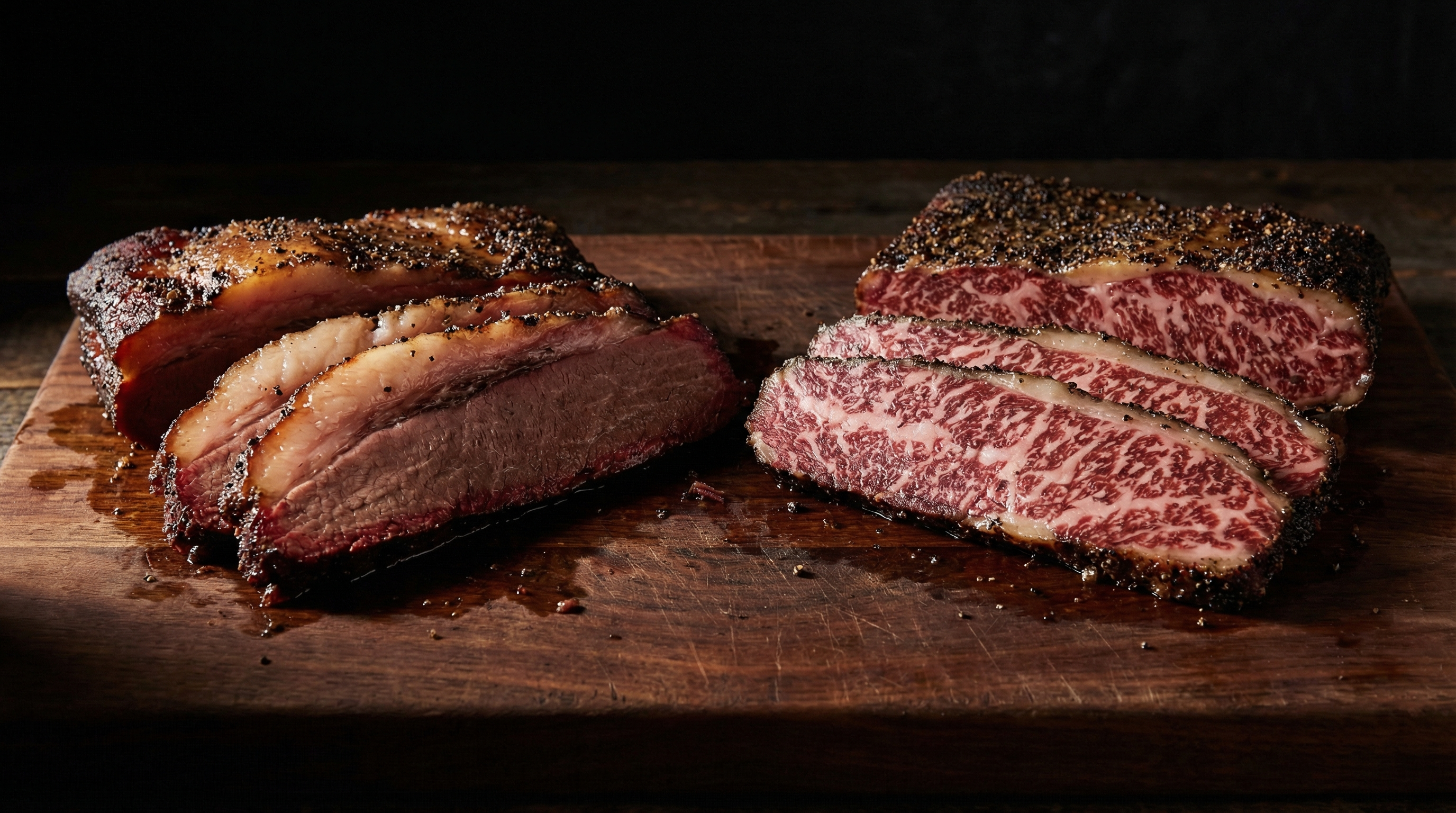
USDA Prime Brisket Flat
- Intramuscular fat: 3-6% (BMS 3-5 equivalent)
- Fat distribution: Concentrated at the seam between flat and point, minimal marbling within muscle
- Cook challenge: Flat dries out easily if overcooked or underrested
- Bark development: Excellent — the leaner surface develops deep, crusty bark
American Wagyu Brisket Flat (F1 Crossbreed)
- Intramuscular fat: 8-12% (BMS 5-7 equivalent)
- Fat distribution: Fine marbling throughout muscle, visible web-like pattern
- Cook challenge: More forgiving — internal fat bastes the meat as it renders
- Bark development: Good but softer — the rendering fat can prevent deep crust formation
Australian Fullblood Wagyu Brisket
- Intramuscular fat: 15-20% (BMS 7-9 equivalent)
- Fat distribution: Dense, even marbling creating almost ribeye-like richness
- Cook challenge: Extremely forgiving — nearly impossible to dry out
- Bark development: Moderate — heavy fat content creates a softer, less textured crust
The key insight: Wagyu brisket solves the traditional flat problem — dryness — but it changes the fundamental character of the BBQ. You trade the lean-meat bark contrast for uniform richness.
How They Cook: Smoke, Stall, and Render
Cook Time Comparison (12-14 lb packer briskets at 225-250°F)
| Stage | USDA Prime | American Wagyu F1 | Australian Fullblood |
|---|---|---|---|
| Initial smoke (to stall) | 5-7 hours | 4-6 hours | 4-5 hours |
| Stall temp | 165-170°F | 155-165°F | 150-160°F |
| Stall duration | 3-5 hours | 2-4 hours | 2-3 hours |
| Total cook time | 12-16 hours | 10-13 hours | 9-12 hours |
| Probe-tender temp | 200-205°F | 198-203°F | 195-200°F |
Why wagyu cooks faster: The intramuscular fat melts earlier and more aggressively, conducting heat through the meat and reducing the evaporative cooling effect (the stall). Less moisture evaporation = shorter stall = faster cook.
Smoke Behavior
Prime brisket: Takes smoke beautifully during the first 4-5 hours when the surface is cool and slightly moist. Smoke ring development is pronounced and deep (0.5-0.75 inches).
Wagyu brisket: The higher fat content causes more aggressive surface rendering, which can interfere with smoke penetration. Smoke rings are often shallower (0.25-0.5 inches), though the visual difference is minimal when sliced. The rendered fat carries smoke flavor internally, creating a different (but still excellent) smoke character.
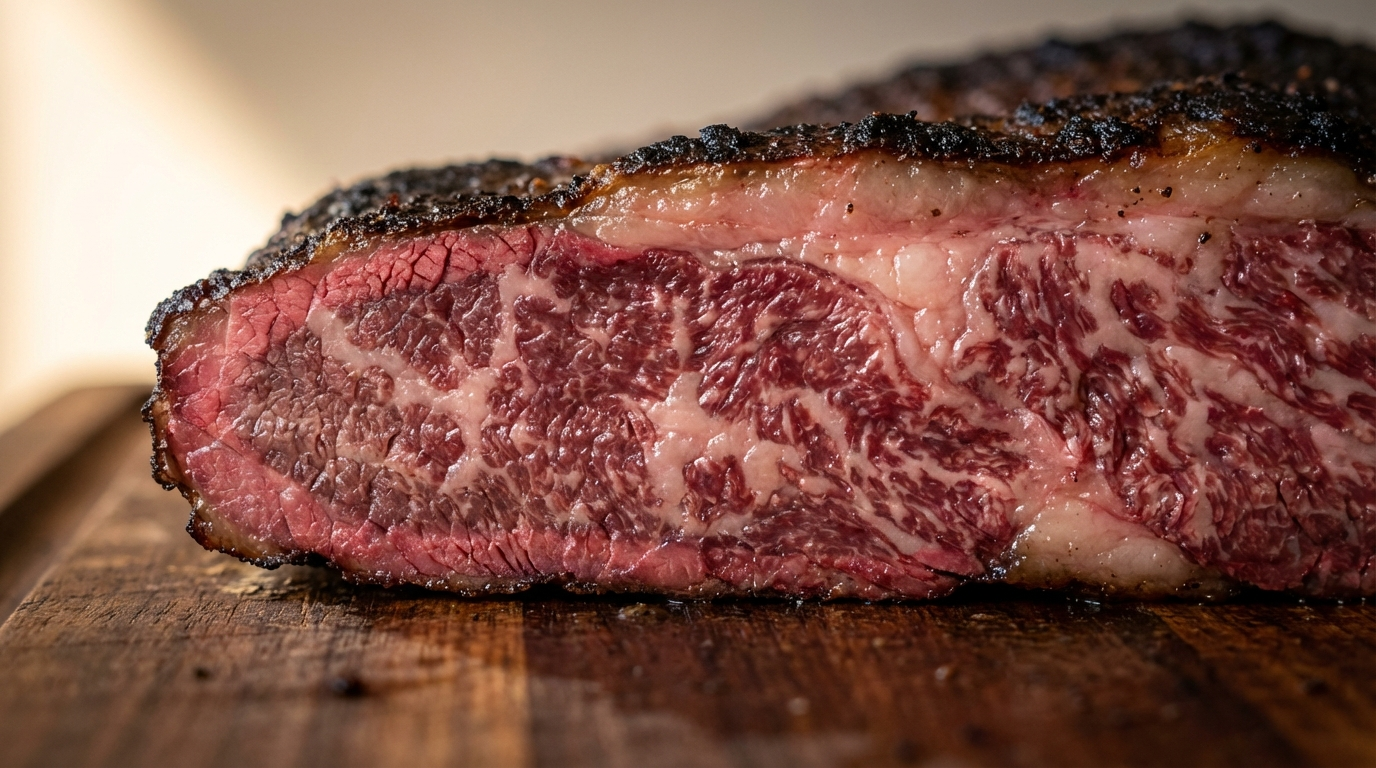
Flavor and Texture: The Eating Experience
Traditional Texas Prime Brisket
- Flat slices: Clean, concentrated beef flavor with peppery bark. Tender but with slight resistance. The lean meat contrasts sharply with the fat cap.
- Point (burnt ends): Rich, unctuous, with pockets of rendered fat. This is where traditional brisket shines — the point naturally has the marbling wagyu brings to the whole cut.
- Bark: Deep mahogany crust with pronounced texture. The bark is a major component of the flavor profile.
- Fat cap: Rendered to jelly-like consistency, providing richness when eaten with lean slices.
American Wagyu F1 Brisket
- Flat slices: Noticeably richer than Prime, with buttery fat laced throughout. Still recognizably "brisket" but elevated. Less textural contrast between lean and fat.
- Point: Almost overwhelmingly rich. The natural marbling of the point combined with wagyu genetics creates an extremely decadent burnt end experience.
- Bark: Good color and spice presence, but softer texture than Prime. Less "crust," more "coating."
- Fat cap: Renders heavily, almost liquid. May need to be trimmed more aggressively pre-cook to prevent greasiness.
Australian Fullblood Wagyu Brisket
- Flat slices: Resembles a cross between brisket and ribeye. Extremely tender, nearly melt-in-your-mouth. Some BBQ purists find this "too soft" — it loses the firm pull-apart quality of traditional brisket.
- Point: Borderline excessive in richness. A 3-4 oz serving is more appropriate than the 6-8 oz you'd serve of Prime brisket.
- Bark: Adequate but not stellar. The heavy fat rendering prevents the deep, crusty bark that defines championship Texas BBQ.
- Fat cap: Must be trimmed to 1/8 inch or less pre-cook. The internal marbling renders enough fat — the external cap just creates grease.
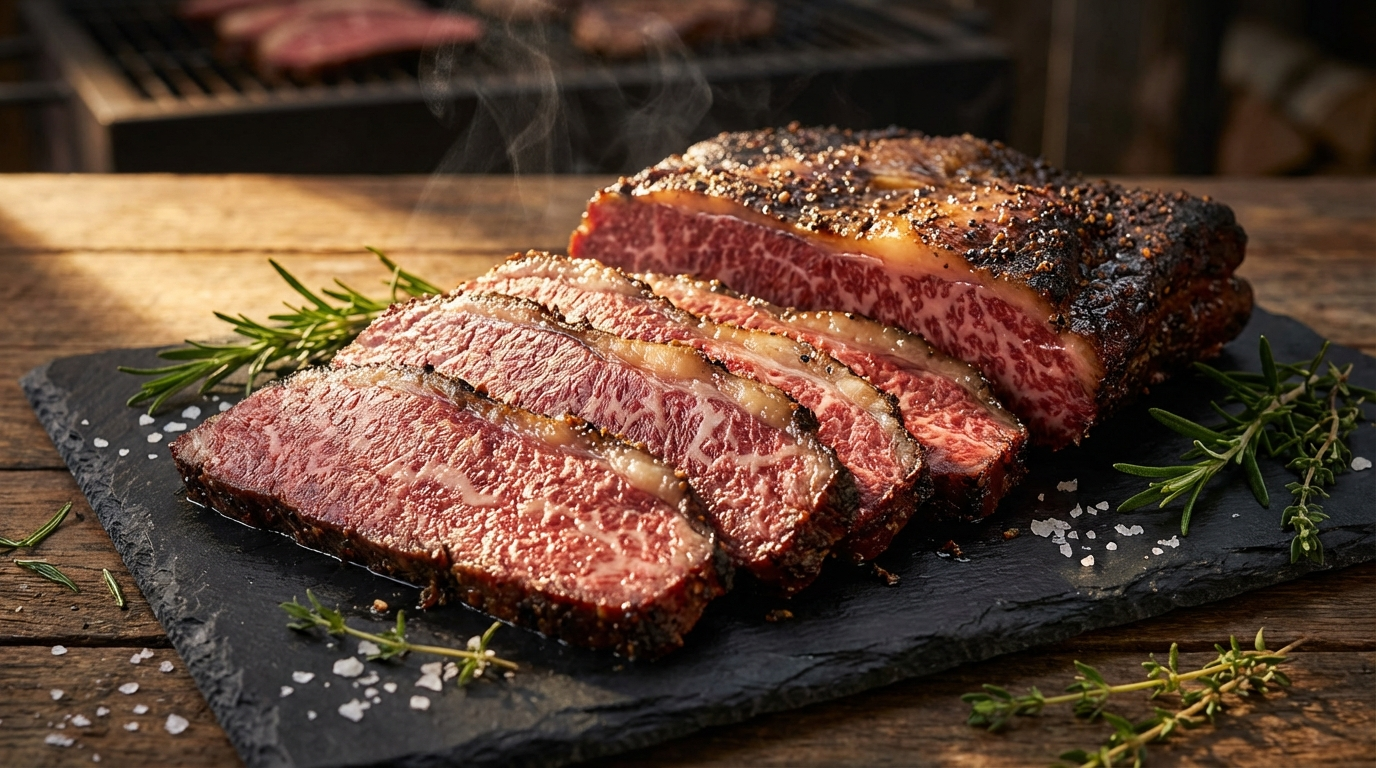
Price Comparison: The Economic Reality
| Type | Price per lb | 12-14 lb Packer Cost | Yield (sliced) | Cost per Serving (4 oz) |
|---|---|---|---|---|
| USDA Prime | $6-12 | $80-150 | 7-9 lbs | $2.50-4.50 |
| American Wagyu F1 | $15-25 | $200-350 | 7-9 lbs | $6.25-11.00 |
| Australian Wagyu Crossbred | $18-30 | $240-420 | 6.5-8.5 lbs | $7.00-12.50 |
| Australian Fullblood | $35-60 | $450-850 | 6-8 lbs | $14.00-26.50 |
| Japanese A5 (rare) | $80-150 | $1,100-2,100 | 5-7 lbs | $40.00-84.00 |
Important notes:
- Wagyu brisket yields slightly less due to heavier fat rendering
- Wagyu allows for smaller portion sizes (3-4 oz vs 6-8 oz for Prime) due to richness
- When factoring smaller portions, cost per person for American Wagyu F1 vs Prime is closer than raw price suggests
Competition BBQ: Which Wins?
This is where the wagyu brisket conversation gets interesting. Since 2019, wagyu brisket has won Grand Champion at multiple KCBS sanctioned events, including:
- American Royal World Series of Barbecue 2021: Plowboys BBQ (American Wagyu brisket)
- Jack Daniel's World Championship 2022: Myron Mixon (Australian Wagyu)
- Houston Livestock Show and Rodeo BBQ 2023: CorkScrew BBQ (American Wagyu F1)
But here's the nuance: competition BBQ is judged on:
- Appearance — wagyu's marbling scores higher visually
- Tenderness — wagyu is objectively more tender
- Taste — subjective, but richness impresses judges in a blind tasting scenario
What competition scoring doesn't measure:
- Authenticity to regional BBQ tradition
- Value for money
- Repeatability for restaurant service
- Customer preference for textural contrast (bark vs meat)
Championship pitmasters use wagyu because it maximizes scores in the KCBS judging criteria, not because it's objectively "better BBQ."
When Wagyu Brisket Makes Sense
Use Wagyu Brisket When:
- Competition BBQ — the judging criteria favor tenderness and richness
- Special occasions — a birthday, holiday, or celebration where cost is secondary
- You're new to smoking — wagyu is more forgiving of temperature swings and timing errors
- Serving BBQ novices — the tenderness and richness appeal to people unfamiliar with traditional brisket texture
- You want insurance — a 14-hour cook investment on a $350 brisket is risky; wagyu reduces that risk
Stick with Prime Brisket When:
- Traditional Texas BBQ is the goal — lean flat, crusty bark, textural contrast
- You're feeding a crowd — cost per pound matters, and Prime serves more people economically
- You value bark — deep, crusty, peppery bark is harder to achieve with wagyu's fat content
- You're an experienced pitmaster — the challenge of perfecting a lean flat is part of the craft
- You want classic BBQ flavor — clean beef + smoke + bark, without extreme richness
Hybrid Approach: The Best of Both Worlds
Here's what many high-end BBQ restaurants are doing:
Use American Wagyu F1 for the flat, traditional Prime for the point.
This hybrid approach gives you:
- Wagyu marbling in the traditionally lean flat (where it helps most)
- Traditional point with excellent bark and classic burnt end character
- Cost savings (the point accounts for 40-50% of the packer weight)
- Textural variety in a single service
Some butchers will custom-cut this for you: specify a wagyu flat paired with a Prime point. If they can't source it that way, buy a full wagyu packer and a full Prime packer, smoke both, and serve the wagyu flat with the Prime point. Freeze the leftovers.
Where to Buy Wagyu Brisket
Trusted Sources for Whole Packers:
- The Meatery — American Wagyu and Australian options, full traceability
- Snake River Farms — American Wagyu F1, consistent quality, Gold and Black grade options
- Crowd Cow — Australian Fullblood available, various MSA grades
- Holy Grail Steak — Japanese A5 brisket for bucket-list cooks (call ahead, limited availability)
What to ask when buying:
- Genetics: Fullblood (100% wagyu) or F1 (50% wagyu × 50% Angus)?
- Grade: BMS or MSA score?
- Weight: Packers range from 10-16 lbs; larger isn't always better for wagyu
- Trimming: Some wagyu briskets come with excessive fat cap that needs aggressive trimming
The Honest Verdict
Is wagyu brisket worth the premium?
It depends entirely on what you value.
If you define "great brisket" as traditional Texas BBQ — a lean flat with crusty bark, smoky depth, and clean beef flavor contrasted with rich, gelatinous point burnt ends — then wagyu is an expensive detour from the platonic ideal. A well-executed Prime packer from a skilled pitmaster will beat a mediocre wagyu brisket every time.
But if you're chasing tenderness, marbling, and a richer eating experience — essentially asking "what if brisket had ribeye marbling?" — then American Wagyu F1 delivers something genuinely special that you can't replicate with traditional beef.
My personal recommendation: Master Prime brisket first. Learn to manage the stall, develop deep bark, and nail the probe-tender finish on a $100 cut before investing $400+ in wagyu. Once you've got the fundamentals down, wagyu is a worthwhile luxury — but it's not a shortcut to great BBQ.
For competition, catering, or special occasions where you want maximum insurance against dryness and toughness, American Wagyu F1 is worth every dollar. For backyard BBQ, weekly cooks, and honoring the Texas tradition, Prime brisket remains king.
Shop premium wagyu brisket and traditional Prime options at The Meatery's brisket collection.