A5 Wagyu vs Kobe: Grading, Geography, and the 10-Digit Certificate You Need
A5 Wagyu and Kobe are not competing products — they're overlapping categories. Every authentic Kobe beef is A5-graded, but most A5 Wagyu comes from prefectures outside Hyogo. This guide breaks down grading standards, regional differences, authentication requirements, and when to pay the Kobe premium.
The confusion between "A5 Wagyu" and "Kobe beef" stems from a fundamental misunderstanding: one is a grading standard (A5), the other is a regional certification (Kobe). They're not competitors — they're overlapping categories with different qualifying criteria.
All authentic Kobe beef must meet A5 grading standards, but the vast majority of A5 Wagyu comes from other Japanese prefectures like Miyazaki, Kagoshima, and Matsusaka. When you see "A5 Wagyu" on a menu without regional designation, you're getting premium Japanese beef — but not necessarily Kobe.
If you're spending $150-300/lb on ultra-premium beef, you need to understand the grading system, regional differences, authentication methods, and when the Kobe designation actually justifies the price premium. This guide provides the framework to make informed buying decisions.
Understanding A5: Japan's Beef Grading Standard
A5 is the highest grade in Japan's beef quality scoring system, administered by the Japan Meat Grading Association (JMGA). It applies to all Japanese Black cattle (Kuroge Washu) regardless of prefecture.
The A5 Grading Breakdown
First character (A-C): Yield Grade — measures carcass yield efficiency
- A: Above standard yield (≥72% usable meat)
- B: Standard yield (69-72%)
- C: Below standard yield (<69%)
Second digit (1-5): Quality Score — composite of four factors:
- Marbling (BMS 1-12): Intramuscular fat density — grade 5 requires BMS 8-12
- Meat color (1-7): Bright cherry red scores highest
- Fat color (1-7): Pure white to slight cream
- Firmness and texture (1-5): Fine, tight grain structure
To achieve A5 grade, beef must score 5 in all four quality categories. That means BMS 8-12 marbling (the top tier), ideal meat color, pure white fat, and excellent texture.
According to USDA import data, only 8-12% of Japanese Wagyu cattle achieve A5 grading. Most grade A4 (BMS 5-7) or A3 (BMS 3-4). A5 represents the absolute peak of Japanese beef production across all prefectures.
Where A5 Wagyu Comes From
A5 Wagyu is produced in 47 Japanese prefectures, each with distinct cattle lineages, feeding programs, and regional characteristics:
| Prefecture/Brand | Annual A5 Production | Characteristics |
|---|
| Miyazaki | ~4,000 head | Competition winner 2007-2017, buttery texture, mild flavor |
| Kagoshima | ~5,000 head | Largest volume producer, consistent BMS 10+ marbling |
| Hyogo (Kobe) | ~3,000 head | Strict Tajima-gyu genetics, 10-digit certification required |
| Matsusaka (Mie) | ~800 head | Virgin female cattle only, delicate sweet fat |
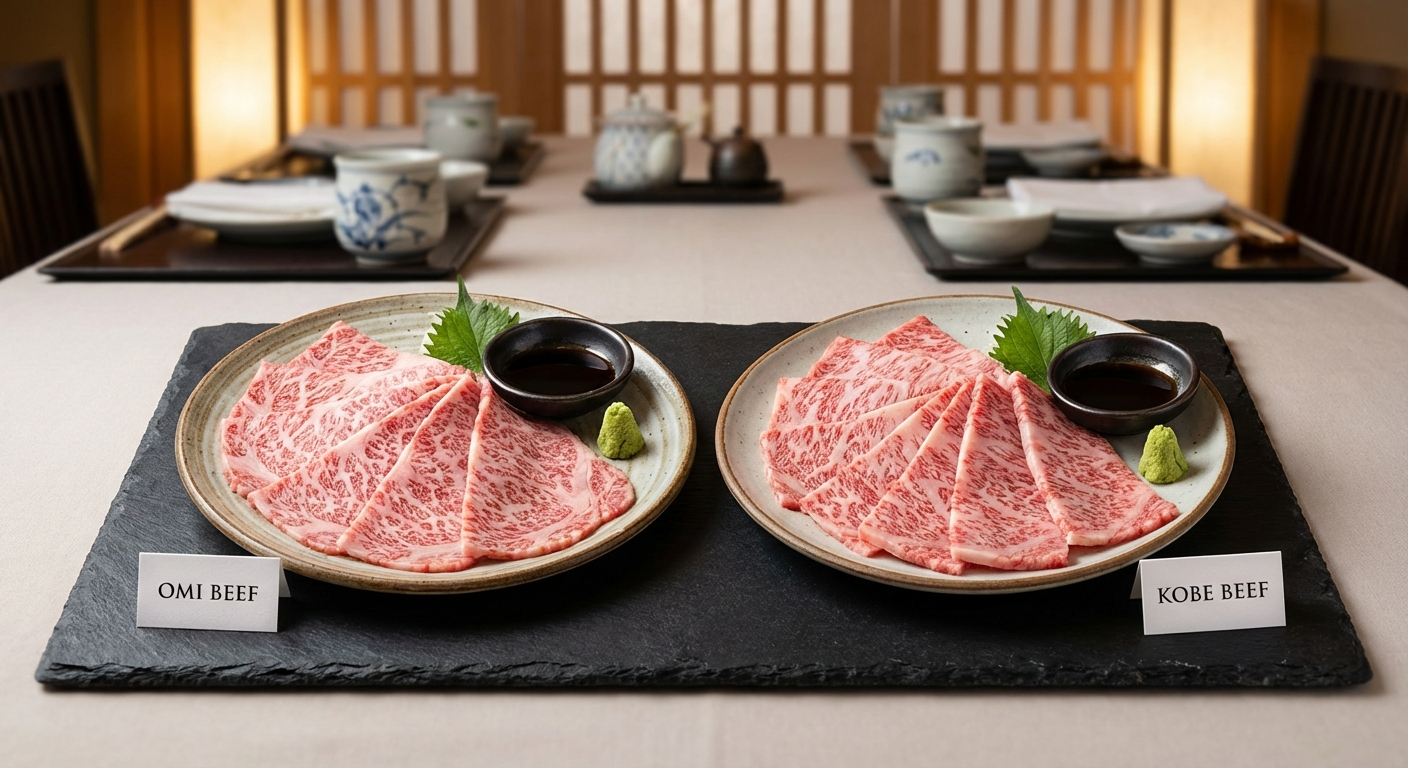
| Omi (Shiga) | ~1,200 head | Oldest wagyu brand (400+ years), balanced beefy flavor |
When you buy generic "A5 Wagyu," you're getting beef that met the grading standard but lacks regional certification. Quality can be exceptional (Miyazaki A5 regularly outscores Kobe in blind tastings), but you have no verifiable origin beyond "somewhere in Japan."
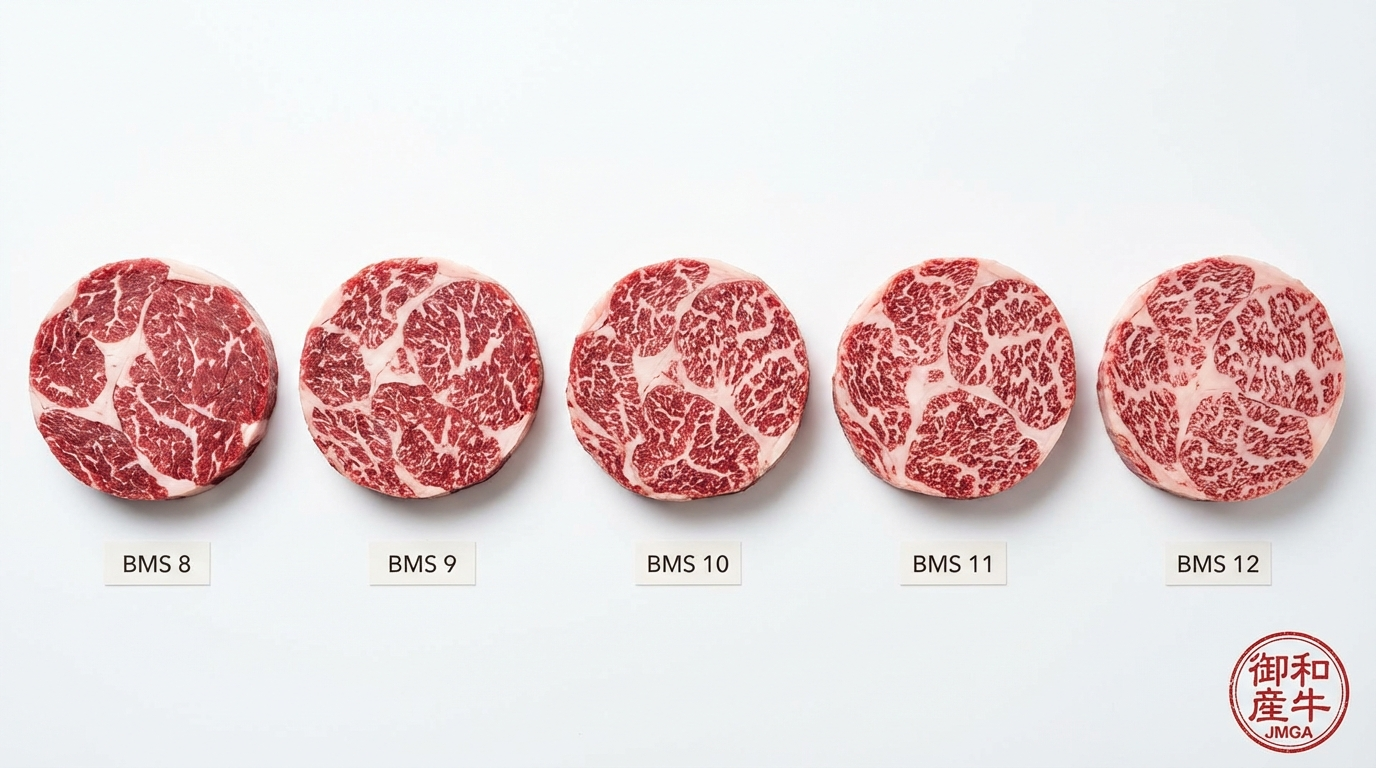
What Makes Kobe Different: Geographic Certification
Kobe beef is not a grade — it's a Protected Designation of Origin (PDO), similar to Champagne or Parmigiano-Reggiano. To carry the Kobe name, beef must meet nine mandatory requirements managed by the Kobe Beef Marketing & Distribution Promotion Association.
The 9 Kobe Certification Requirements
- Breed: 100% purebred Tajima-gyu cattle (verified genetic lineage)
- Birthplace: Born in Hyogo Prefecture, Japan
- Farm location: Raised exclusively in Hyogo Prefecture
- Processing location: Slaughtered at designated facilities in Hyogo
- Marbling score: BMS 6 or higher (most grade BMS 10-12)
- Quality grade: A4 or A5 only (yield grade A or B + quality score 4 or 5)
- Carcass weight: 470kg or less for steers, 470kg or less for heifers
- Gross carcass weight: 260-470kg for steers (specific weight windows)
- Traceability: 10-digit ID number linking to birth certificate and farm records
Only about 5,000 cattle per year pass all nine requirements. That's 0.15% of Japan's total cattle production and roughly 40% of Hyogo Prefecture's output.
The Tajima-gyu genetic requirement is particularly strict. These cattle have been closed-herd bred in Hyogo for over 200 years, producing smaller frames, slower growth rates, and exceptional marbling genetics. When Tajima-gyu cattle are exported to other prefectures (or countries like the US), their offspring can no longer be called Kobe — even if they achieve A5 grading.
Kobe Authentication: The 10-Digit Certificate
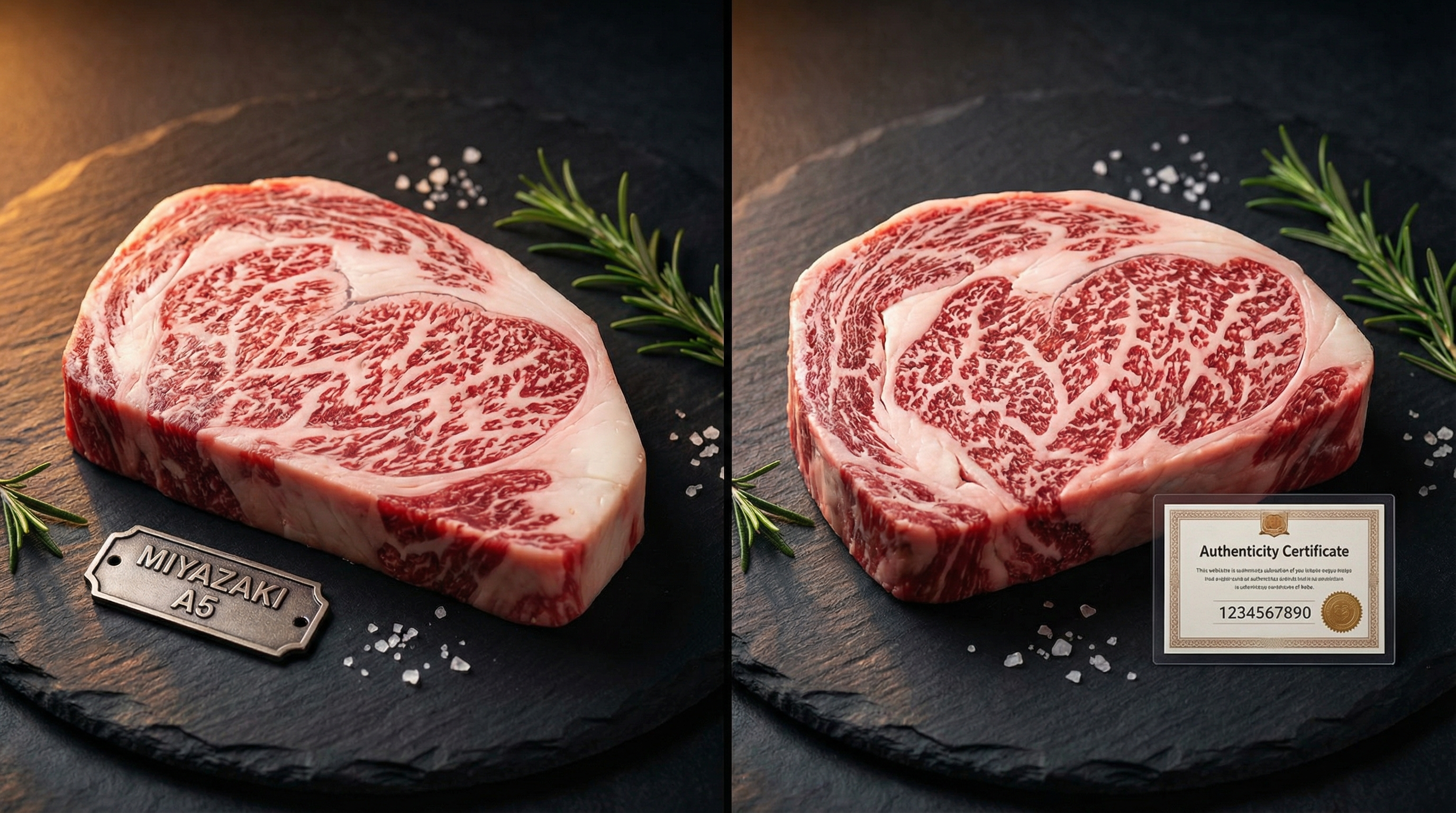
Every legitimate Kobe beef sale (wholesale or retail) must include a Kobe Beef Certificate with a unique 10-digit identification number. This certificate includes:
- Individual cattle ID: Links to the national cattle registry
- Farm of origin: Specific farm name and location in Hyogo
- Birth date: Month and year born
- Processing date: Slaughter and grading date
- Carcass weight: Exact weight at processing
- BMS score: Actual marbling grade (usually 10-12 for Kobe)
- Quality grade: Final grade (A4 or A5)
- Cut information: Primal and portion details
You can verify any Kobe certificate at the official Kobe Beef Marketing & Distribution Promotion Association website by entering the 10-digit ID. If a seller cannot provide this certificate, you are not buying authentic Kobe beef — regardless of what the menu claims.
According to the USDA Food Safety and Inspection Service, fewer than 50 US restaurants and retailers are authorized Kobe distributors. If you're not seeing documentation, you're likely being sold generic A5 or American Wagyu at Kobe prices.
Critical Decision Matrix: When to Buy A5 vs Kobe
Both A5 Wagyu and Kobe deliver exceptional eating experiences, but the price gap ($150-200/lb for generic A5 vs $250-350/lb for certified Kobe) demands strategic buying decisions.
Buy Generic A5 Wagyu When:
- Marbling is your priority: BMS 10+ exists across multiple prefectures at lower cost
- Regional provenance isn't critical: You care about quality, not specific farm lineage
- Value matters: Miyazaki A5 at $180/lb delivers 95% of the experience for 40% less
- You're cooking at home: A5 from any prefecture performs identically in high-heat applications
- Availability is limited: Most legitimate sources stock A5 from multiple regions, Kobe sporadically
Pay the Kobe Premium When:
- Authentication matters: You want verifiable traceability and genetic pedigree
- Heritage genetics appeal: Tajima-gyu lineage represents 200+ years of selective breeding
- Flavor profile preference: Kobe fat has a distinctive melting point (17°C) and buttery finish
- Gift or special occasion: Kobe certification carries cachet that generic A5 doesn't
- Supporting traditional practices: Hyogo farmers maintain heritage breeding vs industrial scale
From 15 years of comparative tasting and butchering both products, I can tell you this: blind taste tests rarely favor Kobe over top-tier Miyazaki or Kagoshima A5. The genetic differences are real, but the eating experience differences are subtle — detectable by trained palates in controlled settings, often indistinguishable in real-world dining.
Where Kobe consistently wins is fat quality and melting point. Kobe fat liquefies at body temperature (37°C / 98.6°F), giving it an almost creamy mouthfeel. Miyazaki and Kagoshima A5 fat melts at 19-21°C, which is still incredibly low but noticeable if you're eating cold or room-temperature beef (carpaccio, tartare, sashimi).
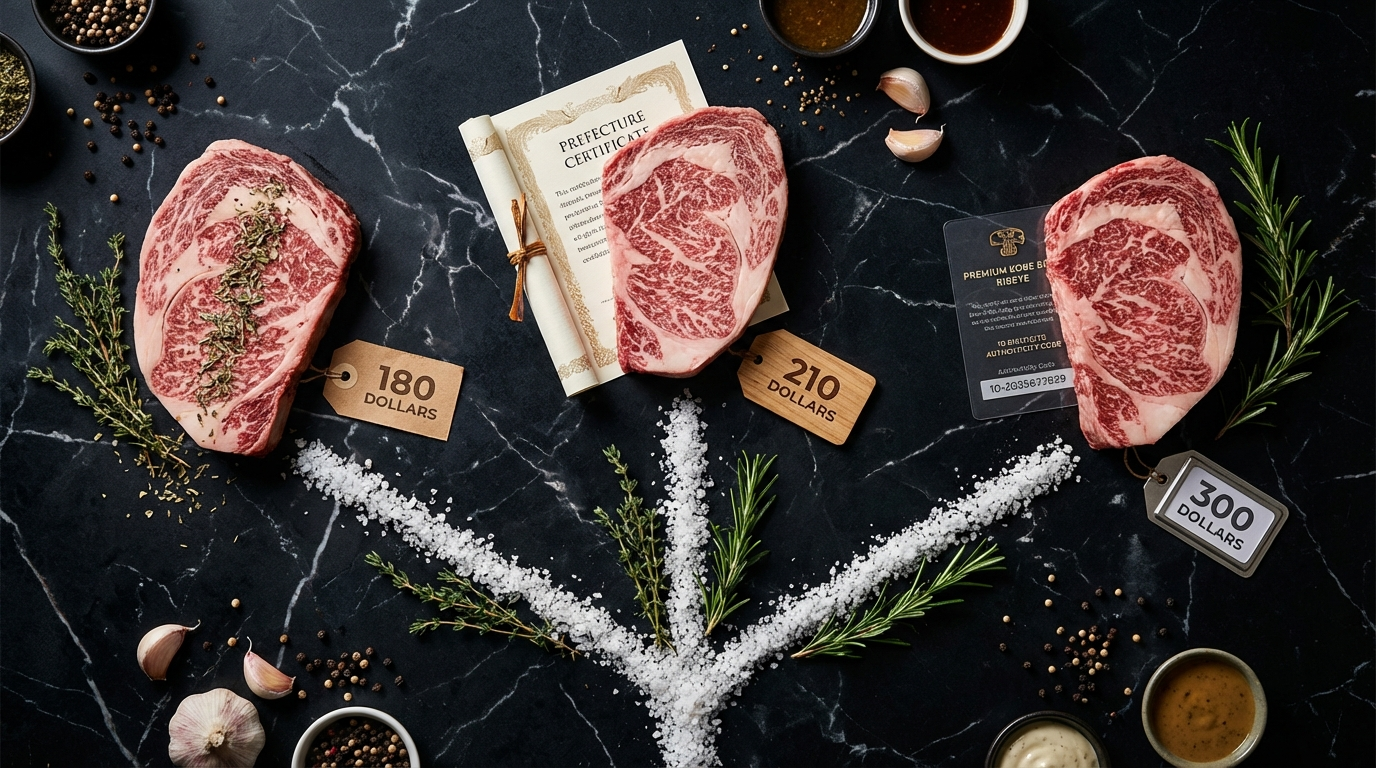
Price Breakdown: What You're Actually Paying For
The retail price gap between generic A5 Wagyu and certified Kobe reflects supply, certification overhead, and brand premium — not always proportional quality differences.
Current Market Pricing (March 2026)
| Product | Price Range ($/lb) | What You're Paying For |
|---|
| Generic A5 Ribeye | $150-$200 | BMS 10-12 marbling, no regional cert |
| Miyazaki A5 Ribeye | $180-$220 | Prefecture branding, competition pedigree |
| Kagoshima A5 Ribeye | $160-$200 | Volume producer, consistent BMS 11+ |
| Kobe A5 Ribeye | $250-$350 | 10-digit cert, Tajima genetics, heritage brand |
| Matsusaka A5 Ribeye | $220-$280 | Virgin females only, limited production |
Per-ounce breakdown for 12oz ribeye:
- Generic A5 @ $180/lb = $135 for 12oz steak
- Kobe A5 @ $300/lb = $225 for 12oz steak
- Premium delta: $90 per steak
That $90 premium buys you:
- Verifiable traceability to a specific farm in Hyogo
- Tajima-gyu genetics with 200-year breeding lineage
- Slightly lower fat melting point (17°C vs 19-21°C)
- Kobe brand recognition and gift-giving prestige
- Support for small-scale traditional farming (vs industrial production)
Whether those factors justify a 67% price increase depends entirely on your priorities. If authentication and heritage matter, Kobe delivers unique value. If you just want the best eating experience, many A5 prefectures match or exceed Kobe's sensory qualities at significantly lower cost.
Common Marketing Deceptions (and How to Spot Them)
The premium pricing of both A5 and Kobe invites fraud. Here's what to watch for when evaluating claims.
Red Flags for Fake Kobe
- "Kobe-style" or "Kobe-grade": Not Kobe. Legal workarounds for mislabeling.
- No 10-digit certificate: If they can't produce the cert, it's not Kobe — full stop.
- American Kobe: Does not exist. Zero Kobe cattle have ever been exported alive from Japan.
- Kobe burgers or Kobe hot dogs: Real Kobe is never ground — too valuable and supply too limited.
- Prices below $200/lb retail: Legitimate Kobe wholesales for $150-180/lb; retail markups push it above $250.
Red Flags for Generic A5 Passed as Regional
- No prefecture listed: If they say "A5 Wagyu" without naming Miyazaki, Kobe, etc., it's generic bulk A5.
- Photos without visible marbling: A5 should show obvious BMS 8+ marbling in product images.
- Suspiciously low prices: A5 under $120/lb suggests misgraded A4 or counterfeit.
- "Japanese Wagyu" without grade: Could be A3 or A4 marketed vaguely as "Japanese Wagyu."
- Frozen products without individual vacuum sealing: Legitimate A5 ships individually sealed with cut tags.
Always ask sellers for:
- Grading certificate (JMGA documentation showing A5 grade)
- Prefecture of origin (if claiming regional branding)
- Kobe certification number (if claiming Kobe designation)
- BMS score (within the BMS 8-12 range for A5)
Reputable sellers provide this documentation unprompted. If you have to ask twice, walk away.
Cooking Considerations: Does A5 vs Kobe Change Technique?
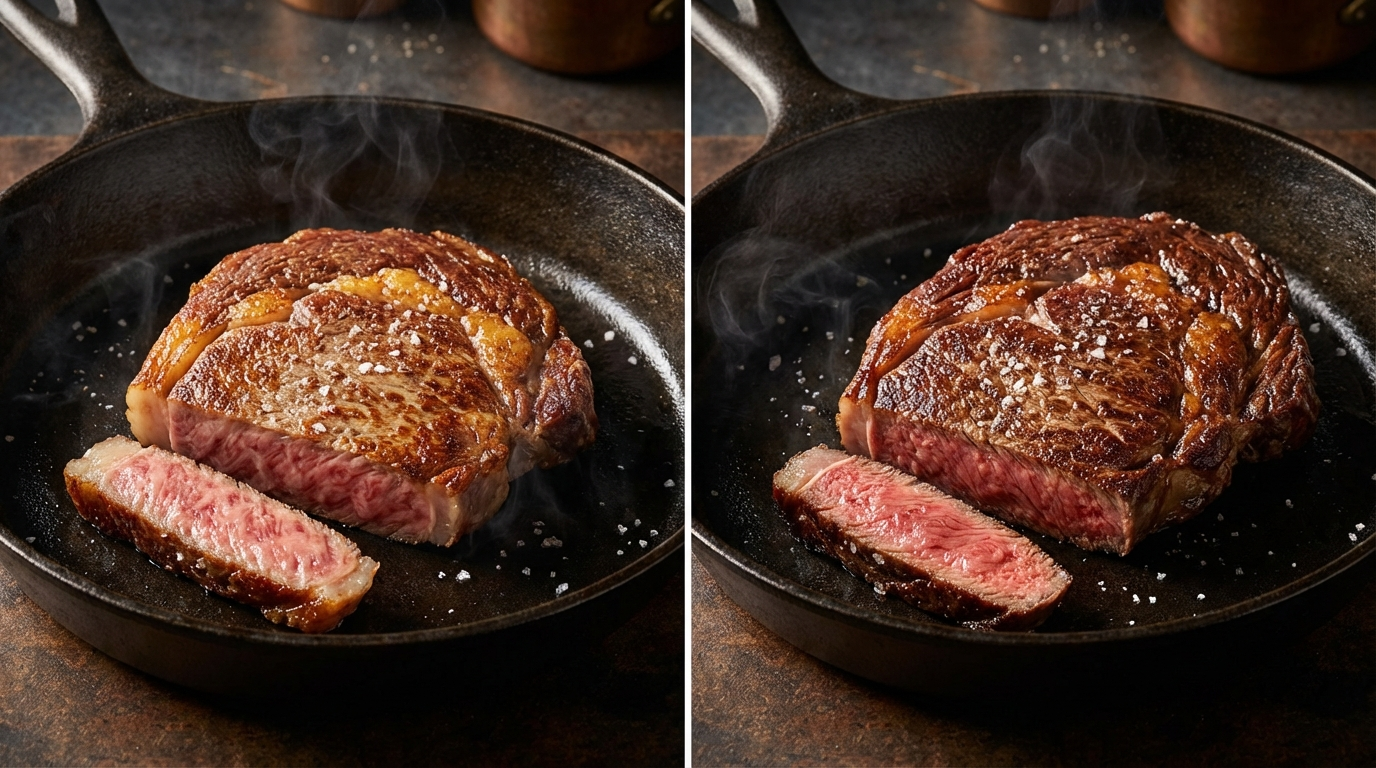
From a culinary perspective, A5 Wagyu and Kobe beef cook identically — both require low-heat, short-duration methods to prevent fat from rendering out completely.
Optimal Cooking Methods (Both A5 and Kobe)
Best:
- Cast iron sear: 60-90 seconds per side over high heat, rest 5 minutes
- Teppanyaki/flat-top: Quick sear in small cubes, traditional Japanese preparation
- Sous vide + sear: 129°F for 90 minutes, then 45-second screaming-hot sear
Avoid:
- Extended grilling: Fat renders too quickly; you'll lose half the marbling
- Oven roasting: Uneven heat causes fat to pool and drain away
- Smoking: Low-and-slow cooking liquefies fat before meat reaches temperature
The one subtle difference: Kobe fat's lower melting point (17°C) means it starts rendering slightly faster than generic A5 (19-21°C melting point). In practice, this means:
- Kobe benefits from slightly shorter sear times (45-60 seconds vs 60-90 seconds)
- Kobe fat renders more completely in the mouth, giving it a "melting" sensation even when served barely warm
- Generic A5 tolerates higher heat slightly better without over-rendering
These are marginal differences. Both products demand respect for their extreme marbling — keep heat high and cook time short.
Nutritional and Fatty Acid Profiles
Both A5 Wagyu and Kobe beef share similar macronutrient profiles due to extreme marbling (60-70% fat by weight in a typical A5 ribeye).
Typical A5/Kobe Ribeye Nutrition (4oz serving)
- Calories: 480-520
- Total fat: 48-52g
- Saturated fat: 18-22g
- Monounsaturated fat: 22-26g (primarily oleic acid)
- Protein: 18-22g
- Cholesterol: 90-110mg
The distinguishing feature is oleic acid concentration — the same heart-healthy monounsaturated fat found in olive oil and avocados. Research published in the National Institutes of Health database shows Japanese Wagyu contains 45-50% oleic acid, significantly higher than USDA Prime beef (37-40%).
Kobe beef, due to Tajima-gyu genetics and Hyogo feeding protocols, averages slightly higher oleic acid than generic A5 (48-50% vs 45-48%), contributing to its buttery mouthfeel and lower melting point.
The practical takeaway: Both A5 and Kobe deliver healthier fat profiles than conventional beef despite extreme marbling. The high oleic acid content means you're consuming primarily monounsaturated fats (associated with improved cholesterol profiles) rather than saturated fats.
Where to Buy Authentic A5 and Kobe (2026)
Buying ultra-premium beef online requires vetting suppliers carefully. These retailers have established reputations for authenticity and proper handling.
Verified A5 Wagyu Retailers
- Holy Grail Steak Co.: Multiple prefectures (Miyazaki, Kagoshima, Kobe), individual cut photos, BMS scores listed
- Crowd Cow: Prefecture-specific A5 from Miyazaki and Kagoshima, detailed farm stories
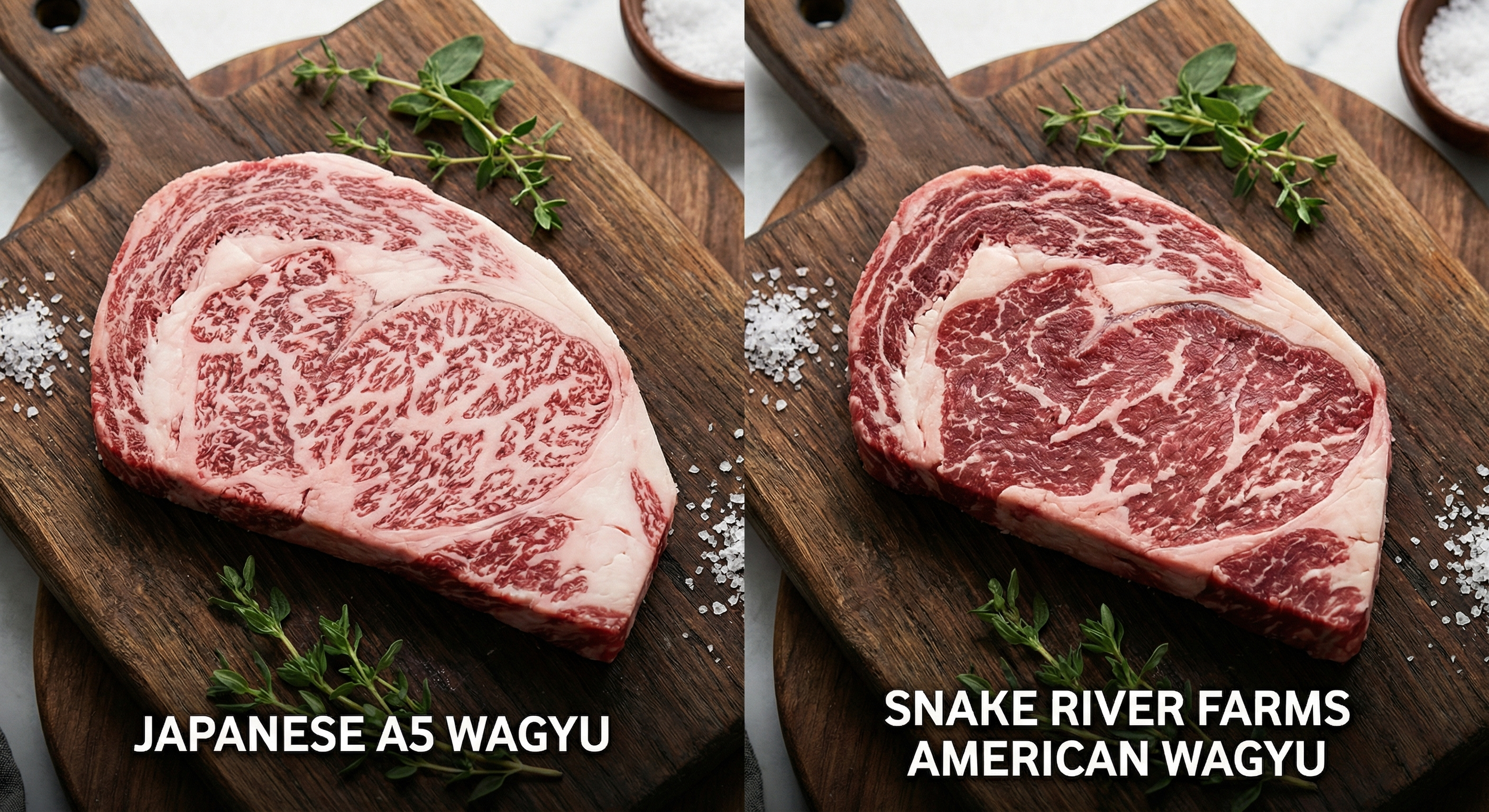
- Snake River Farms: Imported Japanese A5, limited selection but consistent quality
- Porter Road: Miyazaki A5 focus, sustainable sourcing, excellent handling
Verified Kobe Beef Retailers (10-Digit Certification)
- The Meatery: Halal-certified authentic Japanese A5 Wagyu, direct import, full traceability
- Holy Grail Steak Co.: Kobe certificates provided with every order, limited availability
- Crowd Cow: Intermittent Kobe availability, always includes 10-digit ID verification
For Kobe purchases specifically, demand to see the certificate before finalizing payment. Legitimate sellers will email a photo or PDF of the certificate showing the 10-digit ID, farm details, and grading information.
Final Verdict: Which Should You Buy?
After evaluating hundreds of A5 and Kobe cuts over the past decade, my recommendation depends entirely on your priorities:
Choose Generic A5 Wagyu if:
- You want maximum marbling for minimum cost
- Blind taste quality matters more than brand heritage
- You're cooking at home and prioritize value per ounce
- Regional certification isn't important to you
Upgrade to Prefecture-Branded A5 (Miyazaki, Kagoshima) if:
- You want some traceability without full Kobe premium
- You're interested in regional flavor profiles and breeding practices
- You want competition-grade beef (Miyazaki won national championships)
Pay for Kobe A5 only if:
- Authentication and heritage genetics genuinely matter to you
- You're gifting or celebrating a milestone event
- You want to experience Tajima-gyu's unique fat melting point
- You're willing to pay 60-70% more for a 5-10% sensory difference
The brutal truth: most people cannot reliably distinguish Kobe from top-tier Miyazaki A5 in blind tastings. The quality gap is real but narrow. The price gap is wide.
If budget isn't a constraint and authenticity appeals to you, Kobe delivers an exceptional — and verifiable — product. If you want the best eating experience for your money, Miyazaki or Kagoshima A5 at $180/lb delivers 95% of what Kobe offers at $300/lb.
Either way, you're getting world-class beef. The question is whether the Kobe name is worth $90-$120 per steak to you.