Angus vs Wagyu: The Complete Comparison Guide
Angus and wagyu represent two different philosophies of premium beef. This guide breaks down every meaningful difference — from genetics to your plate — so you can decide which is right for your next meal.
Two Premium Beef Breeds, Two Different Philosophies
If you've eaten a great steak in America, it was almost certainly Angus. If you've seen those viral photos of beef so marbled it looks like marble cake, that was wagyu. Both command premium prices. Both have devoted followings. But they deliver fundamentally different eating experiences built on completely different genetics.
This guide covers everything that actually matters when comparing angus vs wagyu: the science behind the marbling, how they taste, what they cost, and which one deserves a spot on your table.
Genetics: Why the Meat Is So Different
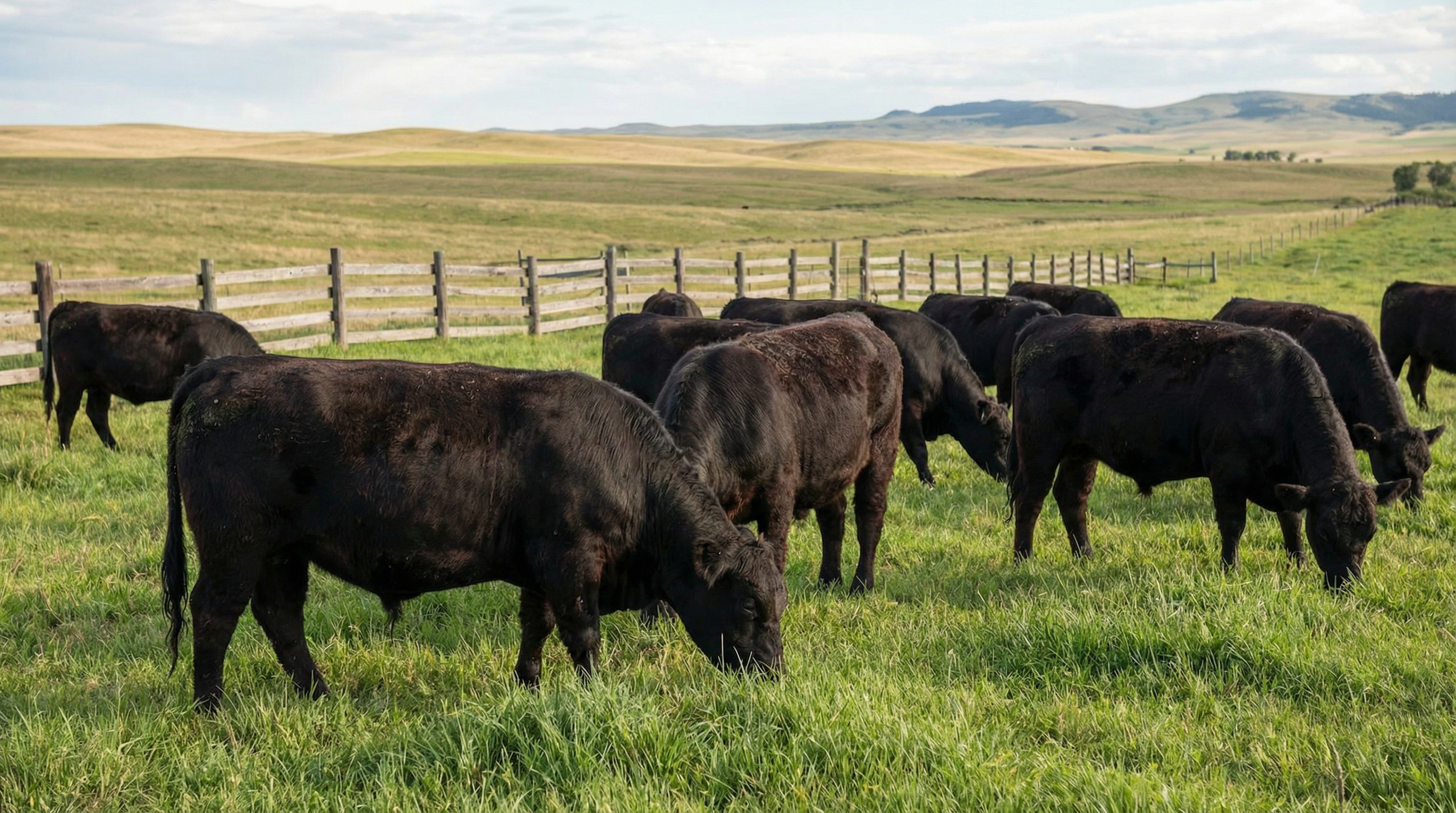
Angus cattle (Aberdeen Angus) originated in Scotland in the early 1800s. Scottish breeders selected for efficient growth, cold hardiness, and consistent meat quality. The result: muscular, adaptable animals that reliably produce well-marbled beef by conventional standards. Today, roughly 60% of America's commercial beef herd carries Angus genetics.
Wagyu cattle (primarily Japanese Black, or Kuroge Washu) evolved over centuries in Japan with one overriding goal: maximizing intramuscular fat deposition. Japanese breeders pursued marbling relentlessly, creating animals with a genetic predisposition for extreme fat distribution within the muscle fibers — not around them, but through them.
This genetic divergence produces measurably different meat:
- Certified Angus Beef (CAB): 4–8% intramuscular fat
- USDA Prime Angus: 8–12% intramuscular fat
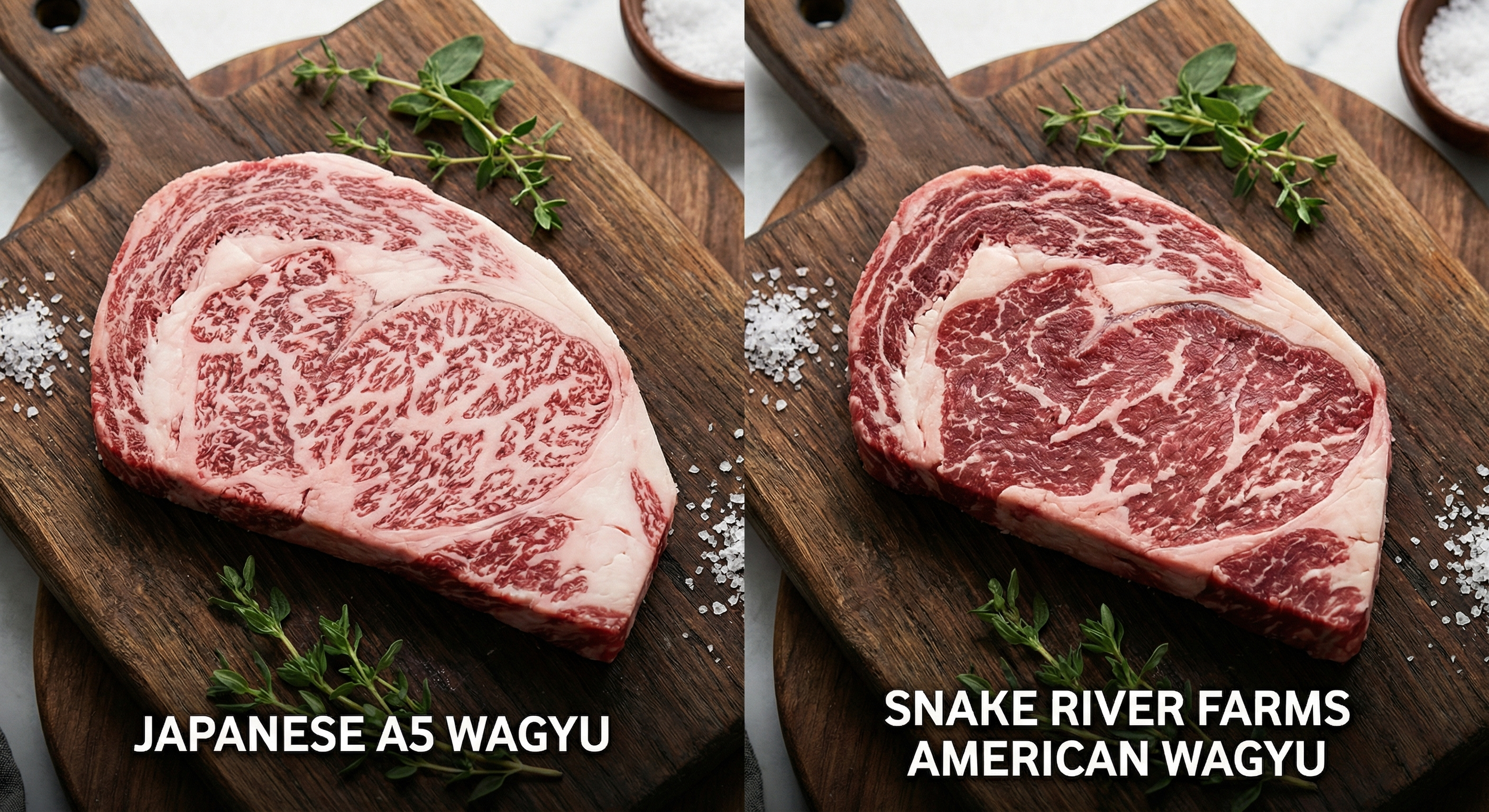
- American wagyu (Angus × wagyu cross): 12–20% intramuscular fat
- Japanese A5 wagyu: 25–40%+ intramuscular fat
At the extreme end, A5 wagyu contains five to eight times the intramuscular fat of quality Angus. That's not a subtle distinction — it's an entirely different product.
Marbling: The Most Important Difference
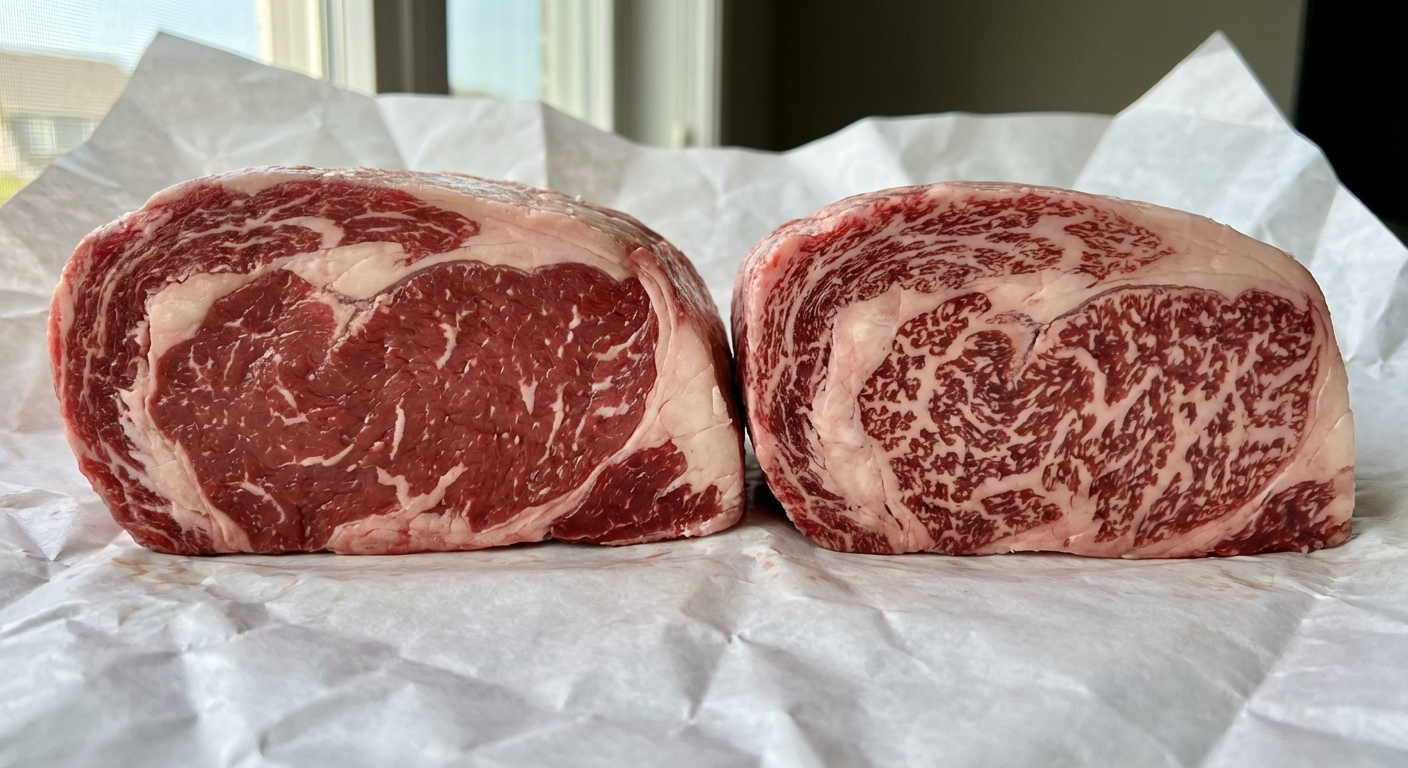
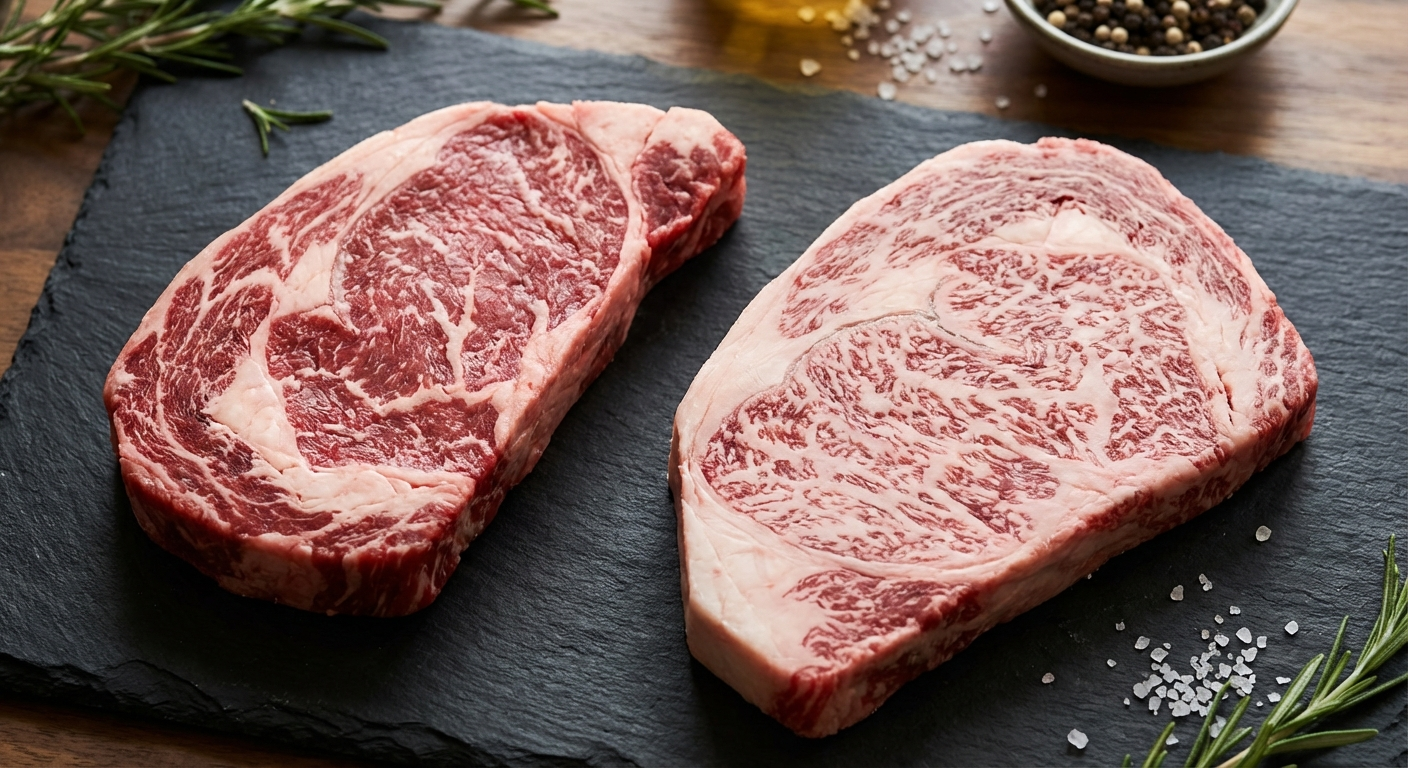
Marbling — the white flecks and lines of intramuscular fat visible in raw beef — is where the angus-wagyu divide becomes undeniable.
How Angus Marbling Works
Premium Angus beef (USDA Choice through Prime) shows marbling as clearly defined white streaks and dots against red muscle. The fat deposits are relatively large, clustered along natural muscle seams. Even top-tier USDA Prime Angus rarely exceeds BMS 5 on the Japanese Beef Marbling Score scale.
This produces excellent steak — flavorful, juicy, with good tenderness. The fat renders during cooking, basting the meat from within. It's why Angus earned its premium reputation.
How Wagyu Marbling Works
Wagyu marbling is structurally different. Instead of large fat deposits, wagyu develops extremely fine threads of fat woven throughout every muscle fiber. At BMS 8+ (A5 grade), the marbling creates a snowflake-like pattern where fat and muscle are so intermixed they become nearly indistinguishable.
This fine-grained distribution is what creates wagyu's signature melt-in-your-mouth texture. The fat melts at a lower temperature (around 77°F/25°C), literally dissolving on your tongue in a way Angus fat physically cannot.
Marbling Score Comparison
| Grade | BMS Score | Intramuscular Fat | Typical Source |
|---|
| USDA Select | 1–2 | 2–4% | Commodity Angus |
| USDA Choice | 3–4 | 4–8% | Standard Angus |
| USDA Prime | 4–5 | 8–12% | Premium Angus |
| Japanese A3 | 5–7 | 15–20% | Good wagyu / top American wagyu |
| Japanese A4 | 6–8 | 20–30% | High-grade wagyu |
| Japanese A5 | 8–12 | 25–40%+ | Peak wagyu (Japanese Black) |
The USDA grading scale wasn't designed for wagyu-level marbling. Its top tier (Prime) covers what Japan considers mid-range quality. This is why wagyu vs USDA Prime comparisons often confuse buyers — the scales don't align.
Flavor: What Each Actually Tastes Like
Angus Flavor Profile
Premium Angus beef delivers what most people think of as "great steak flavor":
- Bold, clean beef taste — mineral, savory, satisfying
- Moderate richness — juicy without being overwhelming
- Firm texture with some chew — the satisfying resistance of well-cooked steak
- Fat that enhances — the rendered fat adds moisture and flavor without dominating
The Angus eating experience is familiar and crowd-pleasing. A perfectly cooked Prime Angus ribeye is one of the great pleasures in food — unpretentious, deeply satisfying, and endlessly repeatable.
Wagyu Flavor Profile
Japanese A5 wagyu is a completely different sensory experience:
- Intensely buttery and sweet — the high oleic acid content creates a richness closer to foie gras than steak
- Complex umami depth — layers of savory flavor that build and linger
- Melt-on-tongue texture — minimal chew required; the meat essentially dissolves
- Fat that IS the experience — the marbled fat doesn't just enhance the meat, it defines it
Wagyu can be polarizing. Many first-timers find it transcendent. Others find the extreme richness overwhelming or miss the "steak" qualities they expect. Neither reaction is wrong — it's a genuinely different food.
The Middle Ground: American Wagyu
American wagyu (Angus × wagyu crossbreeds) splits the difference. You get enhanced marbling (BMS 4–7) with recognizable beefy flavor. Think of it as "the best steak you've ever had" rather than the exotic, almost confection-like quality of Japanese A5.
Price: What You'll Actually Pay
Price is where most people make their decision. Here's what each costs per pound at retail for comparable cuts:
| Cut | USDA Prime Angus | American Wagyu | Japanese A5 Wagyu |
|---|
| Ribeye | $25–$40/lb | $40–$80/lb | $120–$220/lb |
| NY Strip | $22–$35/lb | $35–$65/lb | $100–$180/lb |
| Filet Mignon | $35–$50/lb | $55–$100/lb | $150–$280/lb |
| Ground | $8–$12/lb | $12–$20/lb | $35–$55/lb |
| Brisket | $8–$15/lb | $15–$30/lb | N/A (not common) |
Japanese A5 wagyu costs roughly 4–8× what premium Angus costs for the same cut. But you eat dramatically less per serving — 3–4 oz of A5 wagyu vs 12–16 oz of Angus steak — which narrows the per-serving gap somewhat.
For a deeper analysis, see our angus vs wagyu price breakdown.
Cooking: Different Methods for Different Meats
How to Cook Angus
Angus is forgiving and versatile. The moderate fat content means it tolerates a range of cooking methods and temperatures:
- Grill: High heat, 4–5 minutes per side for medium-rare. The fat bastes the meat over the flames.
- Cast iron sear: Screaming hot pan with oil, 3–4 minutes per side. Butter-baste at the end.
- Reverse sear: Low oven (225°F) to 115°F internal, then blast in a hot pan. Best for thick-cut steaks.
- Sous vide: 130°F for 2 hours, then sear. Perfectly even doneness.
Target internal temp: 130–135°F for medium-rare. Standard 12–16 oz portions.
How to Cook Wagyu
A5 wagyu demands a different approach. The extreme fat content changes everything:
- Thin-sliced sear: Cut into ½-inch slices, sear 30–45 seconds per side on ripping-hot cast iron. No added oil — the wagyu renders its own fat.
- Yakiniku style: Thin strips on a tabletop grill, 10–15 seconds per side. The traditional Japanese method.
- Teppanyaki: Quick sear on a flat iron griddle. Let the fat caramelize, don't let it pool.
- Shabu-shabu: Paper-thin slices swished through hot broth for 3–5 seconds.
Target: rare to medium-rare only. Portions of 3–4 oz. Overcooking A5 wagyu renders out the marbling you're paying for.
Our detailed guide on cooking angus vs wagyu covers technique differences in depth.
Nutritional Comparison
The nutritional profiles reflect the fat content difference:
| Per 4 oz Serving | USDA Prime Angus | Japanese A5 Wagyu |
|---|
| Calories | 280–320 | 400–500 |
| Total Fat | 18–22g | 32–42g |
| Protein | 26–30g | 18–22g |
| Saturated Fat | 8–10g | 14–18g |
| Monounsaturated Fat | 8–10g | 16–22g |
One nutritional advantage for wagyu: its fat has a higher ratio of monounsaturated fatty acids (primarily oleic acid, the same fat in olive oil). This gives wagyu fat its low melting point and is associated with better cardiovascular markers than saturated fat. However, the sheer volume of total fat in A5 wagyu means this benefit requires portion control.
When to Choose Angus
- Weeknight steak dinners — reliable quality at a reasonable price
- Grilling for a group — everyone understands and enjoys a great Angus steak
- Full-sized steak portions — when you want a 12–16 oz slab of beef
- BBQ and smoking — Angus brisket is the gold standard; wagyu brisket is overkill for most pitmasters
- Burgers — while wagyu burgers exist, Angus delivers the ideal fat-to-lean ratio for grinding
- Budget-conscious premium eating — Prime Angus is the best value in premium beef
When to Choose Wagyu
- Special occasions — anniversaries, milestones, bucket-list meals
- The ultimate tasting experience — when you want to eat something genuinely unlike anything else
- Small, focused portions — a 3–4 oz wagyu course as part of a larger meal
- Japanese-style preparations — yakiniku, shabu-shabu, sukiyaki where thin-sliced wagyu shines
- Impressing serious food lovers — nothing starts a conversation like A5 wagyu on the table
- When you want both — Angus-wagyu crossbreeds offer a legitimate middle ground
The Verdict: It's Not About Better, It's About Purpose
Angus and wagyu aren't competitors — they're different categories. Comparing them is like comparing a perfectly crafted bourbon to a vintage Champagne. Both excellent, both premium, both worth celebrating. But they serve different moments.
Angus is the reliable luxury you can enjoy weekly. It's the foundation of American steak culture for good reason: consistent quality, satisfying flavor, reasonable price, and nearly infinite versatility.
Wagyu is the rare indulgence that redefines what beef can be. The marbling, the texture, the flavor complexity — it's an experience that makes you rethink everything you thought you knew about steak. But it's not an everyday food, and it's not trying to be.
The smartest approach? Know both. Keep premium Angus in your regular rotation for steaks, burgers, and grilling. Save wagyu for the moments that deserve something extraordinary. And if you want the best of both worlds, American wagyu crossbreeds give you enhanced marbling with familiar steak character at a price point between the two.
For authenticated Japanese A5 wagyu with full traceability and BMS scores listed on every product, explore The Meatery's Japanese A5 Wagyu Collection.