Wagyu Short Ribs vs Regular Short Ribs: A Complete Comparison
Wagyu short ribs deliver extraordinary marbling and buttery richness that regular short ribs cannot match. This guide compares flavor, texture, cooking techniques, and value to help you decide which is worth your money.
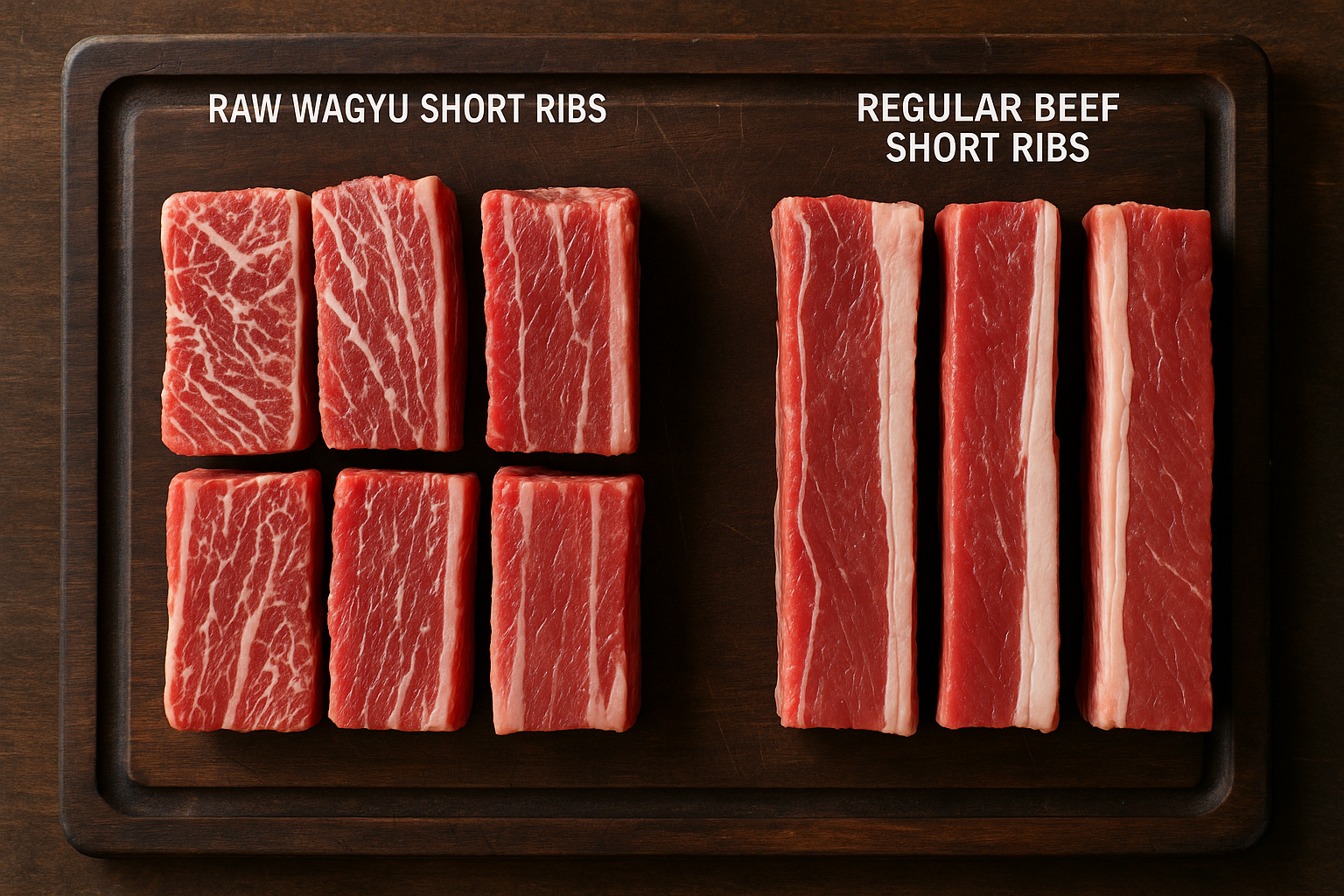
Short ribs are one of the most rewarding cuts in all of beef cookery. Whether braised until fork-tender or smoked low-and-slow for barbecue, they reward patience with deep, beefy flavor and luscious texture. But when you place a wagyu short rib next to a conventional USDA Choice short rib, the visual difference alone is staggering — and the eating experience diverges even further.
I've cooked hundreds of short rib plates over the past decade, from budget-friendly Choice flanken cuts for Korean BBQ to full-plate wagyu short ribs braised in red wine for special occasions. The differences are real, measurable, and significant — but whether wagyu short ribs are "worth it" depends entirely on context. This guide gives you everything you need to make that call.
1. What Makes Short Ribs Special
Short ribs come from the plate and chuck sections of the animal — ribs 1 through 5 from the chuck (called chuck short ribs) and ribs 6 through 8 from the plate (plate short ribs). The cut sits between the rib primal and the brisket, carrying generous intramuscular fat and tough connective tissue that breaks down beautifully under long, slow cooking.
According to the USDA Agricultural Marketing Service beef grading standards, intramuscular fat (marbling) is the primary factor distinguishing quality grades. Short ribs benefit enormously from higher marbling because the cut's collagen-rich structure needs rendered fat to achieve its signature succulence.
There are two primary butchering styles:
- English cut: Bones cut parallel, yielding thick rectangular blocks ideal for braising
- Flanken cut: Bones cut across, producing thin strips perfect for grilling (Korean galbi style)
Both styles exist for wagyu and conventional beef, but the quality of the meat between those bones is where the comparison gets interesting.
2. Marbling and Fat Composition
This is the defining difference. Wagyu genetics produce dramatically more intramuscular fat, and short ribs — already a well-marbled cut — become almost absurdly rich in wagyu form.
| Attribute | Regular Short Ribs (Choice/Prime) | Wagyu Short Ribs |
|---|
| Intramuscular fat % | 8–15% | 20–35%+ |
| BMS range (typical) | 3–6 | 6–10+ |
| Fat distribution | Moderate, somewhat uneven | Dense, web-like, highly uniform |
| Fat melting point | Higher (~104°F / 40°C) | Lower (~77°F / 25°C) |
| Oleic acid content | ~35–40% | ~50–55% |
| Visual appearance (raw) | Red with visible fat streaks | Pink-white with dense marbling network |
Research from Texas A&M's Department of Animal Science confirms that wagyu cattle deposit intramuscular fat at significantly higher rates than conventional breeds, with oleic acid (the heart-healthy monounsaturated fat found in olive oil) comprising a larger percentage of total fatty acids. This changes not just flavor but the literal mouthfeel — wagyu fat melts at body temperature, creating the "buttery" sensation that's nearly impossible to replicate with conventional beef.
I remember the first time I broke down a case of American wagyu plate short ribs. The marbling in the meat between the bones looked more like a well-marbled ribeye than what I'd expect from short ribs. That visual alone tells you the eating experience will be fundamentally different.
3. Flavor and Texture: Side-by-Side Tasting
Having served both side by side at private dinners and comparative tastings, here's what I consistently observe:
Regular Short Ribs
- Flavor profile: Deep, robust, classically beefy with mineral notes
- Texture (braised): Fork-tender when properly cooked, with distinct meat fibers that pull apart
- Texture (grilled flanken): Chewy-tender with good bite, charred edges add complexity
- Richness level: Satisfying but manageable — you can eat a full portion comfortably
- Finish: Clean beefy flavor that fades relatively quickly
Wagyu Short Ribs
- Flavor profile: Intensely rich, sweet-umami, with subtle nutty undertones
- Texture (braised): Almost custard-like — the meat practically dissolves rather than pulling apart
- Texture (grilled flanken): Buttery-soft with rendered fat creating a glossy, lacquered surface
- Richness level: Extremely rich — smaller portions are necessary and preferred
- Finish: Lingering umami and sweetness that coats the palate for minutes
The texture difference in braised preparations is especially dramatic. Regular short ribs deliver that satisfying "fall-off-the-bone" quality we all love. Wagyu short ribs go beyond that — the collagen and intramuscular fat render so completely that the meat reaches an almost mousse-like consistency. It's genuinely a different eating experience, not just a better version of the same one.
For those interested in how wagyu compares across other cuts, our wagyu brisket vs regular brisket comparison shows similar marbling-driven differences in another collagen-rich cut.
4. Cooking Methods Compared
Both wagyu and regular short ribs shine with low-and-slow methods, but the higher fat content in wagyu requires some adjustments.
Braising
| Factor | Regular Short Ribs | Wagyu Short Ribs |
|---|
| Ideal temp | 300–325°F | 275–300°F (lower to prevent fat blowout) |
| Cook time (English cut) | 3–4 hours | 2.5–3.5 hours (renders faster) |
| Liquid ratio | ½ to ⅔ submerged | ⅓ to ½ submerged (more self-basting fat) |
| Searing | Essential for flavor | Essential — renders some exterior fat first |
| Resting | 15–20 min | 20–30 min (fat needs to redistribute) |
| Sauce note | Skim fat from braising liquid | Skim more aggressively — much more rendered fat |
Smoking (BBQ-Style)
Smoked plate short ribs — the "brisket on a stick" popularized by Texas barbecue — are transformative with wagyu. The additional marbling means the meat stays moist through a 6-8 hour cook at 250-275°F without wrapping. I've smoked wagyu plate short ribs unwrapped for the entire cook, and the bark development was outstanding while the interior stayed impossibly juicy.
Regular short ribs benefit more from wrapping (the "Texas crutch") during the stall to prevent the leaner meat from drying out. Wagyu short ribs can power through the stall on their own fat reserves.
Grilling (Flanken/Galbi)
For Korean-style flanken cuts, wagyu short ribs are extraordinary over high heat. The thin cross-cut slices render quickly, creating caramelized, almost candy-like edges while the center stays buttery-soft. Regular flanken short ribs are excellent for this preparation too, but they need the marinade to do more heavy lifting for tenderness. Wagyu flanken can be seasoned with just salt and still deliver remarkable results.
For a broader look at how wagyu handles different cooking approaches, see our guide on cooking angus vs wagyu.
5. Price and Value Analysis
Let's talk about the elephant in the room. Wagyu short ribs command a serious premium.
| Product | Typical Price Range (per lb) | Serves (per lb) | Cost Per Serving |
|---|
| USDA Choice short ribs | $6–$10 | 1–2 people | $5–$10 |
| USDA Prime short ribs | $12–$18 | 1–2 people | $9–$18 |
| American wagyu short ribs | $25–$45 | 2–3 people (smaller portions) | $12–$22 |
| Japanese A5 wagyu short ribs | $80–$150+ | 3–4 people (small portions) | $25–$50 |
The per-serving math shifts the equation. Because wagyu short ribs are so rich, you genuinely eat less. A 4-bone plate of regular short ribs might serve 2 people generously. The same wagyu plate can serve 3-4 with appropriate sides and courses. This doesn't erase the premium, but it narrows the gap.
When Wagyu Short Ribs Make Sense
- Special occasion meals where you want a showstopper main course
- Korean BBQ spreads where thin slices are shared among many guests
- Competition or high-end barbecue where every edge matters
- When you want a single-ingredient dish to carry itself with minimal seasoning
When Regular Short Ribs Are the Better Call
- Weeknight braises where the braising liquid and aromatics do much of the flavor work
- Large batch cooking — pot roast-style meals for families or meal prep
- Recipes with heavy sauces or marinades that would mask wagyu's nuances
- Budget-conscious cooking where USDA Choice delivers excellent results at a fraction of the cost
For a deeper look at wagyu pricing across multiple cuts, our wagyu price comparison guide breaks down costs in detail. And if you're specifically comparing wagyu to the USDA grading system, the wagyu vs USDA Prime guide explains where the grading scales diverge.
6. Nutritional Comparison
According to the USDA FoodData Central database, beef short ribs are a calorie-dense cut regardless of grade. But wagyu's fat composition introduces some noteworthy nutritional differences.
| Nutrient (per 4 oz raw) | Regular Short Ribs | Wagyu Short Ribs (est.) |
|---|
| Calories | ~290–340 | ~380–450 |
| Total fat | 22–28g | 32–40g |
| Saturated fat | 10–12g | 12–15g |
| Monounsaturated fat (oleic acid) | 9–11g | 15–20g |
| Protein | 18–22g | 16–20g |
| Iron | ~2.2mg | ~2.0mg |
The higher oleic acid content is the headline. Wagyu fat is compositionally closer to olive oil than conventional beef fat, which has led researchers to study its potential cardiovascular benefits. While short ribs will never be health food regardless of genetics, the fat quality in wagyu is meaningfully different from a nutritional standpoint.
Worth noting: because wagyu short ribs are typically consumed in smaller portions due to their richness, the per-meal calorie difference may be less dramatic than the per-ounce numbers suggest.
7. Sourcing Quality Short Ribs
Whether you choose wagyu or conventional, sourcing matters enormously for short ribs.
What to Look For in Regular Short Ribs
- Grade: USDA Choice minimum; Prime if you can find it. Select-grade short ribs can be dry and stringy even after braising.
- Cut style: English cut for braising, flanken for grilling. Specify when ordering.
- Bone-in vs boneless: Bone-in delivers better flavor and gelatin for braises. Boneless works for quicker preparations.
- Thickness: For English cut, 2-3 inches between bones. For flanken, ¼-inch to ⅜-inch slices for grilling.
What to Look For in Wagyu Short Ribs
- Bloodline percentage: Higher wagyu percentage (F2 crossbred minimum, ideally F3 or fullblood) correlates with more marbling
- BMS or marbling score: Reputable sellers provide this. Look for BMS 6+ for a distinctly wagyu experience.
- Source transparency: Know whether you're buying American wagyu (crossbred), Australian wagyu, or Japanese wagyu. Each offers a different experience and price point.
- Plate vs chuck: Plate short ribs (ribs 6-8) are generally larger and meatier than chuck short ribs. For special occasions, plate short ribs are the premium choice.
For exploring American wagyu specifically, check our is American wagyu real wagyu guide, which breaks down the genetics and labeling practices. If you're ready to try wagyu short ribs, The Meatery's wagyu collection sources from verified American wagyu programs with full transparency on bloodline and grading.
Frequently Asked Questions
Are wagyu short ribs worth the extra cost?
For special occasions and when you want the short rib to be the undisputed star of the meal, yes. The marbling creates a fundamentally different texture — almost custard-like when braised — that regular short ribs cannot replicate regardless of cooking technique. For weeknight braises with heavy sauces, USDA Choice short ribs deliver excellent value and the sauce masks much of the difference.
Can I cook wagyu short ribs the same way as regular short ribs?
The same methods work, but with adjustments. Braise at slightly lower temperatures (275-300°F vs 300-325°F) and reduce cooking time by 15-20% since the higher fat content accelerates rendering. When smoking, wagyu short ribs often don't need wrapping during the stall. For grilled flanken, wagyu needs less marinade time — the meat is already tender from marbling.
What's the best way to cook wagyu short ribs for the first time?
I recommend flanken-cut over high heat for your first experience. Cut ¼-inch thick, season with just salt and pepper, and grill 2-3 minutes per side over direct high heat. This showcases the marbling without sauces or braise liquids competing for attention. It's the purest expression of the difference between wagyu and regular beef in this cut.
Do wagyu short ribs work for Korean BBQ (galbi)?
They're exceptional for galbi. The traditional soy-pear-sesame marinade works beautifully, but you can reduce marination time from the usual 4-8 hours to just 1-2 hours since wagyu flanken is already tender. The higher fat content creates incredible caramelization on the grill. Many Korean BBQ restaurants in Japan and the US specifically use wagyu flanken as a premium menu option.
What's the difference between American wagyu and Japanese wagyu short ribs?
American wagyu short ribs (typically crossbred with Angus) offer BMS 6-9 marbling with a balance of beefy flavor and wagyu richness. Japanese A5 short ribs can reach BMS 10-12 with extremely dense marbling that's almost more fat than meat. Japanese wagyu short ribs are best in very thin slices or small portions. American wagyu short ribs are more versatile — they work in traditional braise and BBQ applications without being overwhelmingly rich. For a detailed comparison, see our guide on Japanese wagyu vs American wagyu.